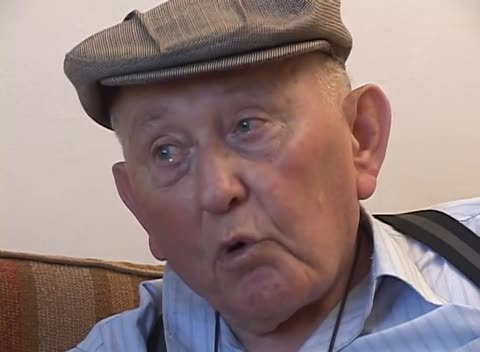
Opening of the interview, with Kerler giving the date and place. Reti explains that his father owned fields with a name that carried an unfavorable association under the Communists, so the family name was changed to Reti. Kerler remarks that a Hungarian passage cannot be translated and asks Reti to go back over what he remembers.
The transcript also contains Kerler's opening remarks on date and place, and his request to return to earlier topics.
Reti speaks about his family, in particular his father. He explains how his father built a prayer house in Rohod and addresses prewar religious life in town. Reti also mentions that the Kosoner rebbe slept on a divan.
Kerler prompts Reti about his father, the rebbe and the Hasidim who came to the town. Reti says his father built a prayer house and a mikveh in a new house, and that Hasidim, including the Kosoner rebbe, came once a year in the thousands. The rebbe slept on a divan, which was later taken to Israel and filmed; Kerler then asks him to sing the Hungarian messiah song again.
Adds Reti's father's morning learning, the thousands of Hasidim who came, and the divan being taken to Israel and filmed.
Reti sings a messiah song in Hungarian and then other hasidic songs and prayers (Purim kiddush and Hanukkah prayer), Reti remembers from his yeshiva education.
Reti sings a Hungarian song about the coming of the messiah, and S2 comments on the lines about girls needing no dowry. He then sings or recites hasidic songs and prayers from his yeshiva years, including a Purim kiddush sung in jest and a supplication about Jewish suffering. Kerler asks when they were sung, and Reti says before the war in the yeshiva.
The catalogue's Hanukkah prayer is not clear in the transcript; what is clear is the supplication about Jewish suffering.
Reti speaks about his life and education before the war, particularly Purim celebrations. He recalls someone who announced Purim celebrations, before reciting parts of the Yosef sphiel. Reti explains how a Purim performance group traveled in to surrounding villages.
Reti says he studied in a yeshiva in a town named Berkan(?) with a rabbi whose family of many children is mentioned. He describes the village Purim figure who made a straw belt and announced the festivities. He recites parts of the Joseph play, in which the brothers sell Joseph, and Kerler asks about the troupe: over twenty young men who performed whole plays around Purim in ten to fifteen villages.
The transcript shows Kerler asking about the number of villages visited and the season of the performances.
S2 asks about yeshiva life and Jewish life before the war. Reti describes the large village with about a hundred families and a hundred yeshiva students, a visiting preacher, and Catholic and Reformed clergy. They also discuss whether the yeshiva was closed after the war, though the answers are hard to follow.
Reti speaks about his life and work after the war. He returned to his hometown Rohod. He recalls how his non-Jewish boss allowed him to observe Sabbath.
Reti describes his work after the war. He led a cooperative covering several villages with about twelve hundred people, with a large furniture and wood business. He returned to live in Rohod and was driven daily in a government car. His non-Jewish boss, who had once worked for Jews, let him stay home on Sabbath instead of working. S2 notes that not everyone was antisemitic. Kerler then asks about the rebbe Yisroel, who used to come.
The catalogue sentence does not mention the cooperative, its size or the company car.
Reti speaks about prewar religious life and the visits of the Kosoner rebbe. He then sings a wedding song and recites a poem, as well as other hasidic songs. Reti then talks about contemporary religious life and his life today.
Reti speaks about a cantor-like man or rebbe named Yisroel, his singing voice, and visits to the town before the war. Kerler and S2 then ask about a wedding song sung after the huppah, and Reti sings it along with the supplication about Jewish suffering and other hasidic songs. Reti also tells of a fall in the synagogue before Yom Kippur and a doctor, and says the synagogues stood in town. These passages are partly garbled.
The catalogue summary does not give the discussion of the wedding song's Hungarian wording, or the Yom Kippur illness story.
Reti discusses the largest synagogue, which burned after the war, and S2 asks whether women also knew Yiddish. Reti mentions a Yiddish-speaking woman who lives near him and the town of Munkatsh, where even non-Jews knew Yiddish. They talk about the Munkatsher rebbe and the rebbe Chaim Elazar Shapira, whose film S2 mentions finding online. Reti also speaks about a rabbi who came to town and a kosher supervisor.
The transcript adds Yiddish among women and non-Jews in Munkatsh, and the film about Chaim Elazar Shapira.
Kerler asks Reti about the Purim play, the costumes and the scene in the Joseph play where Joseph passes his mother Rachel's grave. Reti describes the costumes and the scene. They discuss summer performances before Shavuot, played in several villages, with non-Jews also coming to watch and partly understanding.
Reti speaks about Jewish life in the region. He then discusses his childhood memories. He explains the game nuts, which was done on Sukkoth according to Reti. He also recalls a non-Jew who worked for his family and spoke Yiddish.
Reti recalls the Joseph play episode of the pit and a creature whose name is discussed (a word rendered as a scorpion). He explains a children's game in which a prize went to the person who hit the target from twenty or thirty meters, and relates it to Sukkot, though the catalogue's name "nuts" is not clear in the transcript. S2 asks about the language at home and Reti says his father employed a Yiddish-speaking non-Jewish farmhand. He also mentions the family's fields and servants and the plays staged on Sukkot.
The transcript shows the discussion of the Joseph play's pit scene and the Hebrew term, and the father's servants.
Reti and S2 talk about the Purim play and the other, summer play. They discuss how the plays were staged in a hall or school, with warm air for the heat of the desert scene. They also cover how non-Jews came and saw the play, the story being told first in Hungarian, and Reti's schooling in a non-Jewish school as there was no Jewish school in the village. Kerler ends by asking about Hungarian poetry from school.
Reti recalls school and Reformed prayers and a Christian blessing recited before meals, and the Hungarian words he had to say when passing a cross or roadside shrine. Kerler and S2 ask about words for such things (a cross, a church) and what they were called in Yiddish and Hungarian. Questions on terminology are intermixed with Reti's recitation. At the end Kerler asks about a man who sang and served in the army in Israel.
The transcript adds the passing-the-cross formula and the discussion of words for church, cross and shrine.
Reti and Kerler talk about a man named Goronvalgy(?) who recited a whole Purim play in Hungarian, and about a tailor and a baker who were tsadikim. S2 asks about Jewish life today, and Reti says there is kosher food, a shoykhet who comes from Pest and slaughters cattle, and a kosher shop, but no kosher milk. They also discuss a rabbi and a man who would not pray with a minyan, and Reti sings a snatch of a song.
Adds the shoykhet from Pest, kosher meat and the lack of kosher milk in town.
Reti recalls going to the mikveh as a boy and his time in the yeshiva, and Kerler asks about the upsherin, the first haircut at age three. Reti says it was held in the prayer house with the whole community and that boys wore short trousers until thirteen. He also says the prayer house served as the cheder and that his mother carried him there on her back. At the end he tells a story involving a rabbi and telling the truth.
The transcript also covers boys' clothing until thirteen and the cheder held in the prayer house.