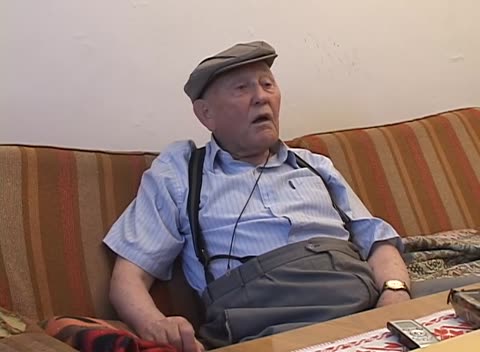
Reti speaks about his life today. He then talks about his family, in particular his father's observance. His father worked as tax collector. He also addresses the fate of rebbes from the region during World War II.
Reti and Kerler discuss what a Jewish hat looks like, with S2 taking part. Reti then says his father was the village tax collector for some twenty-eight years (?) and followed a rebbe whose name is unclear, perhaps Kosoner or Tash. He goes on to the last Tash rebbe, who is associated with Auschwitz and with the saying that God can help but whether He will is unknown.
Also covers Jewish hats and dress and the rebbes' fate in the Holocaust.
Reti talks about Jewish life in the region during World War II. He states that several thousand Jews were confined to the Kisvárda (Yiddish: Klaynvarden) ghetto. He then sings snippets of Hasidic songs.
A passage on the wartime ghetto of Kisvárda (Yiddish Kleynvarden), where several thousand Jews were held. The speakers then talk about a drive to Nagyvárda and Arad and about a train route. Kerler asks about a song, but no Hasidic songs are clearly sung in the transcript. The passage is largely garbled.
Also includes talk about a journey and a song question.
Reti speaks about his condition and about praying on the Sabbath. Kerler suggests that he recall a prayer. Part of the passage is Hungarian side-talk and the rest is garbled, so the Yom Kippur prayer cannot be confirmed from the transcript.
Reti then recites the prayer for "shlogen kapores" (zeh hatarn'gol yelech l'misoh, va'ani elech l'chaim tovim arukim v'shalom). He then addresses folk and healing customs, in particular regarding newborns. He then speaks about his life today.
Kerler asks what was said when swinging the kapores and what was done against the evil eye. Reti describes pouring coals into a glass of water, and the singing of Shema Yisrael and giving of treats for the newborn son before the circumcision. He and Kerler also discuss naming a girl in the synagogue and giving a name. Reti then speaks of a doctor who keeps a kosher home, and the closing lines turn to the games asked about in Hungarian.
Includes customs for a newborn and a doctor who keeps a kosher home.
Reti and S2 describe a play about Rachel's tomb staged in the synagogue before the war, with praying and singing. Kerler asks what a Purim shpiel means and Reti says it was a big play about Joseph. They also discuss songs the children sang. Kerler thanks Reti at the end.
The formal part of the interview ends with wishes for health and a long life. S3 and S2 comment in Hungarian on Reti's health and his taking things to heart. Reti sings or chants a snatch of text. Kerler then asks about rabbis of Hungary and Lithuania, a book about Hungarian rabbis, and whether a badkhn or grammer performed at Jewish weddings, especially Hasidic ones.