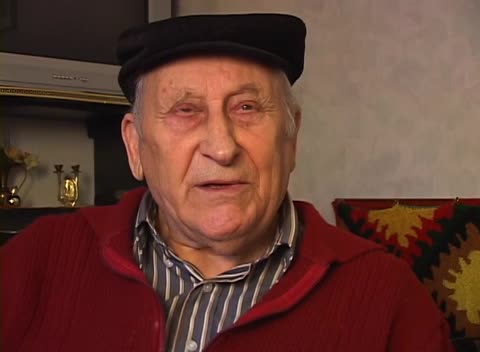
Galambos provides personal information and speaks about his family. His father was also born in Vaja and worked as cabinetmaker. Galambos' father also owned a shop and fields.
From the machine transcript
Galambos gives the date and place of the recording and his own birth in Vaja in 1923. He names his father, born in Vaja around 1880 (?), who was a cabinetmaker, and says the family also had a shop and fields. Kerler also asks about the father's family name and double given name.
Kerler's questions about the father's name and the street address.
Galambos speaks about his family. His mother was born in Pusztadobos. He then addresses his childhood memories and education. Galambos describes his daily school routine in religious school (cheder), Hungarian school and yeshiva, including teachers and lessons. Galambos states that he started his yeshiva education at thirteen and attended yeshivot in Putnok and Kisvárda.
From the machine transcript
Galambos names his maternal grandmother, Chaye Shpitser, and says his mother came from Pusztadobos. He describes his long childhood day, from cheder before dawn through Hungarian school to cheder again until evening. He names his melamdim, Shlomo Pavel and Yosef Fridman, and the subjects taught, and says that at thirteen he went to the yeshiva in Putnok.
The names of the two melamdim and the subjects taught.
Galambos speaks about his family and explains how he takes care of his family's graves at the local cemetery. He grew up with five sisters and two brothers. One of his sisters made aliyah.
From the machine transcript
Galambos says he never knew his grandparents and describes tending the family graves in the Vaja cemetery. In answer to Kerler, he names his siblings, five sisters and three brothers (?), and says most died in Auschwitz. One sister who reached Palestine and a brother died after the war.
A full list of his siblings' names and their fates.
Galambos speaks about his life during World War II. He was a forced laborer in the Hungarian army and dug pits.
From the machine transcript
Galambos talks about the war years, when he was in a Hungarian labor service. He describes the earthwork he was made to do, digging large pits meant to stop enemy tanks. Kerler helps him find the Yiddish words for this.
Galambos returns to his cheder education, including his teacher (melamed), and childhood memories. He also states that he frequently attends Sabbath services today.
From the machine transcript
Galambos answers Kerler's questions about cheder: there was no special chant for learning, and children learned to speak Yiddish and Hebrew and to write. He mentions that he goes to the synagogue every Sabbath despite poor health. He recalls playing in the courtyard with other children, and says the Vaja community had 41 families, a shul and a rabbi named Grinvald who died in the early 1930s.
The 41 families and the rabbi Grinvald.
Galambos talks about prewar Jewish life, as well as prayers and religious customs.
From the machine transcript
Galambos says the Vaja Jews were not Hasidic and did not wear the shtrayml, only the shoykhet had one. He then discusses prayer and the shtrayml-wearing Jews of Munkács, with some doubtful words, and begins to talk about the Tosher rebbe. Kerler asks about the meaning of "shtrayml-wearing", and about the modeh ani prayer taught to children.
Galambos speaks about people asking the Tosher rebbe about the future of the Jewish people in the Kisvárda ghetto. He then sings "Habeit mishamayim" (look from heaven) in Yiddish and addresses his life in Pest in the immediate postwar period. Galambos then sings "papirene kinder" (paper children) he remembers from performances in Pest.
From the machine transcript
Galambos recalls people asking the Tosher rebbe in the Kisvárda ghetto what would become of the Jews. He says the rebbe answered that he could not tell. He sings or recites parts of a prayer-song, evidently "Habeit mishamayim", and a song about paper children, which he heard sung by a Polish Yiddish theater in Pest after the war. Kerler asks him to repeat the first song; the words are largely garbled in the transcript.
The two songs and the Polish Yiddish theater in Pest.
Galambos chants the prayer for blessing of the new month. He also addresses other prayers and speaks about prewar Jewish life, including occupational structure. Galambos maintains that there were no wealthy Jews in town.
From the machine transcript
At Kerler's request Galambos chants the prayer for blessing the new month. He is asked about the Kaddish and says he does not say it without a minyan. He says that none of the 41 families in Vaja was Hasidic, that there were no wealthy Jews, and that the trades were tailors, shoemakers and shopkeepers. His father was a cabinetmaker with a shop and fields worked by non-Jews.
Kerler's questions on Hasidim in Vaja and on trades, and the family's fields worked by non-Jews.
Galambos talks about prewar Sabbath celebrations. He recalls his family's Sabbath goy and what his father told him in Hungarian while he lit the fire.
From the machine transcript
Galambos speaks about the Sabbath goy who lit the fire each Sabbath and did not know Yiddish, and what his father said to him in Hungarian. He says Jews numbered 41 families and the non-Jewish population of Vaja was about 2,000, with 3,800 today (?). He mentions reciting a text from the prayer book (?) every Sabbath, the transcript is unclear on which.
The size of the Jewish and non-Jewish population.
Galambos speaks about his life after the war. He also addresses the Jewish fate in Auschwitz. He then talks about his family. His brother's son lives in America.
From the machine transcript
Kerler asks whether Galambos could continue his studies after the war. He answers by describing what he saw of the Jewish catastrophe, and bitterly says the wealthy American Jews did not come to help the survivors. He says he has no relatives in Israel but his brother's son lives in New York and calls occasionally. Kerler then turns to questions about the evil eye.
The relatives in America.
Galambos addresses folk customs and mentions a recent visit of the Tosher rebbe's grandson. He also recalls visits from the Satamar rebbe Yoel Teitelbaum before the war.
From the machine transcript
Answering Kerler's questions about folk beliefs against the evil eye, Galambos says he does not remember such sayings and that Yiddish in Vaja was plain Hungarian-style Yiddish, not Polish. He mentions the Tosher rebbe's grandchildren who visited from Canada this summer. He criticizes the fund-raising of the Satmar rebbe's followers and recalls the Satmar rebbe Yoel Teitelbaum in Kleinwardein before the war. Kerler then asks about holidays.
The evil-eye questions and the visit of the Tosher rebbe's grandchildren.
Galambos speaks about prewar holiday celebration, including Passover and Purim, in Vaja. He also recites the beginning of the Four Questions and then Purim shpiels.
From the machine transcript
Answering Kerler about prewar holidays in Vaja, Galambos says everyone went to the synagogue and held a Passover seder. He describes the comic Four Questions his father used to stage, and says he was the middle child and a twin. He speaks about Purim and recites at Kerler's request a rhyming Purim shpil verse, repeated for the recording.
The Four Questions and the Purim verse.
Galambos recalls performances, including song snippets, of the Yosef shpiel before the war.
From the machine transcript
Galambos recalls the Yosef play, performed by Jewish children in Vaja before the war and lasting two hours. He says it was performed only on Purim, quotes a few lines from it, and says it is no longer performed. Kerler asks whether his mother or father sang; Galambos says no.
Galambos speaks about his family. He desribes how his mother read tsene rene on Tisha B'Av for her neighbors and his sisters. He then answers questions about cultural terminology and says a prayer for Eretz Yisrael.
From the machine transcript
Galambos says his mother read the Tsene-rene at home, for his sisters and the neighbors, and Kerler asks when this was. He answers questions about the term baal shem and a "good Jew". He then reflects on the state of the world and prays for Eretz Yisrael, before starting to talk about the hardships of a yeshiva student.
The two terminology questions.
Galambos sings a Yiddish song about yeshiva students and describes how difficult life as a yeshiva bokher (student) was.
From the machine transcript
Galambos describes how hard yeshiva life was, with much study and poor students depending on a different Jewish household for meals each day. A song about yeshiva students is introduced here but is not clearly audible in the transcript.
The song is not clear in the transcript.