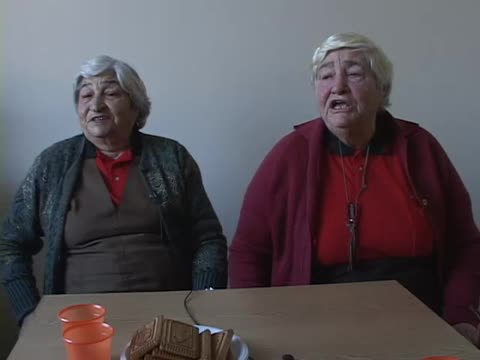
Two sisters sing Yiddish songs they remember from their mother and from before the war. Among them are a song about a cousin, a humorous song about having everything a girl needs, a toast song about drinking and the Messiah, and a children's melody about their grandmother and grandfather. Kerler asks for songs about rebbes and for a drinking song. The passage ends with talk about the move to the next place.
Includes Kerler's requests for particular songs and the end-of-passage talk about leaving.
Dzigifker talks about their family. Their father passed away in 1934. She then discusses folk remedies and remembers stories from her grandmother about a tzaddik and honesty.
Dzigifker answers Kerler's questions about her family: her father died in the 1930s and her mother in the 1970s. She tells how her mother was buried only after the Sabbath. Kerler asks about folk remedies for the evil eye, and she recalls pouring wax or melting lead as a remedy. She then tells a long story, heard from her grandmother, about a tsadik, a woman who tests his faithfulness and a pomegranate tree. Kerler thanks her for it.
Adds the remedy for the evil eye and the tsadik story, and gives the mother's death and burial.
The camera records Sabbath celebrations in the chesed. The community sings the well-known Yiddish song “Beltz, Mayn Shtetele Beltz,” among other Yiddish songs about food, friendship, and family.
At a Sabbath gathering in the Hesed, the group sings Yiddish songs, including "Beltz, mayn shtetele Beltz", a song about Sabbath and holiday food, a song of reconciliation and a toast song. Kerler asks the meaning of one phrase in a song. Much of the middle is garbled, with Russian remarks from others in the room.
Adds the songs about holiday food and Kerler's question about a phrase in a song.
The team meets Maryem in front of her home, who takes the team on a tour of the former Jewish neighborhood in Bălți. They are headed to the former synagogue.
The team sets out with Maryem and the others by car. They talk about the centre of town and about the former Jewish quarter and the Hasidim there. Kerler asks Maryem to show them what remains of the old synagogue. Maryem says nothing is left of it. Much of the speech is in Russian, about directions.
Adds the talk about the town centre and Kerler's request to be shown the synagogue site.
Maryem, who was born in Bălți, talks about her life during the war. She explains that she fled from Bălți to Dnipropetrovsk on foot for six weeks. Maryem continues giving a tour, pointing out former synagogues. They are then headed to a former “Jewish street.” After the team drops Maryem off at home, they are headed to the synagogue.
Maryem begins by recalling that in the war she and others fled on foot for six weeks to Dnipropetrovsk (?). She then guides the drive through Bălți, naming the Nikolaevskaya and Kishinevskaya streets (?) and pointing out sites of former prayer houses and synagogues, a brewery, the Jewish hospital and the old Jewish street. Kerler asks about old Jewish houses and Maryem's childhood home. Maryem also asks where Kerler is from, and he says Moscow. Russian directions and talk about a church and a new postwar synagogue are interspersed.