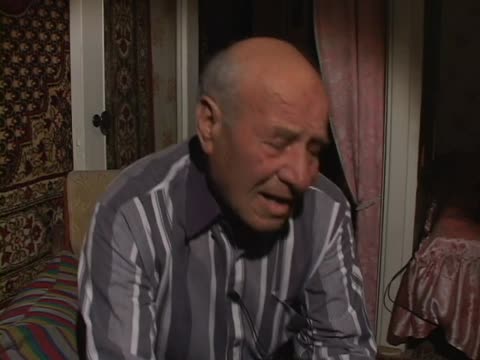
Bukshpun provides personal information and talks about his family. He then briefly recalls the return to their home town after the war. His father owned a shop and farmed three hectare land with a tractor. They also owned a cow, a horse, and ducks.
Bukshpun gives the name of his village, Starye Karkushany, and his own names: Mortko/Mordkhe, Russian Mikhail, patronymic Isaakovich. His surname is Bukshpun and his father was Itsik. He says the family lived there until the war and that three children came back. His father owned a shop and a tractor and farmed three hectares. They also kept a cow and a horse; the Romanians confiscated things and a threat to shoot the father is mentioned.
names and patronymics, and the Romanians' confiscation and a threat against his father
Bukshpun talks about life during the war, when the Romanians occupied Bălți during World War II. He recalls how his family was forced to leave and walked for three months through Mohyliv-Podilskyy, Soroca, and Vertiujeni. His family was imprisoned in the Vertiujeni concentration camp and forced to stay there for three months.
Bukshpun speaks of the family being taken from their house at night in the summer. They were sent on foot for three months. The places named include Mohyliv-Podilskyy, Soroca and Vertiujeni (the last as a concentration camp where they stayed three months). Kerler then asks him to go back to his childhood.
Bukshpun discusses life before the war in Karkushany, where sixteen Jewish families lived. He also talks about his family. He attended a Moldovan school for five years. He has relatives in Israel.
Bukshpun says he studied for five years in a Moldovan school in the village and knows Moldovan well. He names his mother Rive and her father Aron, who had many children and who is buried in Briceni. About sixteen Jewish families lived in the village, with prayers held in the grandfather's house. His father worked as a tailor in a shop and owned three hectares of land, farmed by non-Jews.
the maternal grandfather Aron buried in Briceni, prayer at the grandfather's house, and a Moldovan school
Bukshpun discusses prewar holiday celebrations, in particular Sabbath and Passover. He then talks about Jewish occupations. His uncle was a tailor and Bukshpun remembers how his uncle worked on sewing machines.
Bukshpun answers questions on Sabbath preparation, saying his mother cooked on Friday and a Christian came to light the candles. Kerler asks about the term for a Shabbes goy, which Bukshpun does not know. He recalls Sabbath food, gefilte fish, the shoykhet in Kurzhevits (?), Jewish tailors, Passover matzo, Sukkot, Purim and fasting. His uncle's tailor shop and its sewing machines are mentioned. He notes the Yiddish was spoken at home and he now has little chance to speak it.
Shabbes goy question, Sukkot, Purim and Yom Kippur fasting, and the home's two rooms
Bukshpun addresses contemporary religious life. He then talks about his life during the war in near Petyulke* Obodovsker region, where he was hold with 750 prisoners in a pigsty. The pigsty was turned into a concentration camp. He returned with his brother and sister in 1944.
Bukshpun says that today old Jews attend the synagogue, speaking Yiddish, mainly on Sabbath. He then speaks of the war, naming the Obodivka district in Transnistria and the village of Petkovka (?), where about 750 prisoners were kept in a pigsty. There his father, mother and a brother died of hunger and cold. He came back in 1944 with his brother Shloyme and sister Leyke.
the present-day synagogue and the deaths of parents, plus the names of his siblings
Bukshpun briefly talks about his return to Starye Karkushany. He explains that Christians lived in their former home. Bukshpun returns to his life in the concentration camp, where he was imprisoned for four years. He was protected by partisans.
Bukshpun says that after returning to Karkushany nothing was left; a Christian family lived in their house, and the mayor had run to Romania. He speaks of the camp and says that he tended a cow for the mayor of Stratiivka (?). Russian partisans came and he was claimed as the mayor's child, and the mayor later fled abroad.
the mayor and the partisans; the catalogue does not say the house was occupied by Christians in detail
Bukshpun talks about his life after the war. He worked the field. He then talks about surrounding towns with a Jewish population before the war. He addresses the relationship between Jews and non-Jews, before he describe his father’s general store. Bukshpun talks about synagogue services in his uncle’s town Briceni.
Bukshpun says that after the war they worked in the village; his father had fought at the front. He names Jewish presence before the war in Kurzhevits (?) and Belyavintsy (?) and says Jews and Christians lived without problems. His father's shop sold goods on barter, and he says his father had no time for stories. He remembers the uncle's house in Briceni with its minyan and the elderly man Moshe who led prayers. He recalls the father's tallisim, the synagogue's candelabra and the Torah reading; he does not remember dancing on Simchat Torah.
Bukshpun speaks about childhood: three children, schooling with Christians, Yiddish at home with other Jewish children, and his mother reading in Yiddish on Sabbath. They told stories in the long winter evenings. He answers questions on the evil eye and its spells, on the Briceni rebbe, on the cemetery and graves at Briceni, and on saying Kaddish.
Bukshpun answers questions about cultural terminology. He then talks about his family and their life after the war, before he discusses life today. He lost ten family members. Bukshpun received a medal for his work as a veteran 38:15. After the war, Bukshpun worked odd jobs, such as foreman for four years, for a supplier, and chauffeur (38:30). Bukshpun raised four children. His son lives in Israel and his daughters, who married non-Jews, live in Ukraine. He met his wife in the concentration camp and got married in 1948.
Bukshpun does not know the questionnaire terms for a cemetery, 'a good place' and a dybbuk, and finds it hard after years without Yiddish. He says ten members of the family died in the war. He then describes his postwar work as a brigadier, in a warehouse and as a manager, mentions a medal and a pension, and says he had a son and three daughters. He married in 1948 a Jewish woman from the village he met in the camp. The son lives in Haifa, the daughters in the village with Christian husbands, and he lists grandchildren.
the dialect questions on terms for a cemetery and dybbuk
Bukshpun answers a number of dialectological questions from the AHEYM Yiddish questionnaire. He then talks about life before the war and food customs. They produced butter, cheese, and duck fat. Bukshpun discusses his brother’s bar mitzvah at his uncle’s home.
Bukshpun answers dialect questions on words for ill and weak, flee, converts, rose, people and 'the four of us'. He reflects that life was good before the war, with bread and milk, and that after losing his parents at fourteen he suffered hardship. He talks about butter, cheese and goose fat, stuffed ducks and onions, no mamaliga, a Romanian school director, bees and sheep, songs, and his brother's bar mitzvah at the uncle's house, not his own.
the dialect questions, dairy and goose-fat food customs and the brother's bar mitzvah