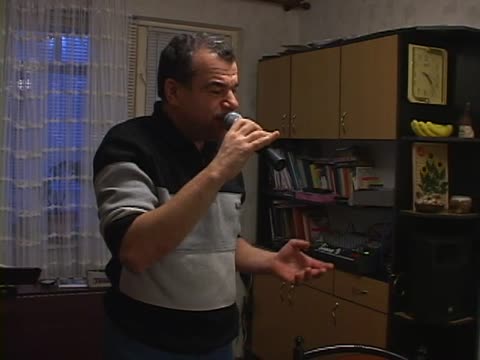
Farber sings a song about longing for the home of childhood, partly in Russian. He then says that two benches are all that remained of his family house in Vertiujeni. His grandfather and mother had sat on them as an inheritance, and he has had them remade.
The benches are an inheritance from his grandfather and mother, and he reports their age.
Farber sings a Yiddish song with the refrain 'khay', while Kerler explains that its author was an acquaintance of his father. Farber then recalls the author as an activist who played the guitar, and the talk turns to a Jewish instrument, the spoons.
Farber recalls the song's author as a guitar-playing activist and mentions the spoons as an instrument.
Farber says he will demonstrate how a spoon is played, and then plays on spoons. He explains that two spoons are used and that the playing goes with a bridegroom, as at weddings.
Farber sings a Yiddish song with lines about mazel tov and about the Land of Israel, taken from a singer's disc. Afterwards the interviewers ask about its source; he says he got the words from old women at the Hesed. Lemster presses him on what he will sing next.
The interviewers ask Farber about a cassette of his songs and where copies can be had. He says he made it himself, as his most recent one, for an anniversary.
Farber describes his mother as a Jewish housewife who baked, cooked, sewed and sang, with a cheerful home. He says his brother has lived in Israel for about fifteen years (the transcript is unclear whether a nephew is meant) and that he lacks people to speak Yiddish with. He sings Yiddish songs at non-Jewish weddings. His father worked as a clerk until 1940 and then went to the mines.
Also covers his lack of Yiddish speakers today, singing at non-Jewish weddings, and a relative in Israel.
Farber addresses Jewish life in Vertiujeni during the war. He explains that Jews were sent to the Urals to work in coal mines. He then speaks about prewar Jewish life and his family. Farber's mother was a seamstress.
Farber says his father was sent to the Urals (Kizel, Perm region) to work in the coal mines and later became a brigadier. He recalls Vertiujeni as having a rabbi and several synagogues, including tailors', shoemakers' and bakers' synagogues. He says his Yiddish comes from his grandfather Shlomo, and he mentions his mother as a seamstress who sewed for teachers and her baking in Vertiujeni.
Gives the grandfather's name, Shlomo, and the synagogues of Vertiujeni.
Farber speaks about his parents' traditional wedding in Vertiujeni, which took place with other couples. Farber was circumcised by a mohel from Soroca. He then speaks about his childhood, as well as his family. Farber describes how his parents met, after his mother returned from evacuation.
Farber tells of his parents' wedding in Vertiujeni in 1948 (?), held with other couples, and of his birth in 1954 (?) with a mohel brought from Soroca. He recalls his grandfather's work in Romania and how his parents met after the war, when his mother returned from evacuation and his father from the Urals. He also describes how the family found their two benches in the house of a non-Jewish man who had shot Jews in their garden and was later jailed.
Includes the return of the benches from a non-Jew who had shot Jews in the garden.
In answer to questions Farber confirms that Vertiujeni had a rabbi before the war. He says a relative, his father's brother Hersh, worked at a factory in Iași, Romania. The talk turns to his father and plans to see him, and a trip to Israel in May.
Includes a talk about visiting his father, the first song he performed, and plans.
Farber sings a Russian-language song about a gefilte-fish recipe and a Jewish home, partly Yiddish and partly Russian. He then sings Hasidic-style melodies with Russian lyrics about Jewish wandering and the Sabbath, with others joining in the refrain syllables. The interviewers then discuss where the tune comes from.
The hasidic-style melodies are sung with Russian lyrics.
A Yiddish song about dancing is heard, with Farber taking part. Lemster and Kerler discuss a word in it, and Farber then says his one plan is to keep singing, mentioning a festival he has just been at in Germany.
Farber speaks about performing before German audiences who took a keen interest in Yiddish songs. He says he was asked in Israel why he sings in Yiddish rather than Hebrew. The interviewers urge him to record songs, and Farber says he sees his as the last generation to know Yiddish.
Farber sings the Yiddish song "Akhtsik er un zibetsik zi," also known as "Bobe un zeyde (Eighty He and Seventy She; grandmother and grandfather). He then sings "Lekhayim" (Cheers).
Farber sings a humorous Yiddish song about an old couple, eighty and seventy, and then the drinking song 'Lekhayim'. Kerler and others talk between the songs, and Farber says the song was filmed for a film about Bessarabian Jews.
Farber sings a Russian-Jewish song about Yiddish, about memories of old Jewish streets and the old people's language. Most of the words are heard only as Russian lyrics, with Yiddish mixed in.