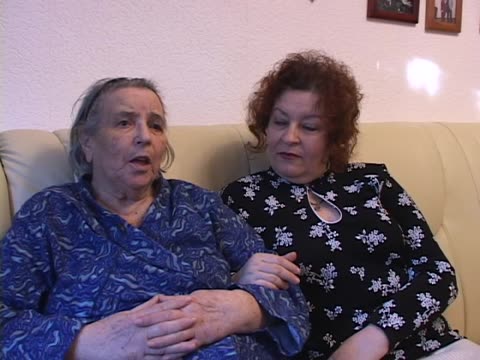
Mester provides personal information and discusses her childhood memories, including friends. She also addresses her education. Between the ages of six and thirteen, Mester received religious education with a private tutor during winter and at a religious school (cheder) during summer. Mester states that the teacher (melamed) would not allow the pupils to speak Yiddish. Mester also attended a Romanian school for four years in Stolniceni, from the age of six.
From the machine transcript
Ancel's mother (Mester) recalls childhood in Stolniceni: playing with a friend and a rag doll, and learning Yiddish at home with tutors. She attended the Romanian village school through the fourth grade. She then studied at a cheder, in private houses in winter and a rented room in summer, where only Hebrew was permitted. She names her best friend.
Names her friend and describes the dictation exercises and breaks in cheder.
Mester speaks about childhood games. She returns to her cheder education and speaks about the melamdim, who came from Zăbriceni and Varotik 5:52.
From the machine transcript
Mester talks about childhood hide-and-seek, which she says was played in Yiddish, and gives the Yiddish name for the game. She names her melamed and says he came from a village near hers whose name is unclear. She recalls Hebrew phrases such as asking permission to go out and the form of address for the teacher. Lemster begins a question about a wedding.
Adds the Yiddish term for the game and the form of address for the teacher; the village names are unclear.
Mester speaks about prewar traditional weddings in her home village. In particular, she describes a wedding in 1937, where the village inhabitants watched. Mester also remembers the food at the wedding.
From the machine transcript
Mester describes a Jewish wedding held in winter 1937, with the canopy outdoors in the snow. Neighbours from the whole village, Christians included, came to watch. She recalls the groom being met on the road, a klezmer or orchestra and the officiant brought from Edineț, and the glass being broken. She names the dishes: stuffed fish, soup with almond noodles, meat cooked in the ground, and portions of pie with leeks sent home with the guests. Christian neighbours were also guests.
Adds the number of Jewish families in the village, the officiant brought from Edineț and the Christian guests.
Mester speaks about prewar religious life. She describes how her mother visited the Rîbnița rebbe regularly.
From the machine transcript
Mester talks about travel to a rebbe in prewar religious life. Her mother went to the rebbe in Rîbnița, who is called a great tsadik. She describes the kvitl handed in with a request and the rebbe's blessing, and says her mother also went to pray for health. She mentions a protective cap that the rebbe's blessing made a good-luck charm.
Mester speaks about religious customs in her family. She also describes how her mother koshered meat, as well as threw a piece of challah into the oven.
From the machine transcript
Mester recalls her mother's religious practices: a prayer said before lighting the Sabbath candles, kiddush over two challahs on Friday night, and soaking and salting meat to kosher it. She says her mother put a piece of challah into the oven. Kerler's question about an anecdote begins the next story.
Adds the Friday-night kiddush and candle-lighting prayer.
Mester shares an anecdote about a Christian maid who threw a piece of challah into the oven. She then speaks about her family's life before the war.
From the machine transcript
Mester tells an anecdote about a Christian maid who threw challah into the oven in the housewife's absence and reported it to the rabbi. She then turns to her family before the war: her father died in 1939, and after his death her mother and the older sister learned dyeing. They went to nearby villages to dye wool. Her mother still travelled by motorcycle at seventy-five.
Adds the father's death in 1939 and the mother and sisters learning dyeing.
Mester talks about prewar religious life Stolniceni and recalls her father's prayer books at home. She mentions how men would rent a house to hold services once a week. She then speaks about holiday celebration, including Simchat Torah and Purim. Mester recalls music performances on Purim.
From the machine transcript
Mester talks about the prayer books and prayer shawl her father had at home. Services on Sabbath and holidays were held in a rented house in the village. She recalls dancing with the Torah on Simchat Torah, and young people in disguise on Purim with fiddle music and Yiddish singing. There was no Purim play.
Mester addresses Sabbath food customs, including her mother's receipe for gefilte fish. She then speaks about her family, as well as prayer customs.
From the machine transcript
Mester describes how her mother prepared stuffed or chopped fish for the Sabbath and gives the name for it. She remembers one grandfather, aged over seventy, and says she knew no grandmothers. She describes the morning prayer said on waking.
The transcript shows only the fish preparation, a grandfather and the morning prayer.
Mester speaks about prewar Hanukkah celebrations, including candle lighting. She then talks about folk and healing customs and states that her mother practiced them. According to Mester, her mother borrowed the texts to avert the evil eye from Moldovan women.
From the machine transcript
Mester describes Hanukkah in the village: candles made from half a potato with oil and a wick, the father's blessing, and gifts of money. She says her mother could remove the evil eye by an incantation in Moldovan, learned from a Christian woman. She also explains how coals were kept in a covered box and used for a samovar.
Adds the coals kept for the samovar.
Mester answers dialectological questions from the AHEYM Yiddish linguistic questionnaire. She then speaks about her family. Mester's father was a tailor. She grew up with three sisters. Mester also addresses prewar Jewish life in Stolniceni and discusses songs.
From the machine transcript
Mester answers a few word questions from the questionnaire, then talks about her family. Her father Moyshe was a tailor; he died in Edineț after being taken there from Stolniceni. Her mother kept house for a family of six or seven. A girl in the village sang, and Mester recalls a few words of a song about emigrants to America.
The father's name Moyshe, his death in Edineț and the singing girl.
Mester addresses prewar Passover celebrations and describes how she stole the afikoman. She then speaks about prewar Jewish life, including occupational structure, in her home village. According to Mester, seven families lived in Stolniceni.
From the machine transcript
Mester recalls Passover: her father stayed up praying after the seder, and she stole the afikoman and was paid for it. She talks about the village's Jewish families, saying there were seven in all, and about the shops, mill and fields. She says there was no Yiddish library, and Kerler asks about Jews in the tavern.
Adds the Seder customs, the shops and mill, and the lack of Yiddish reading.
Mester speaks about prewar drinking customs. She then speaks about her family's life before the war, particularly travling to Edineț. Mester then answers questions about cultural terminology.
From the machine transcript
Mester says only Christians went to the tavern; the family bought a small bottle of brandy for Sabbath. She talks about her mother's trips to Edineț for shopping, by cart in summer and sleigh in winter. She answers questions about the burial-ground phrase 'a good place', plurals of rabbi and rich man, and the meanings of dybbuk and golem.
Adds the Edineț shopping trips and the vocabulary questions.
Mester speaks about her life during World War II. She was imprisoned in the Berlivka camp for three years and then in the Vertiujeni camp for a couple of months. She describes the forced labor life and beatings under Romanian occupation in Vertiujeni. Mester then speaks about how the prisoners had to stay in the Cosăuţi woods for a few days. Mester returns to her life in the Berlivka camp, which was set up in cow barns. Her mother sewed items for Christians in exchange for food. The prisoners were taken to forced labor to rebuilt a bath house. Mester also recalls dancing and singing of the youth. Mester recalls the liberation of the camp by partisans, dressed in German uniforms.
From the machine transcript
Mester describes three years in the Berlivka camp, including a stay in Vertiujeni where Romanian gendarmes beat prisoners and tore at rabbis' beards. She recalls being held in a forest for a few days and her elderly mother being helped to walk. In Berlivka, prisoners lived in a barn, her mother sewed for Christians in exchange for food, and they were taken to repair a bath house. Young people sang and danced; Germans searched for partisans, and the camp was freed by partisans in German uniform. Lemster and Kerler ask about words in camp speech.
A long account of camp life, liberation and the questions about language.
Mester talks about her family and her life after the war. She then speaks about food customs after the war.
From the machine transcript
Mester describes how her parents, or the couple she names, met after the war through an Abraham Hershe, a harness-maker and trader. She tells where the wedding took place, who came, and the food, including pies. The tape ends with a joking exchange about cognac.