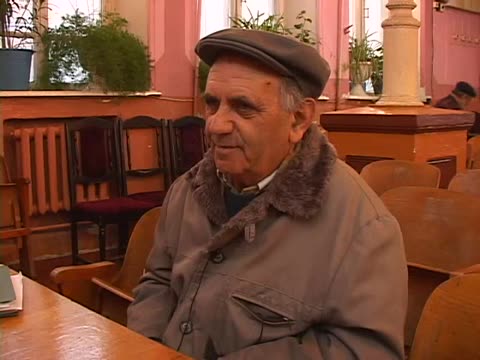
Questionnaire session: a Russian prompt is read out for each item and the interviewee gives the Yiddish. Items include greetings, the time from which a greeting may be used, thanks, body parts, house and animal words, adjectives and adverbs with comparatives (cold, high, fast, near), and 'earlier' and 'later'. There are also short sentences to translate (he came today, he knows everything, he fled from the Germans) and words for 'honest' and 'pious'. Katz asks follow-up questions about usage.
The camera cuts to the formal interview with Abramovich. She shows a Passover cup, she inherited from her great-grandmother. She also addresses personal letters between her great-grandfather and Sholem Aleichem.
Abramovich shows a Passover cup (it has a Yiddish name the interviewers discuss) inherited from her great-grandmother. It passed from the grandmother to an aunt, who gave it to Abramovich when dying in Odessa. She describes the symbols on it and the family archive of photographs and diaries. Her grandmother's diaries include an account of Sholem Aleichem visiting the family's dacha at Bolshoy Fontan near Odessa. A pear tree and a large dog in the story led her to a Sholem Aleichem tale, and so to her idea for a book.
adds the Sholem Aleichem dacha anecdote from the grandmother's diaries, and the plan for the book
Abramovich talks about visiting Sholem Aleichem's house. She then speaks about her father's studies at a conservatory in Odessa. Abramovich published a book about her great-grandfather called "Наш Менделе" (our Mendele).
Abramovich talks about material sent to her from Sholem Aleichem's house and about her visit to Israel and the Knesset. She shows a golden harp tie-pin given to her great-grandfather, which gained symbolic meaning when she graduated from the conservatory in harp and music history, and mentions Łódź (?). The talk turns to Mendele's children, who spoke European languages but not Yiddish, and to a poet grandson, Mikhail Abramovich. The transcript here is partly confused by the noisy Yiddish line.
adds Mendele's children and grandchildren not knowing Yiddish, and the poet Mikhail Abramovich
Abramovich speaks about her family, in particular her father's work. She then shows manuscripts by Mendele's daugther about the encounter of Mendele and Sholem Aleichem.
Abramovich explains the family tree: her father was born in 1900 and taught at the Odessa conservatory (later Chișinău), where he was a prorector and had famous students. She shows the manuscript diaries of Mendele's daughter Nadezhda, including a notebook titled 'Grandfather and Grandson' about Mendele and Sholem Aleichem, and a telegram from the Jewish Anti-Fascist Committee asking for the work. The group works out the place of writing as Molotov, not Kuibyshev. After a remark about Vilnius, Abramovich recalls her summer trips to Lithuania and a Lithuanian composer (name garbled).
adds the Anti-Fascist Committee telegram, the Lithuanian ties and the Kuibyshev/Molotov question
Abramovich and the interviewers discuss dates connected with Mendele: a 1927 anniversary of his death, Mendele's uncertain year of birth (1836?), and a family-memory remark about 1936–37. They consider asking a researcher at the Odessa museum. Chat about Mendele's age at death is mixed with side remarks about slippers and a dropped bag.
Abramovich talks about what remains of Mendele's legacy: autographs, the library, the museum, and his translations and interest in natural science. She says the family fled in 1941 when she was seven. She mentions a Polish song and a poem by Maksim Rylsky dedicated to Mendele, stories her grandmother told, an album made in Vilnius and now in Israel's National Museum, and her father's pseudonym. The visit then turns informal: cake, Israeli press clippings about her, a tennis-champion article, and book sales and names.
adds the 1941 flight, the Rylsky poem and album, and the informal talk over cake