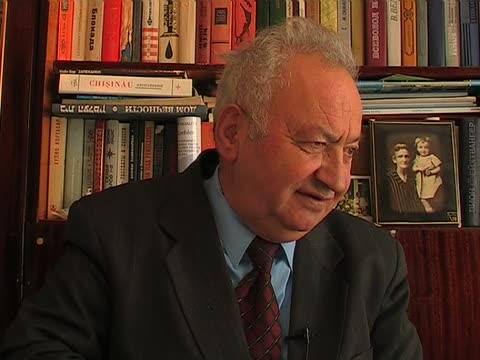
The formal interview begins. Gordin provides personal information and talks about his family. Gordin's parents were born in Velyka Kisnytsya, Ukraine. His parents escaped the Petliura pogroms in 1919 and moved to Flore?ti. Gordin's father worked as loader at the railway. Gordin grew up with two brothers, although his mother gave birth to five children.
After the date and place are established, Gordin gives personal information: he was born in Florești in 1936, and his Yiddish name is Meyer. His parents came from Velyka Kisnytsya in Ukraine and fled to Bessarabia as children after a pogrom in 1919 (?). His father worked on the railway, his mother did not work, and he names his mother and the siblings, including a sister who died before his birth and a baby brother who died before the war.
Gives the siblings' names, including a sister who died before his birth.
Gordin discusses his childhood memories of Jewish life in prewar Velyka Kisnytsya. He also remembers food customs at a traditional wedding and talks about the local religious school (cheder). Gordin then speaks about prewar holiday celebration and recalls his parents going to services.
Gordin recalls Jewish life in prewar Florești, including a synagogue and a shoykhet, and a wedding he remembers where food was served and klezmer played. He describes his parents attending the synagogue on holidays, with men downstairs and women upstairs. He also speaks about cheder and an uncle who was a melamed, and says Jews were religious.
The place of the childhood memories is Florești, not Velyka Kisnytsya; the wedding was in 1945 (?).
Gordin recalls prewar Passover and Purim customs. He then speaks about Passover customs after the war. Gordin then discusses his memories of Simchat Torah, Purim, Rosh Hashanah and Hanukkah celebrations.
Gordin recalls holiday customs: Passover preparations and the removal of bread, and delivering Purim gifts for which he received money. He describes the postwar Purim after his father's death, making Simchat Torah lanterns from pumpkins, and a Purim rhyme children recited. He also mentions Rosh Hashanah and Hanukkah money. He closes by noting that the war began when he was five.
Includes Simchat Torah lanterns and a Purim rhyme, and postwar Purim gift-giving.
Gordin speaks about his life before the war and remembers attending traditional weddings and funerals. He then speaks about the prewar Jewish occupational structure of Florești.
Gordin talks about attending a wedding and the funeral of an aunt, and how the burial was done in a Jewish way. He then lists the Jewish trades and the rich and poor in the small town, and recalls a visiting circus and the burial of a clown. He adds that children studied in cheder and that he was too young to attend.
Gordin describes Florești as a small town that became a city only after 1946, with a gendarmerie, barracks, a small tobacco factory, a mill and an oil press, and says Jews lived on peaceful terms with their Christian neighbors. He then names his grandfathers, whom he saw once in 1941, and his maternal grandfather Velvl Vinitski, and says he never knew a grandmother.
Gordin speaks about prewar religious life. He states that the local synagogue was also functioning after the war. Gordin attended a Russian school. He also describes his Yiddish-language education by Itsik Lander, which lasted two weeks. Gordin then addresses prewar religious life, including holiday food customs.
Gordin speaks about the single synagogue in Florești, which functioned until some time after the war, and about a short course in Yiddish with Itsik Landa that lasted only a couple of weeks. He then answers Katz's questions about holiday customs: Yom Kippur fasting foods, Hanukkah dreidel and money, and cheese bagels on Shavuot. He says he does not remember blessings or Sabbath songs.
Includes answers to specific questions on Yom Kippur, Hanukkah and Shavuot foods and customs, and Gordin's present study of Hebrew.
Gordin talks about prewar life, including non-Jews who spoke Yiddish. He also addresses prewar Jewish life and healing customs. Gordin recalls a sick friend that was healed through healing practice.
Gordin answers Katz's questions about non-Jews who spoke Yiddish: gentile workers in Jewish homes learned it, some well and some poorly. He mentions rare conversions and Jews who converted to Christianity, and says he does not remember hasidim or the rabbi. He describes a folk healing practice for the evil eye, recalling a sick friend who survived, but cannot say how it was done.
Includes talk of conversion and hasidim, and the folk-healing story about a friend.
Gordin answers questions about terms: a dybbuk, which he explains as someone possessed, and a golem, which he does not know. He then gives the term for the cemetery and explains that in Florești the Jewish and Christian fields were adjacent but separate.
Gordin talks about his life during World War II. His father was drafted into the Red Army in 1941. Gordin, his mother and brother evacuated on foot to his grandfather's home in Velyka Kisnytsya, Ukraine, via Vertiujeni and Camenca (Moldova). Gordin continues that they evacuated further to Kryzhopil and Zhabokrych, Ukraine. Gordin's father was a forced laborer, a baker, for the Germans. Gordin states that his family evaded a mass execution in Zhabokrych and was then imprisoned in the Merskivka 37:12 ghetto. Gordin then describes daily life in the ghetto and mentions that his father was taken to build a road in Petikhatka 38:50. Gordin continues that Bessarabian Jews were assembled and taken to Kryzhopil. He maintains that his family was able to buy their way out and stayed in the Merskivka 37:12 ghetto until 1944. Gordin recalls the Red Cross giving out clothes during the war.
Gordin tells of the war: his father was called into the Red Army, and the mother and children set out on foot via Vertiujeni and Camenca across the Dniester to his grandfathers' village in Ukraine. They went on to Kryzhopil and Zhabokrych, where his father worked in a German bakery and Jews were shot in a cellar. They were then held in a ghetto in a village whose name is unclear (Mierskivka (?)), where his father also worked at an oil press and on road building. The family bought its way out of the deportation of Bessarabian Jews to Kryzhopil. Gordin recalls hunger, disease and Red Cross clothing, and that they stayed there until 1944.
Adds the mass shooting in a cellar, the klezmer family that bought Gordin's family out, and the hunger and disease.
Gordin addresses his return to Floresti after the liberation by the Red Army. His father was drafted into the Red Army for the second time an died at the front in 1944. He then speaks about his life after the war and recalls the Hunger of 1946. Gordin continues his education at a Russian school and then joined the Red Army for three years, serving in the Russian Far East. Gordin then studied chemistry at the Vladivostok University until 1963. He then worked as chemstry and physics teacher at a village school for one year, before moving to Chi?inau for graduate studies. After his graduation, Gordin worked as chemist at a furniture factory for two years. Gordin also worked at a trade institute, a mirror factory, as well as a window and door factory.
Gordin recalls the return to Florești in 1944 after liberation. His father was drafted again and killed that year, and is buried in Latvia (?). He describes the great hunger of 1946 and his mother's death in 1947 (?). He says the postwar decades were hard. He then outlines his education and career: Russian school, army service in the Far East, chemistry at Vladivostok University until 1963, a year as a village teacher, and Chișinău jobs in a furniture factory, a trade institute, a mirror factory and a door and window factory.
Adds his failed entry to a Leningrad military institute and his mother's death in 1947 (?).
Gordin talks about his years at a mirror factory and explains how mirrors are made. He describes the chemical silvering method and the later vacuum method with electrodes, aluminum and varnish, often in Russian, and Katz asks him to tell it in Yiddish. He mentions that he traveled to factories in other cities.
Gordin speaks about his life and family today. He was married in 1965 and raised a son, who lives in Israel. Gordin also mentions his visit to Israel. Gordin's two brothers also live in Israel.
Gordin speaks about life today: he married in 1965 and has a son who has lived in Israel since a date he gives. His wife, a biologist and chemist, died sixteen years ago, and he lives with her mother. He has visited Israel five times, most recently for a bar mitzvah. His two older brothers also live in Israel. He answers Katz's questions about his pension and compares pensions in Israel, the US, Ukraine and Poland.