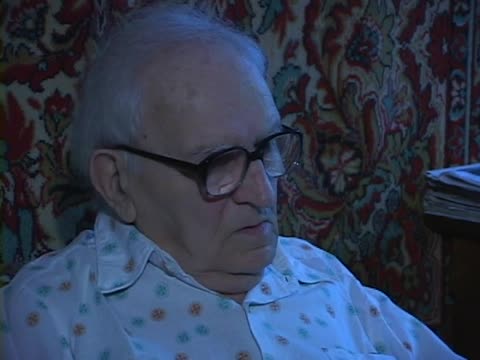
Sherman speaks about his family and life after the war. He mentions his collection of Yiddish songs. He then speaks about his education in cheder before the war.
Sherman talks about collecting Yiddish songs on records and cassettes from America and Israel, and offers to show his collection. He answers Lemster's questions about Jews who converted, then describes his cheder, with a poor teacher who taught only prayer, and how he taught himself to read Yiddish and read many books. Whether Telenești had a talmud torah is unclear.
Includes questions on converts and Hebrew teaching, and the point that he learned Yiddish reading on his own.
Sherman and the interviewers name Yiddish writers and press figures associated with Telenești, with some uncertainty about the names. He mentions a song noted down in Chernivtsi and a Yiddish theater there, with an actor named Sidi Tal (?) who also visited Telenești. He says he lived in Chernivtsi only after the war.
Names several writers; the Chernivtsi residence is after the war.
Asked about life today, Sherman describes working and retiring with his wife, the collapse of savings after the Soviet era, and a pension that rose over time, with support from Hesed and the Jewish cultural center. He gives pension amounts and talks about the hard years of his youth, when he tutored mathematics in Orhei to support himself in school and then went to Chişinău for his baccalaureate with money his mother raised by selling silver spoons.
Gives pension figures and the mother's selling silver to pay for his baccalaureate.
Kerler asks Sherman about his views on God. Sherman answers that it is a delicate question and recalls a university-style lecture on God by a professor, speaking partly in Russian. Kerler then turns to the years of evacuation.
Adds a discussion of God and a remembered lecture, which the catalogue labels only generally.
Sherman recounts being mobilized during the war and moved with a labor unit by way of Central Asia (Almaty) to near Moscow, to Rzhev, and later to Karaganda. They built bridges, railway lines and barracks for workers; Bessarabians were not allowed to join regular units.
Kerler puts questionnaire items, with Russian prompts, for Sherman to render in Yiddish: greetings and their times of day, requests and thanks, house, skin, mouse, color, pigeon, hill, tired, poor people, and to have a book. Lemster adds Romanian prompts. Sherman distinguishes Yiddish from learned vocabulary, and mentions reading Sholem Aleichem and Ansky as a child.
Sherman speaks about the Yiddish literature he would read during his childhood. He then answers more dialectological questions from the AHEYM Yiddish linguistic questionnaire.
Sherman speaks about the Yiddish books and translations he read as a child, including translated American writers such as Jack London. Kerler and a second voice put questions on translated authors and on funeral and condolence formulas. Sherman ends with a joke about a man's death.
Includes a joke and formulas said when someone has died.
Sherman shares an anecdote about Jewish life. He then talks about his family and his life before the war. Sherman's two brothers, sister and mother made aliyah after the war.
Sherman tells an anecdote about a man who died and the livelihood of Jews, then talks about his family. As a boy he studied with a teacher and his mother baked bread for the Sabbath; his mother, two brothers and two sisters all moved to Israel after the war and died there. He mentions relatives in Israel, including a niece's husband working for an American firm.
Gives details on the relatives in Israel, including their towns.
Kerler and Lemster continue the dialectological questionnaire: words for being ill, dying, liking and disliking, walking with difficulty, an honest or religious person, cross and Christian, peasant, a headache, bed, threshing and breathing. Sherman translates from Russian and Romanian prompts and says when he does not recall a word from Telenești.
Sherman speaks about prewar Jewish life, including drinking and food customs. He then describes Sabbath food customs at home and mentions the family's Sabbath goy.
Sherman says Jews in prewar Telenești did not drink; the only drinker was the water carrier. He talks about wine at Passover and memorial days and describes Sabbath food: fish, meat, and cholent kept warm in the oven in a metal box, with a non-Jew called in to light the fire.
Adds Passover and memorial-day drinking and the neighborhood being almost entirely Jewish.
Sherman answers dialectological questions from the AHEYM Yiddish linguistic questionnaire. He then addresses prewar Jewish life, including occupational structure. Sherman then describes how locals traveled to Chişinău with Christian coachmen.
After a question on the word for flowers in Telenești, Sherman describes the hard prewar life of Jewish shopkeepers and traders, who waited a season for peasants to buy. He explains how people went to Chişinău and Iași, with a Christian coachman and horses, to buy goods, and mentions his father traveling this way. Kerler then returns to the questionnaire.
Questionnaire items on grammar and vocabulary: plural forms, such words as such, a ceiling, the floor, window panes, whose, perhaps, a man and woman, and wagons. Sherman also answers on the prewar prayer service, in which the cantor stands at the front, and says people disliked a bad cantor. Lemster asks about the Hanukkah dreidel.
Includes his remarks on the prayer service and cantors.
Sherman speaks about prewar Jewish life, particularly wealthy residents, before he continues to answer dialectological questions from the AHEYM Yiddish linguistic questionnaire.
Sherman says there were few wealthy Jews in prewar Telenești, naming one man with a cash register and cashier. The questionnaire continues with words for tailoring, attic and other household items.
Sherman speaks about prewar holiday celebration, particularly Tisha B'Av. He then continues to answer dialectological questions from the AHEYM Yiddish linguistic questionnaire.
Lemster asks about Tisha B'Av, and Sherman recalls children's customs of throwing burs. Kerler then puts more questionnaire items: face, appearance, return, suddenly, various, good head and enemy. Kerler thanks Sherman at the end and asks for a song.
Kerler closes the formal interview and a few lines of a Yiddish song are heard. Sherman shows a rare edition of Sholem Aleichem's works and says he reads and writes Yiddish well. He also shows a Russian-language book.
Adds a Russian-language book and a few lines of song.