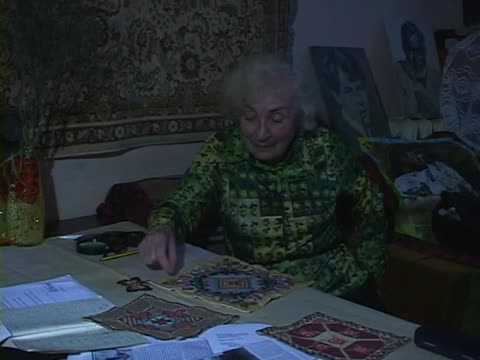
Diner talks about her life during and after the war. She was imprisoned in a Soviet gulag for three years during the war and spent two years in the Mykolayiv prison. Diner was caught in Mykolayiv, escaping the gulag in 1954 and sentenced to seven years. She explains that she was released from prison in 1956. Diner also speaks about her family. Diner then speaks about life in prison and fellow prisoners, as well as shows her handicraft, she made during the imprisonment. Diner then shows her booklet, in which she collected poems and songs during this period.
Diner talks about her arrest and imprisonment: three years in a camp, then exile or banishment, with a long sentence given to her and to her mother after her father, described as a Zionist, was shot. She says she escaped, was caught in Mykolayiv (?), and was held in a camp in the Perm region, and that she was released after Stalin's death. She describes camp life, including the shirts and sacks they sewed from, and shows her handwritten booklet of poems and songs from the camp, including an operetta text. She recalls a fellow prisoner, a talented thief from Kyiv, and a Kyiv political prisoner who wrote.
Also tells of a female thief and a political prisoner from Kyiv, and shows her handicraft or sewing; the dates are garbled.
Diner briefly sings "Itsik hot shoyn khasene gehat" (Itzik already got married). She then speaks about prewar Jewish life in Fălești, including occupational structure, drinking customs and religious institutions. Diner also recalls a Russian doctor who treated patients for free.
Diner sings a few lines of a song about Itsik's wedding. Asked what she wants remembered about her shtetl, she describes the people of Fălești as fine, with many doctors and engineers, and tells of a young man who fell in love with a Jewish girl whose uncle liked a drink. She answers questions about drinking at Purim and Passover, wine, and non-Jews who understood Yiddish. She names a Russian doctor, Putsyata (?), who treated poor patients without payment.
Also covers a family named Braverman, drinking customs, and matzo baking.
Kerler and Lemster put questionnaire items to Diner. They ask about a rare word of Polish Yiddish origin, Lithuanian Jews and the word for a Lithuanian Jew, and the meanings of 'dybbuk' and of a simpleton or fool. They also ask about the term 'a good Jew', Hanukkah food such as latkes and doughnuts, and the golem. She often does not know the word or answers in Russian.
Diner speaks about her childhood friends, before she addresses her mother's cooking during the winter season. She then answers dialectological questions from the AHEYM Yiddish linguistic questionnaire.
Diner recalls a Jewish schoolmate from the third year of gymnasium who volunteered for the Soviet army in 1941 and died near Smolensk, and says many boys perished. Asked for another song, she says she has forgotten the Yiddish ones. She answers questions about her mother's preparations in winter, such as meat salting and preserves, and says Yiddish is hardly spoken today. Kerler asks about expressions and the discussion moves to local customs and eccentrics.
Also covers a schoolmate killed at Smolensk in 1941 and the decline of Yiddish speaking today.
Diner speaks about the shtetl's madman, a character called Khantse (?), who shouted in the streets. She names well-off local Jews, among them Sara Fuks's family with a mill, and a dealer in karakul and furs, and says Fălești had three Jewish pharmacies and many doctors. She says Jewish boys went to the cheder and had bar mitzvahs, and discusses circumcision at home. The interviewers ask about girls' observances and other customs.
Also names pharmacies and shop-owners, and covers bar mitzvah and circumcision customs.
Diner describes her mother's cooking at home, including baking and mamaliga with various toppings such as sour cream and cheese. Kerler and Lemster discuss the Yiddish word for cheese curd. She then talks about her older sister, who lived in Bucharest, met a man there and married him; the sister was later in a ghetto in Transnistria with her husband and his parents. She also says her father, a Zionist, worked all day and had little time for the children.
Also covers the sister's marriage and Transnistria, and her father's lack of time and his Zionism.
Diner speaks about her life after the war, following her release from prison. She married a non-Jewish man and worked at 32:38 as engineer 32:53. Diner does not have children.
Diner speaks about her life after her release from prison. She met a non-Jewish man from the Urals (?) and lived with him for three years until he died; she had no children, saying she did not want any and that doctors had told her she could not. She worked in construction as an engineer on labour and wages and received an apartment through work. The interviewers then praise a very old acquaintance with an excellent memory, and Lemster asks if she can read Yiddish poetry; she says she knows Russian poems.
Also covers a non-Jewish husband, her work as engineer and the apartment, and a mention of Sherman.
Diner recites a Russian poem on Jewish fate, which she says she assembled from three quatrains by Gubermann. She then talks about her life today: she helps neighbours with injections and is afraid to go to the polyclinic. Kerler asks her about God, and she says there is one God and hopes for peace. She comments on contemporary politics, including Russia's relations with Iran compared with its earlier friendship with Hitler.
Also covers her helping neighbours medically and a view on God and politics.
The team concludes the formal part of the interview with Diner. She then speaks about her family. Diner states that she was taught how to read in Romanian by her sister at the age of four.
The formal part of the interview ends and the interviewers ask whether Diner remembers any songs her mother sang, but she has forgotten the Yiddish ones; Kerler recalls lines of a song about in-laws (makhetunim). She says her sister taught her to read in Romanian from the age of four so that she would not have to learn from religious texts. Lemster tells of a very old acquaintance who remembers everything. Kerler thanks her warmly.