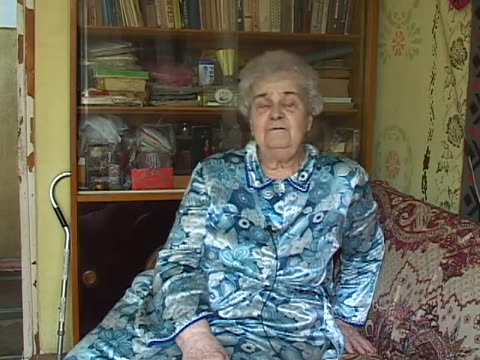
Muchnik speaks about her life before the war and talks about her family. In particular, she speaks about her brother, who prepared his aliyah to Eretz Yisrael as chalutz.
Muchnik talks about her family and her older brother Haim, a Zionist who prepared to go to Palestine as a chalutz. She tells of an evening walk with him to the river, a key he made so he could come home late, and a police episode. She also mentions a sister who studied in Bucharest and another brother who later studied in Palestine. At the end she begins to speak of the Romanian fascists in the years before the war.
The catalogue's brother story also includes a police incident, the sister's studies, and a second brother.
Muchnik describes the activity of Romanian fascists in Orhei before the war: gatherings of peasants with sticks and sacks who were to plunder Jews. She recalls climbing onto the roof to watch their meeting place, and Jewish households closing shutters at night in fear of a pogrom. She tells of a night alarm in which neighbours knocked on windows to warn the Jews.
Includes a night alarm among the Jewish neighbours and a childhood vantage from the roof.
Muchnik speaks about prewar religious life. She maintains that her father attended daily services at the market synagogue and the Great Synagogue on holidays. Muchnik remembers the cantor in the Great Synagogue. She then shares an episode about spending Rosh Hashana at a Romanian police officer's house.
Asked about her mother's candle-blessing and prayers, Muchnik says she does not remember. She recalls her father's two synagogues, the market shul daily and the large Kleyz on Sabbath and holidays, and the handsome young cantor. She then tells an episode about visiting a police officer's daughter before Rosh Hashanah and going through the house of a Romanian police chief. At the end she mentions being first in her class at the gymnasium.
Begins with Lemster's questions on her mother's candle blessing and ends with her school prizes.
Muchnik speaks about her life before the war, specifically sharing an episode about her work as school teacher. Muchnik also her addresses her book collection.
Muchnik tells how, after a school year when she received no prize book, a parcel slip from Bucharest led to a post-office package of books from the royal publishers. This became the start of her own library. She says she now reads mainly Russian, never read Yiddish, and studied French and German at the gymnasium.
Adds her present reading language and her gymnasium languages.
Muchnik speaks about her education at the local tarbut school. She sings a song, written by Hayim Nahman Bialik. Muchnik then talks about individual family members, who faced state persecution in during the 1940s and 1950s.
Asked by Kerler about the Tarbut school, Muchnik recites a few lines of Bialik in garbled Hebrew and says she only picked up some from older people. She then speaks of relatives persecuted by the Soviet regime: a brother-in-law (named Vinogrād Mendl Haimovitsh, from Mărculești) sentenced to ten years in 1942, rehabilitated around 1950 after her sister, an accomplished teacher, was also affected. Kerler asks about the dates and the Yiddish inscription on a gravestone.
Adds the brother-in-law's arrest and rehabilitation and Kerler's questions about a gravestone inscription.
Muchnik speaks about postwar Yiddish culture in Orhei. She recalls performances by Sidi Tal. Muchnik then speaks about her family's and local's fate during World War II.
Answering Lemster and Kerler, Muchnik says the Yiddish actress Sidi Tal used to perform in Orhei before the war and she herself was not much at the theatre. She tells of the fate of her parents and a lawyer friend of the family during the war, who went to their death. She regrets that no memorial marks the place where Orhei's Jews were killed and buried.
Adds her parents' killing and the absence of a memorial at the burial place.
Muchnik tells how she started travelling to Orhei to find the graves of her relatives and finds her grandfather's Yiddish gravestone; on the day she mentions it is a brother-in-law's yahrzeit. She speaks of the rabbi's wife Leah Abelsky, the Sabbath table, and the rabbi's Lithuanian-style Yiddish. She asks the rabbi about a Hebrew birth date.
Adds the rabbi's wife Leah, the rabbi's Yiddish, and the Sabbath table.
Muchnik discusses her childhood home and family's observance. In particular, she addresses the generational gap between her Hasidic grandfather and her non-Hasidic father.
Muchnik talks about the family house in Orhei, shared with her paternal grandfather, a Hasid whom a rebbe visited. She says her father did not take part in the Hasidic celebrations and dancing, and she did not understand why as a child. Kerler suggests he was a mitnaged.
Adds the shared house and the rebbe's visits to the grandfather.
Muchnik answers questions about cultural terminology. She then speaks about her maternal wealthy grandfather. Muchnik then shares episodes about prewar local life and recalls a non-Jew who got along with locals.
Asked about the word 'dybbuk', Muchnik explains it as a stubborn person; Kerler and Lemster also ask about other words. She then describes her wealthy maternal grandfather, a landowner with a carriage and horses, and his richly furnished house. She also recalls the all-Jewish street where she grew up, and a Moldovan who bought a house there and became friendly with the Jews and learned Yiddish.
Begins with a terminology question on 'dybbuk' and ends with a Moldovan neighbour who learned Yiddish.
Muchnik speaks of her present life: the Jewish centre, writing, and the few people with whom she can speak Yiddish. She answers questions on expressions and prayers, including 'a gut ort' and a prayer for Sabbath night. She says women went to the synagogue only on Rosh Hashanah and Yom Kippur, and recalls Roza Zabritsky dressing up on Yom Kippur.
Adds her speech with others today, expressions asked by Kerler and Lemster, and women's synagogue attendance.
Muchnik explains family photographs and speaks about her life today, as well as mentions artifacts for the local museum. Muchnik also talks about her sister's studies.
Muchnik explains family photographs, including one of her sister and her husband, and speaks of items she plans to give to the local museum: old postcards, photographs and her sister's diplomas from Bucharest. She tells how she once sold postcards and regretted it. She also mentions her sister's studies and a professor's comment about her nationality.
Adds the sister's diplomas and her professor's remark.
Kerler puts a short sentence to translate into Yiddish (a Russian sentence about someone bringing a book). Muchnik gives a Yiddish version and says that people at the centre forget words.
Contains a single sentence-translation item and her remark about forgetting words.