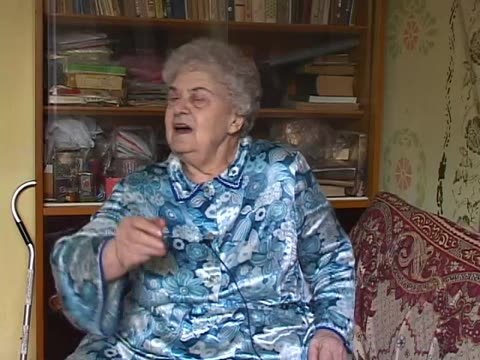
Muchnik recites Heine's Lorelei in German, which she learned at the gymnasium, after Kerler asks her to repeat it. She then starts to speak of another piece or of an article she wrote, which she sent to a brother in America, and recalls her elder brother's participation in a Yiddish theatre.
She also mentions an article she wrote and sent abroad, and her brother's theatre role.
Muchnik tells how her elder brother acted in a Yiddish theatre, taking the role of Death, and forgot to remove his wristwatch, so that he was nicknamed after it. Lemster and Kerler ask what plays were staged and whether they were in Yiddish. She recalls a symposium of Hebrew specialists where her brother, a carpenter, corrected a professor, and talks of her brother's love of Hebrew and Yiddish and of cheder.
Adds the story of the brother's wristwatch in the role of Death and his Hebrew interests; the location of the circle is unclear.
Muchnik discusses a prayer text and a request to transcribe it into Russian letters, and her reaction to being called a nationalist because of her support for Israel and the Jews. In answer to Kerler she says she must believe in God. She stresses that she is the last of the Muchnik family and tells a story of a friend rescuing her from a fire, which she calls a miracle. Kerler then starts asking how one says 'why' in Yiddish.
Beyond life today and religion, the passage includes a prayer for Israel, her statement of identity and a story about a fire.
Muchnik answers dialectological questions from the AHEYM Yiddish linguistic questionnaire and questions about cultural terminology. She also talk about her life today and shares Yiddish and Hebrew sayings.
Kerler and Lemster ask Muchnik for Yiddish equivalents of 'why' and 'about what', and she answers. She says that old Jews say a phrase asking God to protect from something worse. She explains the word golem (a helpless person) and gives a Hebrew-sounding saying. The interviewers remark that she has not learned Yiddish formally.
Adds the explanation of the word golem and the saying about God protecting from worse.
Muchnik speaks about Yiddish literature and talks about contemporary Jewish life. She then speaks about her religious education with a private tutor before the war.
Muchnik answers questions about Yiddish writers: she has heard of Bialik, Sholem Asch and Sholem Aleichem but did not read them. She mentions an older Jewish woman in Chișinău who reads Yiddish. She recalls writing letters in Hebrew to her brother, and her religion lessons at the gymnasium with a private teacher who had studied in Vienna. She can read an Israeli newspaper only with vowel points.
Adds her Hebrew letters to her brother and the ability to read a Hebrew newspaper.