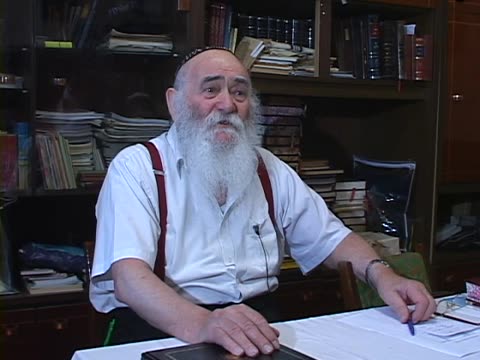
Abelsky speaks about his work, before discussing historiography with historical examples. He also addresses the difference between Hassidic and secular historical studies.
Abelsky speaks about his past travels as an emissary of the Rebbe, then about the unreliability of historical books, which rest on archive documents. As an example he describes the Chabad rescue of Jewish children conscripted as cantonists in Russia. He mentions Dubnow, Graetz and the Rebbe's writings on historians, a Yiddish-language Chabad memoir series, and the fate of Jewish life under Communism. Kerler introduces the recording in the Chișinău synagogue and Lemster and another voice ask about Dubnow.
Adds the cantonist-rescue story, the Dubnow and Graetz discussion, and Kerler's introduction to the session.
Abelsky addresses religious, Hasidic, life in Moscow during the postwar Soviet period. He specifically describes the underground organizational structure.
Abelsky describes underground Chabad yeshivas in the Soviet Union, where he studied in Moscow before the war, with hundreds of students. He speaks of the wartime flight to Uzbekistan and studying in Samarkand, and of the postwar escape from Russia in 1946. He explains how a committee funded and forged papers to get Jews out via Lemberg and Chernivtsi, and mentions people who were caught, including a Matskin (?). He ends with a letter exchange with a Chabad contact abroad.
Adds the wartime evacuation to Samarkand and the 1946 escape with forged papers.
Abelsky continues about a dispute in a correspondence with a rabbi abroad over whether the Lubavitcher Rebbe is the Messiah, and about the lack of replies from other rabbis. He explains the Chabad idea of the 'tsadik of the generation' and the Rebbe's role in preserving Judaism in Russia. He also mentions his own writings, a planned website and the republication of a booklet.
Adds the Messiah dispute with a rabbi abroad and the explanation of the tsadik of the generation.
Asked by Kerler about life for Jews in Chișinău, Abelsky describes hardship: old people with tiny pensions, the young leaving for America, and elderly parents left behind. He criticizes wealthy Jewish businessmen who give little to charity and need to be educated, and talks with Kerler about the role of the Joint and of Jewish aid organizations and the difficulties he meets from the authorities.
Adds the criticism of rich businessmen's giving and the discussion of the Joint.
Abelsky speaks about his life after the collapse of the Soviet Union and reasons why he moved to Chişinău from Moscow. He was encouraged by the American Chabad organization "Ezrat achim."
Abelsky explains how he came to Chișinău from Moscow at the start of perestroika. An American Chabad organization wanted emissaries in Moscow and Chișinău, and he was encouraged to go to Chișinău, where nobody was active. Lemster remarks that he was in Moscow at the same time, and Kerler then turns to the old Chabad traditions about the Alter Rebbe and Napoleon.
Adds Lemster's recollection of being in Moscow at that time.
Abelsky speaks about Hasidic life during the Napoleonic invasion. He specifically addresses Rabbi Baal HaTanya, (der Alter Rebbe) anticipating Napoleon's attacks to conquer Russia.
Answering Kerler's question about old Chabad traditions, Abelsky tells how the Alter Rebbe supported Russia in the Napoleonic war while other Polish tsadikim favored Napoleon. He tells of the contest between the Alter Rebbe and Israel of Kozienice over who would blow the shofar first. He recounts how a rabbi, Moshe Meizlish (?), spied for the Russians inside Napoleon's headquarters. He then answers Kerler's question about the origin of the Chabad melodies sung with words.
Adds the shofar-blowing contest and the story of the spy in Napoleon's headquarters.
Abelsky talks about contemporary Hasidic life and reasons for the Hebrew translation of the French national anthem. Abelsky then chants Napoleon's march, which is traditional with Lubavitcher Hasidim to sing at the conclusion of the Ne'ilah service on Yom Kippur, before the sounding of the Shofar.
Abelsky explains why the Lubavitcher rebbe had the French anthem and Napoleon's march learned and sung. He tells of a Chabad emissary in Paris and a Simchat Torah hakafot episode in which the rebbe led the Marseillaise. He says Napoleon's march is sung at Ne'ilah on Yom Kippur. Kerler asks for the year and asks him to sing it, and the group sings or hums the melody.
Also covers the Paris emissary and hakafot story and a call for singing.
Abelsky addresses the differences between Russian and Polish Hasidism. He lists different Hasidic groups and their lifestyle. He then shares contemporary episodes from Hasidic life.
Abelsky answers Kerler's question on the difference between Russian (Chabad) and Polish Hasidism. He contrasts Chabad's intellectual approach with the Polish groups' emotional approach, and lists Lithuanian Hasidic groups. He tells an anecdote about a misnagid and a Hasidic Sabbath gathering. He says Chabad alone survived in Russia and remarks on Chabad's attitude to visiting tsadikim's graves, with a story about the Rebbe Maharash and his elder brother at Lubavitch.
Also covers the misnagid anecdote and grave-visiting practice.
Abelsky addresses his childhood in Moscow and his family. Abelsky's father was a kosher butcher. He also addresses prewar holiday celebration and describes underground religious life before the war. Abelsky then addresses contemporary religious life.
Abelsky speaks of his childhood in Moscow, where he studied a little with a teacher and played in the synagogue. His father was a shoykhet and his grandfather the Hasidic rabbi of Moscow. He describes prayer rooms and Purim pranks on misnagdim, and notes that slaughter was illegal. He also recounts the Soviet persecution of Chabad followers, an NKVD expert on religion, the Memorial group, and the fate of the wives and of a woman called Aunt Sarah. He ends with a Russian military-style song.
Also covers underground religious life, Soviet repression of Chabad and the Memorial group.
Abelsky continues with the Russian army-style Hasidic song and its connection to a Budyonny book. He then turns to Moldovan culture, trying to recall a well-known Moldovan Jewish writer or poet. Lemster suggests names, and they discuss the family name Iimenesku (?) and the Jewish origins of many notable cultural figures.
Abelsky shares stories about his grandfather, who was the chief Hasidic rabbi of Moscow, he heard from different people. He then shares stories about prewar Hasidic life, he heard from his father.
At Kerler's request Abelsky tells stories about his grandfather, the rabbi of Moscow, that he heard from others. One concerns a misnagid who argued with the grandfather over blessings on the four species at Sukkot and over jumping with joy. He also mentions the grandfather's earlier origin in Sredina Buda and relates a story he heard from his father about a Hasidic timber merchant at the Rebbe Maharash's court.