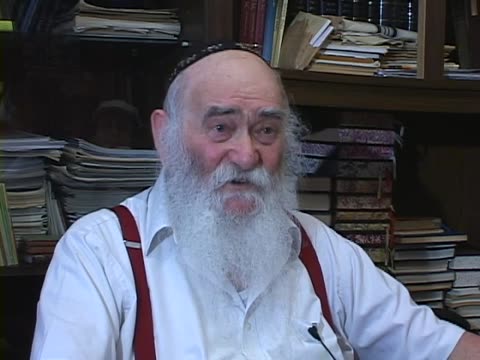
Abelsky tells a Hasidic story about a Hasid of a rebbe who visited him in a short jacket, and names the man from whom he heard the stories (name uncertain). Lemster asks about Hasidic songs on Moldovan and Romanian motifs, and Kerler and Abelsky discuss Hasidic adoption of melodies. Abelsky says he was in Romania in 1948, just after the war, where many refugee Jews lived and few remain now. They also talk about a Chabad emissary in Iași or Bucharest.
Includes talk about Hasidic songs on Moldovan motifs and Abelsky's stay in Romania, which the entry mentions only partly.
Abelsky distinguishes Hasidic and Mitnagdic customs and mentions several traditions that were originally started by Rabbi Baal HaTanya. Abelsky then speaks about Purim celebrations.
Abelsky contrasts Hasidim, who sing and are joyful, with Mitnagdim, who he says took their nigunim from Hasidim. He mentions disputes over customs such as the heated mikvah and the sharpened slaughter knife introduced by the Alter Rebbe. Kerler then asks about Purim in Chabad: Abelsky says there was no dressing up, and that drinking on Purim was limited to a measure, with stories of heavy drinking.
Covers the slaughter-knife dispute and the Purim drinking limits.
Abelsky speaks about today's generation, which he calls a generation of the messiah, and about secular Jews who are not culpable for transgressions out of ignorance. He discusses what an apikoyres (heretic) must know, with an anecdote about Abraham Mapu. He tells of a self-declared atheist, a doctor of philosophical science, who came to the synagogue to buy matzah and whom Abelsky questioned about his unbelief. Lemster comments on priests who became atheists, and Abelsky talks about a Spinoza institute in Jerusalem.
Includes the atheist-doctor anecdote and the Spinoza discussion.
A nigun is sung, a Hasidic march, with a second voice joining in with wordless refrains. Afterwards Abelsky explains that nigunim are made for the rebbe's birthday, with a committee choosing among the entries. He begins another nigun connected with the rebbe's seventieth year.
Adds the explanation of nigunim composed for the rebbe's birthday.
Abelsky sings a contemporary Hasidic nigun with a verse text, and another voice joins with wordless refrains. He then says Hasidim have no use for cantors, since their own prayer leaders are better. He mentions an American offer of twenty thousand dollars for him to lead the High Holiday prayers, and recalls cantors and the composer Tkatch, whom Abelsky says was very impressed when he heard Abelsky recite the selichot.
Adds the discussion of cantors, the American offer and the composer Tkatch.
Abelsky gives a blessing for the interviewers' work. Kerler speaks of printing the material and of returning from Romania, and the interview is wrapped up.