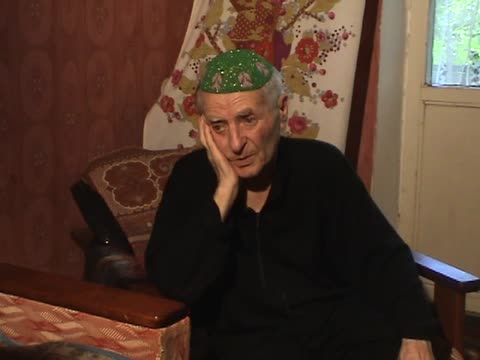
Goldman provides personal information and talks about his family. He also addresses his father's fate during World War II. Goldman's father, who was born in Cărpineni 3:05, was a merchant. His mother was born in Ialoveni. Goldman grew up with two sisters in Ialoveni.
Goldman gives his name, his Hebrew name and his birth year, and says he lived in Ialoveni until the war. He names his father, a merchant who traded at markets and was from a village in Bessarabia (name garbled, perhaps Cărpineni). He says his parents were killed in the war, his father buried alive at about age 59 and his mother at about 57. His mother came from Ialoveni and was a housewife. He did not know his grandparents and had two sisters.
The catalogue entry already covers this; the transcript adds the parents' ages at death and the sisters' names (Miriam and Roze).
Goldman speaks about his life before the war. He worked in a textile shop. During his adolescence, Goldman attended meetings of the youth Zionist organization Gordonia. He explains how he prepared for his aliya to Eretz Yisrael in 1939, but was asked by his parents to stay for another year. He then addresses his education before the war. Goldman studied with a private religious tutor for four years.
Asked about his childhood, Goldman says he worked in a textile shop before the war. He attended Gordonia meetings in Ialoveni and was due to leave for Eretz Yisrael in 1939, but his parents asked him to stay another year, and then the war began. He studied with a private Jewish teacher in the teacher's home for four years, learning Yiddish, Hebrew and prayer, with perhaps fifteen or twenty other children.
The transcript shows Lemster pressing him to recall his childhood and the size of the teacher's class.
Goldman describes Jewish life in Ialoveni before the war: many Jews lived on two streets, and he recalls two or three synagogues, later saying there were five, one of them large. His father prayed daily with tefillin and tallit and attended synagogue. He cannot say how many Jews lived there.
The transcript adds the father's daily prayer and the large synagogue, and Goldman's wavering on the number of synagogues.
Goldman talks about his life during World War II. He evacuated to Kazakhstan and was drafted for his military there and served until 1946. Goldman left the army with the rank of major. Goldman then briefly speaks about his personal life and how he met his wife Khone. They were married and lived in Ialoveni before the war and moved to Chișinău after the war.
Goldman says he was evacuated to Kazakhstan, where he was mobilised and served until 1946, and recalls serving officers up to colonel and living better than before. He says he married in 1928 (?), a date that conflicts with his birth year, and met his wife in Chișinău. Before the war they lived in Ialoveni, and afterwards in Chișinău. He does not recall Jewish weddings in his childhood.
The transcript adds that the rank of major is raised in the Russian aside and that the marriage date is given doubtfully.
Goldman addresses prewar holiday celebration at home, particularly Passover and Sukkot. He also addresses prewar religious life and his mother's holiday cooking.
Goldman describes prewar holidays at home: going to synagogue, the Passover seder at which he as a small boy asked the four questions of his father, and Sukkot, when they built a sukkah and only ate in it. He remembers little of Hanukkah, Shavuot or Purim, mentions lighting Hanukkah candles, and recalls only some of his mother's cooking. He cannot say what tatshikelekh (?) were. In the middle he asks where Lemster was during the war and speaks of Israel.
The transcript shows Lemster asking about Hanukkah, Shavuot, Purim and a Hanukkah food term, with Goldman remembering little of them.
Goldman speaks about his praying customs. He then talks about prewar Jewish life in his hometown and recalls non-Jews who spoke Yiddish. Goldman then remembers activities organized by Gordonia. According to him, twenty members were in the local Gordonia branch.
Goldman says he still prays and goes to synagogue on Sabbath, but has been ill and not gone for a month. He recalls little of his bar mitzvah or prayers. He says some non-Jews near him spoke Yiddish, as traders buying goods. He recalls Gordonia in Ialoveni, with dancing, and says it had about twenty-five members, boys and girls together. Few made aliyah, perhaps two or three, one named Shaykele Bikhman (?). He cannot recall its leaders.
The catalogue says twenty members; the transcript has twenty or twenty-five (clearly heard as 'a twenty, twenty-five').
Asked about a Yiddish library, Goldman says there was one in another town and mentions relatives there, including his father's sister. He cannot recall what he read, whether Yiddish newspapers came, or Yiddish theatre, though he says there was one Yiddish book at home. Asked about the war years, he mentions two Jews with him, one named Shaykele Bikhman (?), who is now in Israel and unwell. The passage breaks off with Goldman asking to finish.
The transcript adds that the library was in a different town and that the passage ends with a brief mention of a fellow Jew in the war years.