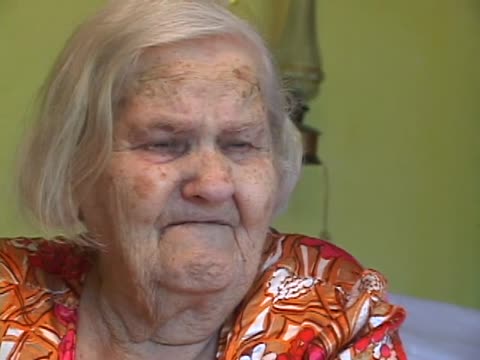
Opening identification: the interviewers confirm Dajch's patronymic and her first name. She gives her birth year as 1915 and her married and maiden surnames; Kerler then asks for her address and telephone.
Dajch provides personal information and talks about her family. Her father was born in Făleşti and passed away when Dajch was three years old. He worked as deliverer. Dajch's mother was also born in Nisporeni. She grew up with four sisters and one brother. Dajch's sister made aliyah.
Dajch gives her parents' details. Her father, a dealer who bought and sold horses, died when she was three. Her mother Reizl was also born in Nisporeni and died in the 1960s (?) in her late eighties or nineties, after raising the children alone. Dajch names her siblings: a brother killed in the war, and sisters, one of whom died in Samarkand and one in Israel. She then describes her maternal grandfather, who supplied yeast to Warsaw. Kerler states the date and place of the recording.
adds the maternal grandfather's yeast trade and the sisters' names and fates, and Kerler's statement of the date and place
Dajch discusses childhood memories of her grandparents. She also speaks about her life after her father passed away. Dajch's step-father owned a grocery shop, where she helped out.
Dajch recalls her mother's family, orphaned young and poor. Her mother kept a small shop in a house outside the village, and the children helped with small trade. She tells of a sister who worked for a tailor and of another sister's marriage to a brother of a relative. She herself attended a school and the family faced school fees.
the transcript has more on the mother's own orphaned childhood, the shop outside the village and the sisters' marriages, than the catalogue mentions of a step-father's shop
Dajch speaks about her life before the war. She attended a middle school and also worked for a tailor. Dajch then worked different jobs, including at a bank (at the age of thirteen), law office, the city hall and in Iași from 1931 until 1936. Dajch then describes her return home, to Nisporeni, to work in her sister's shop. Among otherh things, Dajch sewed clothes. Her sister was married to a chalutz and they earned money to make aliyah.
Dajch describes how she left school and was placed in a bank at thirteen (arranged through a relative), then worked for a lawyer and in the city hall. She went to work in Iași, staying until 1936, then returned to Nisporeni at her mother's wish. There she sat with her sister, whose husband joined the Zionist pioneers (halutsim) hoping to emigrate. Lemster steers her back to the prewar period.
Dajch speaks about her family's life before the war. She also remembers presentations, organized by Zionist organizations. Dajch describes how her sister and brother-in-law attended meetings for chalutzim.
Dajch says she did not attend a Yiddish school, though her brother went to cheder. She tells of lectures by Jewish students under a cultural league, which promoted emigration to Palestine, and of the books read. She describes her sister and brother-in-law's time with the halutsim. She then recounts how she and her husband returned to the village and opened a small shop.
the transcript includes the shop she and her husband opened, and the books read at the cultural events
Dajch addresses her childhood memories and education. She attended a Romanian school, starting at the age of six. Dajch then speaks about her mother's observance and describes religious customs at home.
Dajch says she started a Romanian school at six, without any Yiddish lessons. She recalls her mother's religious instruction at home and her mother's payment of dues to a committee of wealthy men, to avoid seeming poor. Kerler asks about the mother's prayers, such as modeh ani; Dajch recalls them only partly and says the mother taught in Yiddish and Hebrew.
Dajch talks about prewar celebrations of Yom Kippur. She describes how her mother practiced the ceremony for repentance ("shlogn kapores"). She then speaks about her life, including work in the city hall, before the war.
Dajch recalls the preparation for Yom Kippur, in particular the custom of swinging a chicken (kapores) which her mother performed with poor means. She describes children helping wash and dry walnuts for sale to visiting Americans. She then talks about working in an office and a fixed-price task connected with a textile firm and checks.
the walnut trade and the textile-firm episode are in the transcript but not mentioned by the catalogue
Dajch discusses her childhood memories of games. She also speaks about her family's observance and addresses her mother's cooking. In particular, Dajch remembers Yom Kippur celebrations.
Dajch describes children's games in response to Kerler's questions: stone knucklebones, sticks, buttons in a hole, and nuts. She then recalls how her grandfather brought a sugar lump from synagogue on Sabbath mornings and how the children shared it. She also covers Sabbath bread and meals and what her mother cooked, and Yom Kippur at home, including her brother's prayers. She begins to recite a poem.
adds the specific games, Sabbath food and Yom Kippur at home, and the grandfather's sugar
Dajch recites a Yiddish poem about an educated girl in Warsaw, she learned from her mother during her childhood. She then addresses her adolescence and books she read.
Dajch recites a Yiddish poem her mother taught her, about an educated girl in Warsaw too choosy about suitors, and repeats the last lines at Kerler's request. Asked about songs, dancing and courting, she says she did not dance or like balls and read Romanian books and Sholem Aleichem instead.
the transcript includes questions on songs, dance and reading, and Sholem Aleichem
Dajch speaks about her life before the war and describes how she met her husband, who spent a year in prison in 1940. She then recalls her first visit to Chișinău. Dajch also lived in Hînceştii before the war. After the war, she worked as accountant in Nisporeni and moved to Chișinău in 1957.
Dajch tells how she met her husband: he was a communist who had been in prison, and she was in Iași from 1931 to 1936. He was then drafted and they later registered their marriage without a wedding. She recalls her first visit to Chișinău, where he bought her a record and a red scarf. In 1940 he was held for about a year. After the war she worked as a bookkeeper and came to Chișinău in 1957 (heard in Russian).
the account of the courtship and the red scarf is not in the catalogue
Dajch talks about prewar Jewish life in Nisporeni, including synagogue structure. She also addresses holiday celebration, occupational structure, locals and activities of the youth.
Answering Lemster, Dajch describes Jewish life in Nisporeni: the old and new synagogues, one for the poorer and one for the wealthier, and her mother's synagogue attendance. She recalls Rosh Hashanah customs and lanterns, a brother's disapproval of a boy's bicycle, and the Jewish population with its shops, taverns and a few craftsmen. She tells of a Greek baker who was friendly to Jews and who taught her mother to trade grain for flour.
Dajch speaks about her family, particularly her mother's observance. She also mentions how her mother married off successfully her daughters. She then speaks about life before the war and non-Jews who spoke Yiddish.
Dajch speaks of her mother's piety and hard life and of her success in marrying off all her daughters, which neighbours envied. In answer to Kerler she describes the Greek neighbour Ivan Grek, who spoke Yiddish. She says her non-Jewish neighbours also spoke Yiddish with the children, and that the family lived in a mostly non-Jewish outskirt.
At Kerler's request Dajch recites again the Yiddish poem her mother taught her, about the educated Warsaw girl seeking a doctor husband. She says the mother taught it to teach the children not to aim too high. Kerler then asks about Romanian poetry.
Dajch sings a long Romanian song, about a gypsy girl and a prince, which she learned in school. Asked for a Yiddish song, she instead talks about her mother's working life and her mother's sewing. The same passage returns to her own year of apprenticeship as a seamstress.
the Romanian song itself is in the transcript, along with the question about Yiddish songs
Dajch answers questions about cultural terminology. She then speaks about her life in Iași before the war and recalls performances by Joseph Schmidt. Dajch then addresses prewar holiday celebration, specifically Purim and Sukkot. She recalls gypsy musicians and children wearing masks.
Dajch answers terminology questions, with Kerler asking for the Yiddish word for a Romanian term. She says she was in Iași from 1931 to 1936 and describes going to the national theatre there to hear Joseph Schmidt. She recalls Purim, with gypsy musicians going from house to house, children in masks and a Purim rhyme, and Sukkot customs, including the shoykhet's rounds, Hoshana Rabba and the shofar.
adds the terminology questions and the shoykhet's rounds and shofar at Sukkot
Dajch addresses prewar cultural life. She recalls cantors visiting. Dajch then talks about folk and healing customs and shares episodes when her mother practiced them.
Dajch says cantors visited the town to sing in the synagogue. Asked about the evil eye, she describes her mother's cures: pouring wax, quenching coals in water, and the ritual after a fright, including covering the child and a visit to the synagogue. Kerler asks about related sayings and songs; the passage ends with a song fragment.
the specific cures, wax, coals and covering the child, and the closing song question