Recordings › Chișinău

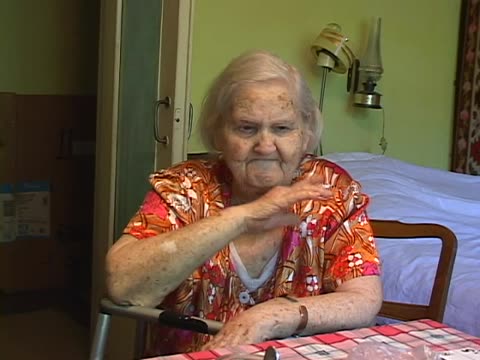
MDV 173 · Dora Abramovna Dajch

Chișinău, Moldova 2 June 2006 Interviewed by Dov-Ber Kerler, Jeffrey Veidlinger, Moisei Lemster Part 2 of 2 39 min · 8 passages

One conversation with Dora (Dvoyre) Abramovna Dajch, continuing over MDV 172, MDV 173.

Loading the player…
Passages

0:00

Dajch speaks about life today, as well as how her mother practiced folk customs.

From the machine transcript

Dajch says she cannot recite songs in Russian, since Romanian was spoken before the war and Russian came only afterwards; she says she left in 2000. She describes folk signs her mother used, such as a spinning object used to tell whether a young man would return. She also describes a home remedy of dough smeared with honey for a boil, and answers Lemster's questions about how the dough was made.

Also covers language use, her departure, and a home remedy with dough and honey.

4:02

Dajch describes a traditional wedding, including food customs, in prewar Nisporeni.

before the war Marriage and weddingsFood · MCO
From the machine transcript

Dajch recalls a wealthy man's daughter's wedding in Nisporeni, where the groom was a learned young man and the leading men were invited. She mentions the chuppah and kiddushin conducted by the shoykhet, dancing in the Casa Națională to traditional dances, and Gypsy musicians instead of klezmer. She names a few people connected with the wedding, with some doubt about the names, and does not remember the synagogues or the rabbi.

Adds the Gypsy musicians, dances, and the shoykhet performing the ceremony.

7:15

She addresses prewar cultural life, including Zionist organizations. She also talks about Simchat Torah celebration in Nisporeni and mentions the neighboring village Boldureşti.

From the machine transcript

Dajch speaks about prewar Jewish organisations in Nisporeni: many Zionists and some communists, but no Bundists. She describes Simchat Torah, with men gathering in the synagogue to drink wine and eat nuts and bread, and women sitting separately. She explains that her mother read Yiddish books brought by Jewish students from Iași and nearby Boldureşti (?), that her brother studied in cheder, and discusses amateur theater at the Casa Națională.

Adds Yiddish reading in her family, books brought by students, and amateur theater.

12:21

Dajch answers questions about cultural terminology and from the dialectological questions from the AHEYM Yiddish linguistic questionnaire. She then talks about her family.

From the machine transcript

Dajch answers questions about terms such as dybbuk and golem, and Lemster asks for words like 'a pair' and 'table'. She then talks about a child prodigy, Arkadie Pinchevski (?), born in 1930, who performed poems and plays on stage from a very young age. Lemster asks about tailors' songs, and she does not remember any.

Adds a talented child performer and a few vocabulary items.

15:02

Dajch speaks about her life and work as tailor before the war. She then sings "A sikele, a kleyne" (a small sukka), written by Avrom Reyzen.

Singing before the war Work and tradesSongs and music · MCO
From the machine transcript

Dajch tells how she apprenticed with a dressmaker, who sewed only for non-Jews, and was fed a snack after school. Asked for songs sung by seamstresses, she says she does not remember, then recites and repeats a song about a small sukkah, which Kerler identifies as by Avrom Reyzen. Lemster discusses the song's sadness and poverty, and asks for further songs about marriage.

Adds Kerler's identification of the author and the discussion of poverty.

18:00

Dajch addresses wedding customs. She then speaks about her life during World War II, which she spent in evacuation in the Caucasus and Chortoq, Uzbekistan from 1942 through 1945. Dajch was an accountant on a kolkhoz. Dajch also mentions the cities she visited after the war.

From the machine transcript

Dajch tries to recall a bridal song sung while the bride was seated at the wedding, but cannot. She then lists where she lived: Iași before the war, then evacuation in the Caucasus and Uzbekistan. She says there was no Jewish life in evacuation, worked as a bookkeeper on a kolkhoz, and gives 1942–1945 as the period, returning to Nisporeni in 1945. She mentions the cities she visited after the war.

Adds the places visited after the war and the 1945 return.

22:35

Dajch answers dialectological questions from the AHEYM Yiddish linguistic questionnaire. She also addresses prewar Jewish occupations in Nisporeni (29:40).

Questionnaire before the war Yiddish language and dialectWork and trades · MCO
From the machine transcript

Dajch answers a long series of dialectological questions, with Lemster and Kerler prompting in Russian and Romanian: greetings, 'please', luck, house and room, colours, deaf, cold, ill and sleep, believer, apostate, peasant, and others. Around 29:40 she talks about Jews in Nisporeni working the land: only one did, and a Jewish field worker is recalled. Further items include 'from where', midwife, 'on this street', river, well, potatoes, flowers, everyone, 'only Jews', attic, hazan's place, rich men, and enemy.

Adds the Jewish farmer in Nisporeni and many specific vocabulary domains.

38:05

The team concludes the interview with Dajch and she sings the beginnings of a song in Romanian.

Singing Songs and music · MCO
From the machine transcript

The interviewers wrap up and thank Dajch, who says she is not tired. Lemster asks her to sing another song; she does not remember a Yiddish one and begins a few lines of a Romanian song. She is thanked in Russian and Yiddish.