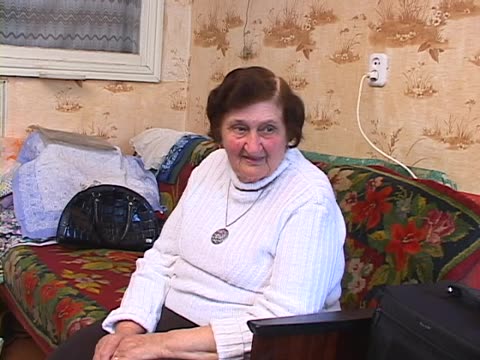
Opening of the recording. Manevich says there is only one synagogue left in Tiraspol and gives a rough number of Jews before the war. Kerler states the date and place. The interviewers and Manevich then sort out her official and home names, including the form in her passport and the name her mother and grandmother used. She says she does not know whom she was named after, and gives her age and her birth year, 1923.
The passage also covers the number of synagogues in Tiraspol and the question of her name and the person she was named after.
Manevich speaks about her life before the war. She then talks about her family. Her parents were also born in Tiraspol. Manevich's father worked at a mechanical plant. She also describes her grandparent's home.
Manevich says she lived in Tiraspol until the war and names the district where her family lived, near the militia building on Rosa Luxemburg Street. She gives her parents' and grandparents' names (the father Hershl, the mother Ite, the maternal grandparents Shmuel and Malke) and says all were born in Tiraspol. Her father worked at a mechanical plant (a locksmith or turner, she is unsure) and her mother and grandmother were housewives. She remembers her grandfather with a white beard driving a horse carriage and her grandparents going to synagogue.
Besides her parents and the grandparents' home, she names the street district in Tiraspol and recalls the grandfather's horse carriage and synagogue-going.
Manevich speaks about her family, particularly her siblings. She grew up with two sisters and one brother. Her sisters live in Israel and America. Manevich's brother, who was an officer in the Red Army, died during World War II.
Manevich says there were four children in her family: she and two sisters, Klara in Los Angeles and Rose in Israel, and a brother, Moshe, who was killed in the war. Kerler remarks that he had heard of an uncle Moshe who perished. She names her husband, Sasha. Kerler then starts asking about synagogues in Tiraspol.
Names the siblings Moshe, Klara and Rose and mentions her husband Sasha.
Manevich speaks about prewar Jewish life in Tiraspol. She also discusses her childhood memories of attending the synagogue on holidays. Manevich then speaks about her education, including subjects, at a Yiddish school. Manevich also recites a Russian poem.
Manevich says she did not count the Jews of Tiraspol, which also had Moldovans and others. She recalls going to synagogue on holidays with her mother until about age seven and then stopping when she entered school. She describes the Yiddish school, where reading, writing, arithmetic and literature (Sholem Aleichem, later Peretz and Mendele) were taught in Yiddish, with Russian lessons alongside. At Kerler's request she tries a Pushkin poem in Russian, remembering only a little, and says she has forgotten much of the Yiddish.
Adds the Yiddish literature taught (Peretz, Mendele, Sholem Aleichem) and the attempt to recall a Russian Pushkin poem.
Manevich says the pupils danced Yiddish dances at school (the sher and the freylekhs are named) under a leader who taught them. She cannot sing but could dance. Kerler asks about a song she does not recall. They then discuss how long she attended the Yiddish school, seven classes up to about age fourteen. Kerler mentions that his mother studied in a Polish school.
Manevich speaks about her life during World War II in evacuation in Central Asia. She then returns to her school education at the Yiddish school, before recalling her grandparent's visits.
Kerler asks about childhood friends and the languages of instruction. Manevich says she was taught in Russian and in Yiddish, with German and Ukrainian also taught, that geography and history were taught in the Russian school, and that literature was taught in Yiddish. At home she spoke Russian with her parents, a mix with her grandparents. She recalls her grandmother and grandfather visiting, walking with a stick, and the children leading them home. She mentions a stay in Turkey (or among Turks) during the war, but evacuation in Central Asia is not clear in the transcript.
The transcript shows no clear evacuation account, but a brief mention of speaking Turkish during the war, and it adds the languages of instruction and of the home.
Manevich speaks about her family and life before the war. She also touches upon Yiddish literature. She then talks about prewar holiday celebration at home. Manevich also lists non-Jewish holidays.
Manevich says her father read Yiddish when he had time, but her mother was unlettered in Yiddish and later learned to write Russian. Russian was the language used in the city. She names Jewish holidays she remembers (Passover, Hanukkah, Purim) and the Soviet holidays celebrated at home, such as the anniversary of the October Revolution, May Day and Constitution Day. Asked about a New Year tree, she is unsure. A discussion follows about Sholem Aleichem in Russian-letter versus Yiddish-letter editions.
Adds the father's and mother's reading ability and the Soviet holidays observed at home.
Manevich talks about her life after the war. She worked as accountant. She then addresses prewar Purim celebrations. She also mentions the Yiddish school with a library, where she studied for seven years. Manevich finished her secondary education at a Russian school.
Manevich says she worked as a bookkeeper after the war, using Russian. Asked about Purim in Tiraspol, she recalls only gift-giving (hamentashn) and says there were no Purim plays or masks before the war. She says the one Yiddish school there had seven classes, was closed before or after the war (she is unsure), and had a library with Yiddish, Russian and German books. She herself moved to a Russian school and finished her schooling there.
Adds that she recalls no Purim plays, and the library of the Yiddish school.
Manevich speaks about prewar cultural life and recalls touring Yiddish theater troupes. She also mentions performances by Sidi Tal. Manevich then addresses postwar Yiddish performances in Chişinău.
Lemster asks whether Yiddish theatre came to Tiraspol. Manevich says troupes came on tour for a week; she names a performer, possibly Sidi Tal (unclear), but does not say she saw them. After the war, a Yiddish theatre came to Chișinău, and she and her husband attended and liked the performance, though she has forgotten its title.
Adds that she went to a performance in Chișinău with her husband.
Manevich addresses her education at the Yiddish school and discusses Jewish life in prewar Tiraspol. She also briefly addresses her life after the collapse of the Soviet Union.
Kerler asks whether Jewish history and holidays were taught in the Yiddish school. Manevich says they were not, since it was a Soviet school in an essentially Russian city. She says that outside the home people spoke Russian rather than Yiddish and that a person can be Jewish without Yiddish. She mentions speaking Turkish during the war, and recalls a time in Moldova when only Moldovan was supposed to be spoken, and how the Jews were regarded by others.
Adds the discussion of Jewish identity without Yiddish and language pressure in postwar Moldova; the catalogue's remark about life after the collapse of the USSR does not clearly appear.
Manevich says she lived in Tiraspol until 1954, when her husband, a senior engineer or chief specialist, was transferred to Chișinău and the family was given a house. She now lives alone, her husband having died. Her daughter lives in Chișinău and has children, and the grandchildren visit when they have time.
The year she gives (1954) differs slightly from the catalogue's 1955.
Manevich talks about her education, including teachers, at the Yiddish school. She then addresses prewar Jewish life in Tiraspol, including occupational structure. Manevich also recalls childhood friends and describes how she met her husband. She then remembers her wedding.
Manevich names the director of the Yiddish school, Garber, and a teacher of arithmetic, and says she has forgotten others. Kerler asks about a Yiddish actor, Shloyme Mikhoels, whom she vaguely recognises. She says no Jews from prewar Tiraspol remain, that the town had Jews, Moldovans and Russians, and that she had Jewish friends from school. She tells how she met her husband, also from Tiraspol, after he returned from the war, and that they lived as neighbours. The wedding was held without a huppah, with klezmer music playing Jewish and Russian tunes and guests of mixed backgrounds.
Adds how she met her husband and that the wedding had no huppah but klezmer music.
Answering Lemster, Manevich says she had relatives, rich people whose property was taken by the Soviets, apparently in Bender. She says there was no contact across the border, which was closed, until after the war when they visited Bender and found them. She says she lived in Tiraspol and recalls the years in the 1960s, adding that before the war the family did not travel, though Lemster asks about going to the sea.
Manevich says her mother died in Chișinău and is buried in the Jewish cemetery. Her father was taken in the war and listed as missing, so his grave is unknown. She and her family visit the graves to tidy them and place flowers. Kerler and Lemster ask what she says there, and she answers that she speaks to God daily and asks for what she needs. She says she knows God by the name Hashem, the interviewers mention other names, and she discusses whether the dead can help or hear and her belief that only words remain.
The catalogue mentions only brief wartime life and religious customs; the transcript centres on the parents' deaths and burial and on her belief about God and the dead.
Manevich answers dialectological questions from the AHEYM Yiddish linguistic questionnaire. She also speaks about contemporary religious life and talks about Jewish life in Birobidzhan.
A short elicitation: Manevich is asked how to say a given Yiddish sentence, and she says she may forget Yiddish for lack of Jewish company. Kerler asks whether she knows the rabbi's wife and the rabbi (Rabbi Zalman) of the synagogue in Chișinău. Asked about Birobidzhan, she recounts that people went to Israel and returned to Birobidzhan. She says her sister lives there. She then comments on conflicts in Israel and Egypt and on violence everywhere, as she sees it on television.
Adds the talk about the rabbi and rebbetzin and the views of Israel's conflicts.
Kerler asks whether Manevich remembers the NEP, which she identifies as Lenin's new economic policy, but she says she does not remember it. She says there were no merchants or wealthy Jews in prewar Tiraspol and that people worked in factories. Life before the war was ordinary Soviet life, she says, with few good things to recall. She describes the war years as bad, and the postwar years as hard.