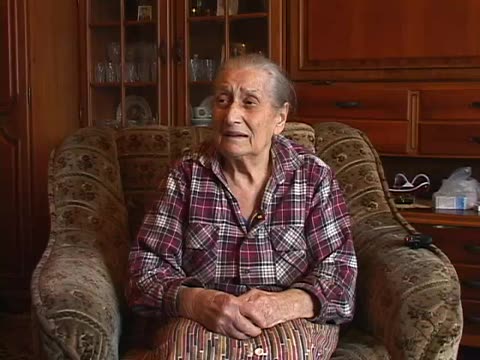
Kerler and Lemster settle in at the start, and Shmid is asked in which American city her brother lived (New York). She names him as Moshe Glikman (?) and mentions his two sons. Kerler then announces the date and place of the interview as the last of the expedition.
Brother in New York, the date and the setting of the interview.
Shmid gives her Yiddish name (Khayke), which was changed to Khaya in Russian, and her birth year (1917 (?)). Kerler also asks for her telephone number.
Shmid speaks about her family. Her brother moved to America in 1916. She raised one daughter. She then addresses her childhood memories of her family's life, specifically her father's work in agriculture.
Shmid says she knows of her brother's departure for America in the mid-1910s only from her mother, and that she raised one daughter, now dead. Kerler asks about her childhood in Onitskan: her father Pesakh worked on the land and kept a village shop with kerosene, oil and manufactured goods. She was the youngest of seven children, and names her sisters Rakhel and Manya and her brothers Yisroel and David.
Names the siblings and describes the father's shop alongside his work on the land.
Shmid addresses prewar holiday celebration at home. She recalls going to synagogue services on Yom Kippur in Chișinău. She then speaks about her life and education before the war. Shmid attended a primary school at the age of seven. After finishing four years of school, she moved to her sister's in Chișinău and continued studying. Shmid's sister owned a bakery.
Shmid says her family went to the city for the High Holidays and synagogue, while Passover was spent at home with matzo bought and a chicken slaughtered. She started school at seven. After four village classes she moved to her eldest sister Rakhel in Chișinău and continued studying there. Rakhel owned a bakery.
Shmid speaks about prewar Jewish life in Onitskan Orgeyev and describes her father's work. Shmid's family owned a shop. According to her, three families lived in the village. She then speaks about prewar Passover celebrations at home.
Shmid describes Onitskan as a small village, not a district centre, where her father worked the land and ran a shop, travelled to the city for goods, and the sons later helped him. Kerler asks how many Jewish families lived there (the answer is unclear). Shmid describes the Passover seder at home with her father leading, and her brother David's names.
Passover seder at home and the brother David's names.
Shmid talks about her family. She describes how her parents met in the village. She then talks about her life at the beginning of World War II, when she evacuated. Shmid returns to her family and also addresses life today.
Shmid names her mother Faige, who finished gymnasium, and remembers how her parents met. She cannot recall when her mother died. She says her parents and brothers were evacuated from the village, and mentions her son-in-law Misha, who lives with her. Kerler establishes seven children (three sons, four daughters) and asks about a visit by her brother from America and about her grandmother.
Covers the visits of the American brother and her grandmother.
Shmid recalls childhood games with little stones and says her mother Faige, who came from Chișinău and had finished gymnasium, sang well, although she cannot recall the songs. She says her parents met at a wedding. She speaks of her sisters' marriages and of her brothers: David worked in the village and Yisroel went to the daughter in America, where he died.
The mother's singing and the fates of the brothers, including Yisroel's death after a trip to America.
Shmid talks about her life in Chișinău before the war. She attended a Yiddish professional school. Shmid was married in Chișinău. She also touches upon her education at the professional school.
Shmid says she met her husband Aron, a native of Chișinău, while living at her sister's, and married before the war (?). She attended a vocational school in the city and says she learned Yiddish there but Romanian in the village school. Kerler asks about the languages of instruction (the answers vary), and about her reading Yiddish books and using a library.
The husband Aron and the languages of the vocational school.
Shmid talks about her life today, as well as her family. She then speaks about prewar holiday celebration in her home village. Shmid describes how the community hired a cantor for Rosh Hashana. She then addresses Purim celebrations in Onitskan Orgeyev and Chișinău.
Shmid says her late daughter and son-in-law Misha lived with her, and she lives with him now. In Onitskan there was no synagogue; a cantor was hired for Rosh Hashanah and Yom Kippur and services were held in the mill, and afterwards people emptied their pockets. She remembers little of Simchat Torah, and for Purim speaks of baking hamantashen and sending sweet gifts. Few Jews lived in the village. She does not know what a Purim shpil was.
Covers Rosh Hashanah and the cantor in the mill, Simchat Torah, and her life with her son-in-law.
Kerler asks about her life in Chișinău before the war, but Shmid remembers little. She says she lived at her sister's, studied at the vocational school, and had Jewish friends from the district. Kerler clarifies that the Orgeyev district (zhudets) is larger than a raion. She talks about reading and the Yiddish theatre and photographs from Israel and America.
Friends, reading, Yiddish theatre and photographs.
Kerler puts questions about the meaning of cultural terms: dybbuk, golem (including a clay golem) and Litvak. Shmid answers hesitantly, giving Russian equivalents and Yiddish explanations for some and not knowing others. The talk is mostly Yiddish with a few Russian prompts.
Shmid talks about her life after World War II. She then describes her traditional wedding before the war. Shmid then talks about her family's life and holiday celebration before the war. Shmid particularly points to her parents' observance. She also addresses again how the community hired a cantor on the High Holidays, who performed in the local mill. She explains how a room in the mill was turned into the prayer room.
Shmid says the postwar years were hard after the evacuation, with no house on return, and she cannot recall much about the prewar years. She describes her wedding after the war (?): the chuppah, friends, dancing, kugel and fish, and breaking a plate at the engagement. She speaks of her devout parents, who took the family to the city for the High Holidays, and again of the cantor in the mill, where a room was made into a prayer space. Lemster asks about wedding dances and customs.
Wedding details and the postwar return, and the synagogue made in the mill.
Shmid says she has not sung since her daughter died, though she once sang at home. She talks about life today and her memory. Kerler asks about her engagement: the tenaim were written and a plate broken, with no dancing at an engagement but dancing at the wedding, and the interval before the wedding varied.
At Kerler's request Shmid describes how she makes gefilte fish: cleaning, boning and chopping the fish, adding many onions, eggs and matzo meal, with only a little pepper, salt or sugar. She says sweet fish was the custom at weddings. Lemster asks about stuffed derma, which she never made, and about stories of Hershele Ostropolyer, which she has heard of but hardly read.
Shmid mentions her son-in-law and then answers Kerler's questions about drinking in the village: Jews drank on holidays but were not drunkards, unlike the non-Jews. Her father took a small glass on Sabbath. She calls her parents' home very Jewish, and says the family went to the city for Rosh Hashanah and Yom Kippur, staying with relatives and later with the married children in Chișinău.
Starts with her son-in-law and adds the Sabbath drink and the family's observance.