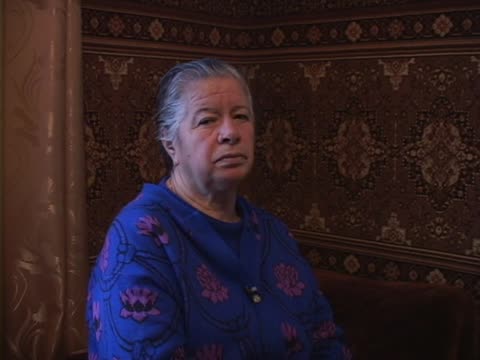
Kleyman talks about prewar Jewish life, in particular occupations. She talks about Jews who worked the field and answers questions about cultural terminology. Leibovna Kleyman.
Kerler asks what village Jews did for a living. Kleyman says there were few craftsmen, only some tailors, and that many Jews worked the land and threshed alongside others. She mentions her family's poverty and her father's aunt, who left many daughters. Kerler then asks terms for a peasant, a tsadik and a rabbi, and Kleyman discusses how Yiddish differed between Latvian, Ukrainian and Bessarabian Jews.
Also covers a terminology exchange about peasant, rabbi and tsadik, and comparison of Yiddish dialects.
Kleyman discusses traditional weddings. She then recalls what her mother-in-law told her about prewar Jewish life in Lipcani. She also addresses Jewish culture. about cultural terminology.
Kleyman discusses traditional Jewish weddings, which she says were the finest, including a wedding she attended as a girl in Briceni. She describes the wedding pastries and the flodn, and explains a flodn ingredient. She recalls what her mother-in-law said about Jewish merchants in Lipcani before the war. Katz asks about writers, theatre and the film or cinema in Lipcani, and Kleyman says she was a child then. Kerler ends by asking about folk remedies against the evil eye.
Also includes wedding food and the flodn recipe, and Katz's questions about writers and theatre.
Kleyman answers questions on folk healing: a spoken charm against the evil eye, used by non-Jews, and a Jewish woman's story about asking a rebbe to perform one. She tells how her infant sister fell ill after a wedding and was cured when a non-Jewish woman performed a charm and quenched coals. Kerler then returns to wedding customs, asking about the entertainer and the songs her mother sang.
Also includes the story of her infant sister's cure and the wedding entertainer.
Kleyman talks about her life during the war. She was imprisoned in the Bershad ghetto. She describes her life after the beginning of World War II. She came through Balanivka on the way to Bershad. She recalls that many people were forced to work Mykolaiv and Tulchyn. Kleyman states that whoever was sent to work under German command did not return. Kleyman explains how they were under German command and sent to the Kasarulitser* forest, Moldova, where she escaped a mass shooting.
Kerler asks Kleyman to tell her war experience. She describes being driven to Balanivka and then Bershad, where they were in the ghetto. Many were taken to work in Tulchyn and Mykolaiv and did not return. She also recalls a forest where Germans on one side and Romanians on the other, at a bridge, had people sent to a shooting. Her brother-in-law was a gymnasium graduate. The transcript is partly garbled.
Adds Kleyman's brother-in-law and her comments on Germans and Romanians at the forest bridge.
Kleyman talks about hardship today: the small quarterly payment from Germany that Jewish survivors receive, her expenses for soap, utilities and gas, and aging acquaintances who are sick or paralysed. She complains that non-ghetto survivors get nothing and contrasts Germany's treatment of Jews with the poverty here. Her son went to Germany six years ago and is an immigrant there. Katz questions her about the sums.
Kerler asks about the war years and a camp, and Kleyman says she was in Balanivka for a year, then Bershad ghetto until the war ended; she returned home in 1944 or 1945 (unclear). She names three villages near Bershad. Kerler asks about a song on the Bershad ghetto and then moves toward the dialect questions.
Also includes Kerler's question about a ghetto song and the names of nearby villages.
Kerler and Katz run the dialectological questionnaire. Kerler gives items in Russian and Kleyman translates into Yiddish. Items include household objects, animals and body parts, adjectives and adverbs, sentences, numerals and months, and religious and moral terms. Also covered are praying and a convert, rivers and place names, potatoes and flowers, and a few forms of 'we' and 'you'. Katz adds terms for fields and a fence, a face, and the Hebrew-derived words for gehenna and wealthy man.