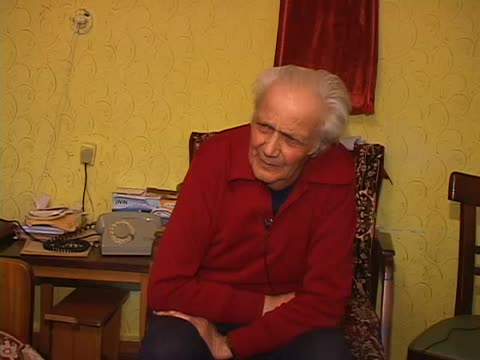
Sharhorodskij talks about contemporary Jewish life in the region. The formal interview then begins and Sharhorodskij provides personal information. He also speaks about his family. His father, who was born in Rîbniţa, worked as tradesman. His mother was born in Rîbniţa. Sharhorodskij then talks about his grandparents, who lived in Tiraspol. Sharhorodskij grew up with two brothers, one of whom fell ill with scarlet fever in 1937, and a sister, who passed away in 1958. His oldest brother was drafted into the Red Army in 1939. Sharhorodskij continues that his brother was mortally wounded during the liberation of Crimea and died at a hospital in 1944.
Sharhorodskij answers Kerler's questions on the number of Jews today in Israel, America and Moldova (a few towns, with only a few thousand left). After the formal introduction he gives personal data: born in Rîbniţa, as were his grandfather, grandmother and father. He names his parents and grandparents, with his maternal grandparents living in Tiraspol. He tells of his brother Shmilik, who died of scarlet fever in 1937, his sister who died in 1958, and his eldest brother Moshe, wounded in the war and dead in 1944.
The opening talk compares numbers of Jews in Israel, America and Moldova and mentions Russian-language switching; he also names his mother and maternal grandparents.
Sharhorodskij addresses his childhood memories and education. He attended the Rîbniţa Yiddish school for seven years and mentions subjects and teachers. The finished his school education at a Russian school.
Sharhorodskij recalls studying at the Rîbniţa Yiddish school, which he describes as a ten-class school. He names teachers (Markus for Yiddish literature, Garber for mathematics and physics, Khane for chemistry and Russian, and Kardonskij, a German teacher). He says Kardonskij warned the pupils that German would be of use if they ever met Germans.
Teacher names and subjects, with the German teacher Kardonskij.
Sharhorodskij speaks about his life during World War II. He was confined to the Rîbniţa ghetto in 1941. Sharhorodskij recalls how the Germans opened up a hospital outside the ghetto in 1943. Sharhorodskij explains how he worked at the hospital as trained carpenter for eight months. He also worked as translator for the Germans.
Sharhorodskij tells of the Rîbniţa ghetto under German and Romanian occupation. In 1943 the Germans converted an agricultural school building into a hospital and demanded carpenters from the ghetto. He worked there for eight months and picked up spoken German from the lessons he had had before the war, which led to his being used as a translator.
Details of the hospital in the converted school and his translating for the Germans.
Sharhorodskij returns to his school education, including the principal, who was deported in 1937. He then speaks about Rabbi Yosef Ber, who was deported in 1937 during the period of Stalinist political terror, according to Sharhorodskij. He then speaks about other teachers.
At Lemster's prompting, Sharhorodskij returns to the Yiddish school and its director, Yakov Pogorelskij, who was arrested in 1937. He speaks of Rabbi Yosef Ber, also arrested in 1937 and never seen again, and of the fate of his children. He then describes the teacher Fanya Borisovna, who taught Ukrainian, and remarks on how modestly people lived before the war.
Adds Rabbi Yosef Ber, the arrests in 1937, and the teacher of Ukrainian.
Sharhorodskij talks about prewar Jewish life in Rîbniţa, in particular his neighbor. Sharhorodskij then recalls what he studied in Ukrainian literature class, German class and Yiddish literature class. He also speaks about Yiddish writers.
Sharhorodskij talks about a neighbor who was a German prisoner of war in the First World War and did not expect the Germans to kill Jews, and about those who evacuated. Kerler asks what he learned in Ukrainian and German classes; he names Ukrainian writers (Shevchenko, Franko, Lesya Ukrainka, Marko Vovchok) and Yiddish writers (Sholem Aleichem, Peretz, Bergelson, Pfeffer), recalling the lives of Sholem Aleichem and Mendele.
A neighbor's wartime story, evacuation, and what he studied in Ukrainian, German and Yiddish literature.
Sharhorodskij talks about prewar Jewish life in Rîbniţa. He states that the synagogues were closed down in the late 1930s. Sharhorodskij describes the activities of a Yiddish club in place of the synagogue. He mentions peaceful relations among ethnic minorities.
Sharhorodskij says Rîbniţa had three or four synagogues before they were closed in the late 1930s, and that one became a Yiddish club with readings, performances and dances. He says there were more than three thousand Jews in town and that Jews, Moldovans, Poles and Ukrainians lived peacefully, each with its own school. He answers Kerler about his father's prayer and says he knows no Hebrew.
Adds the number of Jews and his father's prayer habits.
Sharhorodskij speaks about holiday celebration, including Purim and Yom Kippur, at home before the war. In particular, Sharhorodskij recalls his mother's baking and cooking.
Sharhorodskij answers Kerler's and Lemster's questions on how holidays were kept at home. He mentions Passover, Shavuot and fasting on Yom Kippur, and describes his mother's baking for Purim and the dishes she cooked. He does not remember the recipe for the fish dish.
Adds Passover and Shavuot, fasting on Yom Kippur, and his mother's cooking.
Sharhorodskij talks about his family, particularly his sister. He also mentions again his German literature teacher and addresses his parents' observance.
Sharhorodskij speaks of his sister Frume, who finished school in 1941, studied law after the war, worked as a notary, married in 1958 and died of tuberculosis. Her daughter lives in Israel with her family. Kerler asks about the neighbor Shepsl who served the Germans. Sharhorodskij also describes his parents' observance: his mother's Friday candles, his father's prayer shawl worn in the kitchen after the war, and the seder.
Adds his sister's later life and the neighbor Shepsl.
Sharhorodskij addresses his school education. He explains how his school was transformed into a Russian school in 1936.He speaks about History and Literature at the Yiddish school.
Sharhorodskij says he studied seven classes at the Yiddish school, which was closed in 1936–37 because few Jews were sending their children, and became a Russian school. He talks about the teachers' retraining, the fate of the literature teacher Markus, who he says went to the war and did not return, and the Jewish history lessons (Egypt, Mesopotamia). He also recalls how holidays were described in class.
Adds the school's change to Russian, the retraining of teachers and Jewish history lessons.
Sharhorodskij discusses his childhood memories and holiday celebration. He then speaks about postwar religious life, particularly the Rîbniţa rebbe, Chaim Zanvl Abramowitz. He mentions the rebbe's work as kosher butcher in postwar Rîbniţa. Sharhorodskij also recalls the rebbe from the Rîbniţa ghetto and how he went to forced labor services. Sharhorodskij then describes secret services with the Rîbniţa rebbe in the ghetto, as well as the rebbe's bathing in winter after the war.
Sharhorodskij recalls that Jewish children all came to school on Yom Kippur, and that matzo was baked at home. He talks about Rabbi Chaim Zanvl, a learned man who studied in a Romanian yeshiva and acted as shochet after the war, and about his hidden prayers in the Rîbniţa ghetto. He tells of his departure for Israel (?) and then America, his winter ritual immersion, his illness and death at about ninety-five, and how others saw him as a fanatic.
Details of the rabbi in the ghetto, his emigration, ritual bathing in winter and death.
Sharhorodskij speaks about Rabbi Yosef Ber and his deportation. He then speaks about prewar cultural life and his family, in particular his observant sister.
Sharhorodskij speaks about Rabbi Yosef Ber, arrested at night; he knew of it only from his mother, as he was a child of about fourteen or fifteen. He answers questions about a library of Yiddish books and says his father did not read. He then turns to his sister Frume, whom he describes as devout and honest, and begins a story of her behavior in the ghetto.
Adds the Yiddish book library and his sister's conduct in the ghetto.
Sharhorodskij speaks about his family's life in the Rîbnita ghetto. In particular, he describes how his father went to the market twice a week and received help from his former business partners. Sharhorodskij also speaks about his sister's career. She lived in Israel.
Sharhorodskij describes ghetto life: Jews could leave for the market for an hour on two days a week, and his father met old business acquaintances who helped. His sister, whose name appears as Perele, quietly brought food to their mother, and she graduated from an institute in 1944 as the top student. He mentions letters exchanged with her in Israel, her language ability and her schooling, and Kerler asks where she lives.
The name Perele (?), the letters from Israel and his sister's institute graduation.