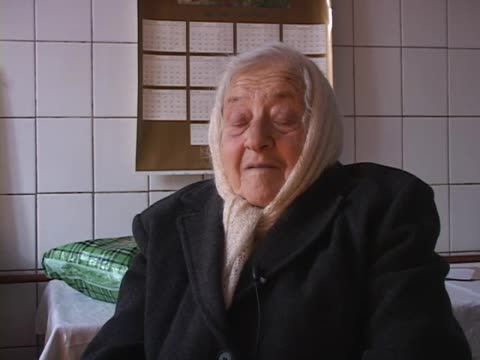
Magetman answers dialectological questions from the AHEYM Yiddish linguistic questionnaire.
From the machine transcript
Magetman answers dialectological questionnaire items. These cover sentences to translate and the words for attic, vagon and plural forms, dreydl, 'a good person' and the cantor's lectern. She also gives words for a fence, 'face', suddenly and 'enemy'. Katz repeats items and checks her forms, and S3 prompts in Russian.
The team concludes the interview with Magetman. She talks about her family. Her sister lives in Israel.
From the machine transcript
Katz closes the questionnaire and praises Magetman's memory. She declines to tell more but names her family: her father's siblings, of whom one brother, about ninety, lives in Chicago, and her mother's four sisters and brother. Only her sister, in Israel, survives with her children. Katz then announces the date and begins the interview with Plotnik.
Katz's opening of the Plotnik interview at the end
Plotnik, nee Vereta, provides personal information and talks about her family. Her father was also born in Dumbraveno and owned land and an inn. Her mother helped out with the inn in Dumbraveno. Plotnik grew up with one sister. Plotnik worked as a telephone operator.
From the machine transcript
Plotnik gives personal information. She was born in Dumbraveni near Soroca on 25 February 1926 and lived there until the war. Her father Tankhum Vereta had ten hectares of land and an inn, and her mother worked with him. She recalls her grandmother and her sister Yente, who was four years older and died in 1996. She worked as a telephone operator after the war, and her father died when she was seven.
names her sister Yente
Plotnik talks about her childhood memories and prewar life in Dumbraveno. According to Plotnik, there were five synagogues (e.g. tailor's and German synagogue) and five hundred houses in the village. Plotnik's father passed away in 1934. She then talks about commemorating her father and returns to discussing prewar Jewish life. Her parents hired a private religious tutor during her early childhood.
From the machine transcript
Plotnik recalls the village before the war, with about four hundred houses and five prayer houses. She names the tailors' synagogue, the German synagogue, the rabbi's, a klayzl and the one where her father prayed. As the girl, she said kaddish for her father at age seven, since there were no sons. She remembers little of cheder or of religious learning, and her sister studied at the Jewish gymnasium in Soroca.
gives the names of the five prayer houses and the kaddish for her father
Plotnik discusses holiday celebrations, in particular Sabbath. She then talks about prewar Yiddish cultural life and mentions a local Yiddish library.
From the machine transcript
Plotnik describes her mother lighting Sabbath candles and her father's languages: Hebrew, Russian, Romanian and Yiddish. She mentions a Jewish library in Dumbraveni run by the community. She says nothing is left from before the war and begins to tell of being driven from her home.
Plotnik talks about her life during World War II. She recalls the beginnings of German occupation, when she and her mother were forced out of their home into the Rublenita ghetto. The Yiddish school in Soroca, her sister attended, was evacuated to Uzbekistan. Plotnik states that before her sister evacuated, she went home to ask her mother to join. Plotnik continues that her mother refused because she rather wanted to stay home than being a servant. Plotnik then talks about their forced marching through the village Rublenita, for ten days, the Bălți prison, for one night, and Vertiujeni for ten days. Plotnik adds that her grandmother lived in the village Lublin, nearby Vertiujeni. Plotnik then talks about the horrendous journey from Vertiujeni to Cosauti (by the Dniester River). On the way, her mother died and was thrown into a ravine, according to Plotnik. In Cosauti, Plotnik stayed for one night and then crossed over to Transnistria, toward Zugovka (Berezovka?) 34:50. She recalls shootings and the killing of a child, as well as remembers how she was received with food by the Jewish community of Zugovka. On the way to the ghetto Bershad, Plotnik joined a family, Friedman, from Dumbraveno. Before Plotnik reached Bershad, she stayed in a village of a former kolkhoz. She then talks about life in the Bershad ghetto, where she lived with locals, as well as the family from Dumbraveno. Plotnik maintains that she left the ghetto to beg for food for one year, before she worked at a liquor factor near Bershad. In order to get access to the factory, Plotnik dressed as a Christian. Plotnik recalls how the family's mother attempted suicide, while she went to get water for potatoes. Plotnik explains how she took care of a child.
From the machine transcript
Plotnik tells of the deportation. She and her mother were driven from their house and held in a courtyard, then marched through Rublenita and the Bălți prison to Vertiujeni. Her sister had been evacuated to Uzbekistan with the school. Her mother, who was sick, was thrown into a ravine on the road, and Plotnik crossed the Dniester near Cosauti. She tells of a child killed by a soldier and of being fed by Jews at Zugovka, then continues to Bershad with a family from Dumbraveni. There she lived with a family and begged for food for a year. She worked near a liquor factory dressed as a Christian and tells of the dying child Dudele.
gives many details: the child killed at the Dniester, the deaths in Bershad, the factory work
Plotnik talks about life after the ghetto, when she returned home from the Bershad ghetto. She then talks about her family's life after the war, as well as her son.
From the machine transcript
Plotnik tells of the Bershad ghetto: the deaths of the mother and a child, and of Dudele's father. She also tells of a boy Brie, whom she cared for and who was taken in by a woman, and of how she later reunited him with relatives. She speaks of her husband, who died after three years of marriage, and of her son, who studied at an institute in Rostov, married in Russia and moved to Kishinev. She tells of her grandson, who knows five languages, and says she has endured a great deal.
the case of the child Brie and her son's life
Plotnik talks about her life after the war. She worked as a chief telephone operator for forty-five years. She then talks about her family's life before the war, in particular her grandmother.
From the machine transcript
Plotnik says she worked as a telephone operator for forty-five years and as chief operator, without any complaint against her. She talks about her grandmother, who stayed with a son in Lublin and came to visit, and about her prewar Jewish home. Her father led the Passover seder and sang well, though she does not remember the singing.
Plotnik discusses holiday celebrations, in particular Rosh-Hashana and Yom Kippur. Plotnik maintains that she would even fast on Yom Kippur in the Bershad ghetto, despite the little opportunity to obtain food.
From the machine transcript
Plotnik describes the High Holidays before the war. Her mother prayed in the women's section as a prayer-leader, and the family had a field with nut trees. She fasted from age seven and describes the meal before Yom Kippur and the tea afterwards, and the words for these. She says that in the Bershad ghetto she wanted to fast and to eat, and mentions begging.