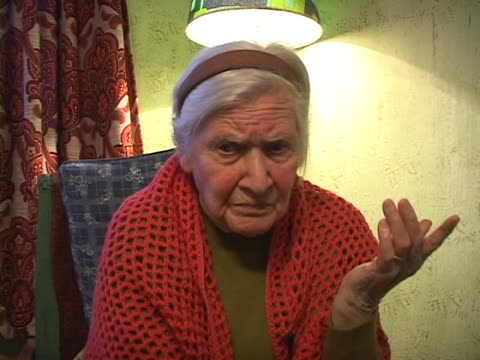
Rolshut briefly talks about life during the Great Hunger in 1932/33. She recalls how Jews tried to escape to Russia across the frozen Dniester. She then talks about prewar cultural life, in particular Jewish writers visiting Soroca.
Rolshut finishes recounting a group of Jews who tried to cross the frozen Dniester to Russia in the early 1930s and were shot by soldiers on the bank; a friend of her sister was among them. Kerler then asks about Yiddish writers: none lived in Soroca, but many in Bessarabia, and lecturers came to town. She does not remember names, including that of Moyshe Altman. Kerler then hands the vocabulary questions to Lemster.
Kerler asks about Moyshe Altman and hands the questions to a colleague.
Rolshut discusses her leisure activities before the war and recalls theater perfomances. She then answers questions about cultural terminology and talks about her travels before the war.
Kerler and Lemster explain the Russian-to-Yiddish translation task, and Lemster asks if she remembers poems and whether she had a friend. Rolshut describes prewar leisure in Soroca: walks, the park, cafés, the cinema, Yiddish and Russian theater and visiting concerts. Lemster asks about the phrase "a good Jew" and a tsadik; she says there were none in Soroca and defines a tsadik as a good man who gives blessings. She mentions visits to Chișinău and Bucharest with acquaintances.
Includes questions on the term for a tsadik and her travels.
Rolshut answers Lemster's dialectological questionnaire, translating Russian prompts into Yiddish, with S2, S3 and Kerler helping. Items include greetings and times of day, "please", "excuse me", wedding congratulations, "mouse", sick versus sleeping, honest, pious, cross and apostates. Further items include a sentence about sitting, "before me", the synagogue, "grandmother" and a sentence on three people arriving. She repeatedly says she has forgotten much Yiddish. She also mentions a convert acquaintance and a relative who married a Russian and converted.
Prompted by Lemster to talk about her husband, Rolshut says she met him through a friend from her Romanian school, who was his sister, on a visit to a nearby town (the name is unclear). He studied at an institute in Iași, was mobilized and served at the front, and came back from Germany in 1945. She joined him there, where their son was born. She describes him as a loving husband and good father; he did not read her poetry.
Rolshut talks about traditional weddings until 1940, as well as life before the war in general. She recalls the local water carrier and the execution of Jewish communists.
Rolshut says Jewish weddings with a chuppah and a rabbi were held in Soroca until 1940; she attended friends' weddings but cannot recall the songs or dances. She and Lemster discuss whether the town had a madman, klezmers and the water carrier she remembers filling a vat in her parents' kitchen. They touch on handsome young men and women of the town and Jewish communists. She recalls a group of Jewish communists shot on the Dniester bank after a non-Jewish guide betrayed them. Lemster mentions the poet Yasik Baltsan(?).
Rolshut says she has many acquaintances and childhood friends from Soroca in New York and Brooklyn; the name Tendler comes up in connection with a Jewish newspaper. She worked as a laboratory assistant for about thirty years. Lemster asks whether Jews were admitted to hospital at night; she says Jewish doctors worked there but there were no Jewish patients. She notes that many Jews lived in Soroca until 1940, few remained after the war, and many of those emigrated.
Rolshut talks about her life during the war. She was imprisoned in the Rîbniţa ghetto from 1941 to 1944. She recalls daily life in the Romanian-occupied ghetto, when prisoners were allowed to leave the ghetto to buy food at the market between 11 and one o'clock. Rolshut also remembers how people were forcibly gathered, as well as helpful non-Jews. She then describes how she escaped the ghetto, but eventually she joined a forced labor unit to work on the Ulmu state farm (sovkhoz). Rolshut continues that she fell ill with typhus and was sent back to the Rîbniţa ghetto. According to Rolshut, Bessarabian Jews were ordered to return to Bessarabia by Ion Antonescu. She escaped the group and stayed in 38:15. She then returned home to Soroca.
Rolshut recounts the war years in the Rîbniţa ghetto under Romanian guards, where Jews could go to the market only for a couple of hours, and gendarmes once took some Jews away. She tells of being sent toward a bridge over the Bug where Germans were, of two brothers hanged for trying to escape, and of the order that Jews over fifty be removed from the ghetto. She was held briefly in a stable and an attic, then sent to the Ulmu sovkhoz, fell ill with typhus and was taken back to Rîbniţa. On Antonescu's order Bessarabian Jews were sent back; she and a companion left the column, stayed with a family in a village and walked home to Soroca.
Details of the Bug bridge group, the hanging of two brothers, the over-fifty order and the walk home.
Rolshut talks about her return to Soroco after being imprisoned in the Rîbniţa ghetto. She explains how she got in touch with her then boyfriend. Her parents and siblings joined Rolshut in 1945 and then moved to 39:51.
Rolshut describes finding her house in Soroca empty and full of feathers from torn pillows, and starting to work. She then found her boyfriend, whose family had been evacuated, by letter to the front, and they corresponded in Russian. His parents came to Soroca in 1944 and her own parents, sister and brother in 1945. He visited in autumn 1945 and went back to Germany. Lemster asks about two surnames of writers, which she does not know.
Asked by Lemster how she lives today, Rolshut says she has a pension, including a German pension. Lemster then asks about Yiddish curses and blessings, and she repeats a few formulas she does not know well. Lemster thanks her and closes the interview.
The latter part is a request for curses or blessings; no family photographs are identifiable in the transcript.