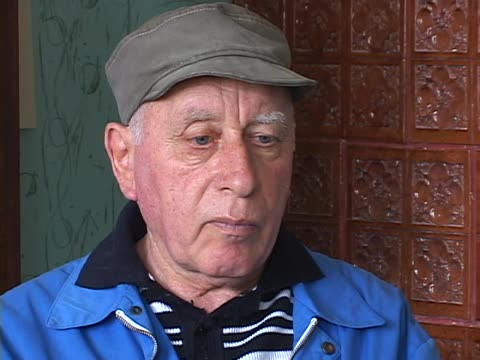
Questionnaire session with Meir, with Lemster asking for Yiddish equivalents of Romanian words and phrases. Items include greetings, thanks and please, colors, building terms, a house and window, adverbs such as early, late, near and far, and some religious-institution words. Also covered: words for the wealthy, a cart, 'whose', and a few sentences to translate. Romanian and Russian are mixed in.
The session includes many Romanian prompts and glosses, with a second voice answering.
David talks about prewar Jewish life in Botoșani. He then speaks about his work as a basketball coach and his contemporary activities as the head of the community, as well as contemporary Jewish life.
David talks about his work for the Jewish community in Botoșani. He recalls an episode involving his sick mother and a kosher butcher, mentions that he was a professor and coach of basketball who travelled to other countries, and describes the Jewish bath and mikveh. He describes how, as community head, he arranged Passover and Yom Kippur meals, a children's club, and help with the municipality, and speaks of the small number of remaining, elderly Jews in Botoșani and other Romanian towns. Lemster asks why he gives himself so wholly to the Jews.
Also covers the community's present size, its meals and its children's activities, and a question from Lemster.
David talks about his family. His father David was a kosher butcher and his mother a tailor, and he had two brothers who live in Israel. He names his grandfather, a shoemaker, and his grandmother, and remarks that his father was observant. Kerler and Lemster ask about names and relatives.
David explains why he does not move to Israel and speaks of his satisfaction in the local Jewish community. He also recalls how his mother prepared fish and holiday dishes, and describes dishes he prepared for the community, including varenikes and a Botoșani specialty.
Gives his reasons for staying in Romania, which the catalogue summary only implies.
David talks about his family, in particular his father's observance. He also talks about contemporary religious life and Sabbath celebrations, including food customs, at home before the war.
David talks about his father's observance and his own lapse and later return to synagogue attendance as community president. He describes the weekly Sabbath kiddush and what Friday-night and Sabbath customs and food looked like in his mother's home, including fish, soup, challah and the koshering of meat. In answer to Kerler's questions he names his grandparents and gives their death years and ages.
Includes his grandparents' names and death dates, and the Sabbath food.
Lemster asks about Maccabi and prewar Jewish sports, and David recalls the sports clubs and his brothers' travels. He then talks about present Jewish life: the local community president, abandoned Jewish houses, Hanukkah celebrations with children, and support for mourners and kaddish.
Includes Hanukkah events and support for mourners today.
David speaks about his mother's teaching and about his father, then turns to Jewish life today: an elderly woman professor, the community president Salomon and his temperament, the fate of former Jewish houses, a visit to Debrecen with the federation president, and the medical aid the federation gives to elderly members.
David discusses his childhood memories and life during World War II. He recalls how he traveled with his father to the surrounding towns and went to the market.
Kerler asks David about his childhood before and during the war. He recalls first and second grade, his father's forced labor digging trenches, the closing of schools, and the deportation train from Iași, and tells of hunger and shortages, shopping for food in a market square near the family's home, and non-Jewish neighbors. He also describes heating with wood and the restrictions of the Ceaușescu years.
Also covers hunger, shortages and neighbors; the catalogue's travel with his father is not clearly heard.