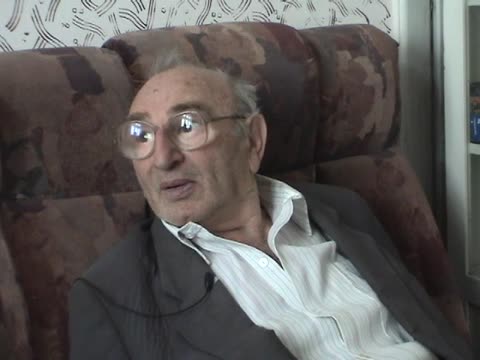
Cohn answers questions about the meaning of Yiddish and Romanian words. These include dybbuk, golem (including the phrase about sitting like a golem) and terms for a Jewish cemetery versus a non-Jewish burial ground or field. Kerler also asks how a field or cemetery is called in Romanian.
Includes the golem and dybbuk terms and the Jewish and non-Jewish cemetery vocabulary.
Cohn talks about his life during World War II. He explains how he was taken with his father to do forced labor in road construction under Romanian command in Tiraspol. According to him, his mother and two brothers stayed in Botoșani during the war. Cohn also mentions beatings by Romanian soldiers and states that he was liberated by the Red Army in 1944.
Cohn tells how he was taken to Tiraspol with his father during the war. They broke stones in a quarry and spread them on roads under Romanian guards, with beatings, hunger and no German guards. His mother and two brothers stayed in Botoșani. He recalls being beaten by a Romanian gendarme for stealing food from a field. They were brought home as the Russian front approached, in 1944.
Adds the father's separate work group and the theft-of-food beating episode.
Cohn says Jews sang Yiddish songs in the labor camp, then sings a Yiddish song about walking hungry and cold and sleeping on boulevard benches. He repeats it at Kerler's request.
Cohn speaks about his life after the war. He remembers the hunger and the support of the Joint Distribution Committee in the immediate postwar period. Cohn moved to Botoșani in 1941 and continues that he was sent away from his hometown due to fire. Cohn was trained as carpenter and glazier.
Cohn speaks about the great hunger in Romania just after the war and the Joint, which ran soup kitchens in the Jewish towns. He describes life under Ceaușescu as very bad, with Jews fared worse. He moved to Botoșani in 1941, a few days before the war, because Jews were no longer allowed to live in the royal towns. Houses were set on fire. After the war he worked as a metalworker and glazier, and is asked for the word for window glass.
Adds the Ceaușescu years and the expulsion with burning of houses.
Cohn answers dialectological questions from the AHEYM Yiddish questionnaire. He then speaks about his life after the war and how he met his wife. He also remembers his traditional wedding.
Cohn answers a question about the word for a windowpane. He then explains he fell in love with his wife and met her in Botoșani. He describes the wedding, with a rhymester-entertainer named Finyele (?) and a badkhn. The musicians were a klezmer band, including some Christians, led by a Jew and playing modern and Yiddish songs.
Adds the wedding band and the badkhn, and the question on window glass terms.
Cohn answers questions about postwar Jewish life in Botoșani. There were many Jewish doctors, who spoke Romanian and Yiddish at home. He names synagogues, including the High Synagogue, a Passover (?) synagogue and a carpet-makers' synagogue. Kerler then asks about the words 'parves' and similar terms, with an unclear exchange.
Cohn talks about prewar cultural life in Suliţa, in particular presentations by Zionist leaders, including Ze'ev Jabotinsky. He also recalls how people left for the Land of Israel.
Cohn recalls prewar lectures in Suliţa, where Zionist speakers came to talk, among them Jabotinsky, who came from Chernivtsi (80 km away) and spoke in Polish-style Yiddish. Another speaker, a Mr. Zekler (?), spoke in Romanian Yiddish about going to the Land of Israel. Many people emigrated. There was a hakhshara and Cohn was a halutz, and he recognises a pioneer song.
Adds the hakhshara and Cohn's own halutz past, and the Yiddish of the speakers.
Cohn describes visiting Suliţa now, where the Jewish cemetery remains but no Jews live, though relatives come from Israel. He recalls prewar life there as hard and the winters as a disaster, with a lack of firewood. A relief committee gave wood to the poor. Some Jews farmed their own fields. The town had a Jewish doctor named Gras (?) but no lawyer.
Adds the Jewish doctor in Suliţa and visits to the cemetery today.