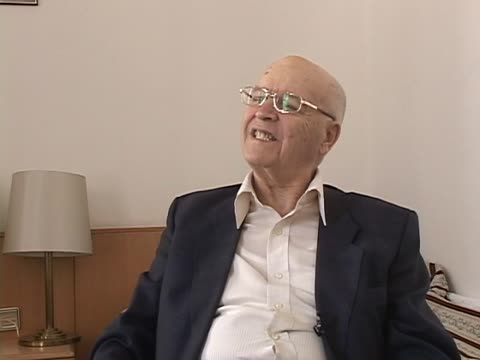
Hershkovich provides personal information and briefly addresses food customs. Although Hershkovich was born in Bogata de Sus, he moved to Dej at the age of ten.
Opens with a question about the Yiddish word for turkey meat, which Hershkovich says was called 'kurke fleysh' at home. Hershkovich then gives personal information: his name Solomon, his Yiddish name, and his birth on 27 June 1922 in Bogata de Sus. He says he grew up in Dej and discusses the village's name and its two parts (upper and lower).
Includes an elicitation of food and place-name terms and the village's division into two parts.
Hershkovich discusses his childhood memories and education. He attended a religious school (cheder) and a Romanian school for four years in the village. According to Hershkovich, twelve Jewish families lived in Bogota de Sus.
Hershkovich recalls his childhood in the village until age nine or ten, after which he went to Dej to study. He attended both cheder and a four-year Romanian school in the village, and discusses which state ruled the area before and after his birth. He puts the number of Jewish families at about twelve, many of them Kohanim, and begins to speak about his father.
Adds the discussion of Romanian versus Hungarian rule.
Hershkovich talks about his family and prewar Jewish life. His father was born in Volovets, Ukraine. Hershkovich explains that his father's parents left for Israel when he was eleven years old and moved to his brother, who was a professor in Pest. His father studied at a yeshiva and worked as a religious teacher (melamed).
Hershkovich talks about his father Aharon, who came from Volovets and whose parents went to Israel when he was eleven; he stayed with a brother in Pest, studied, and was then sent to the village. The father came from a Hasidic family, was a follower of the Belz Hasidim and a modern man, and later worked as a melamed in Dej. Kerler asks where Volovets lies and whether the village had a congregation; Hershkovich says about twelve families.
Adds the father's Hasidic affiliation and a terminological aside about 'shtraymldik'.
Hershkovich talks prewar religious life. He recalls how people from the surrounding communities came together for services in Bogota de Sus. He also describes professional life.
Hershkovich describes religious life in the village: Sabbath and holiday services drew people from neighbouring places into a room that served as a prayer room with one Torah scroll, since there was no synagogue building. He then says what the other families did: his grandfather had an inn, a shop and fields, and another family of Kohanim also owned fields.
Hershkovich speaks about learning Chumash at cheder in the village and then studying at the yeshiva of the rebbe Panet in Dej. He explains how study worked, with the review student (khazer bokher) helping the rebbe's lessons and the Thursday examination. Kerler asks about havrutas and about a song on the hard life of a yeshiva student, which Hershkovich has forgotten.
Returning to the village, Kerler asks about the melamed; Hershkovich says young men came from elsewhere for a term and the cheder was a small room in a courtyard. He confirms that only Yiddish was spoken at home, though his parents also knew Romanian and Hungarian, which were used with non-Jewish neighbours.
Adds the languages spoken at home and with neighbours.
Hershkovich addresses Purim and Passover celebrations. He describes how he helped to bake matzos. He then speaks about life today and continues to share information about Purim celebrations. According to Hershkovich, children dressed up in non-Jewish clothing on Purim. He then recalls a Purim shpiels.
Hershkovich describes Purim and Passover customs: sending gifts at Purim, preparing for Passover from after Sukkot, and baking shmura matzo, in which he helped as a child. He reflects that Jewish observance can hardly be kept today. He recalls going out as a child to perform a Purim play in disguise, in non-Jewish clothing, to nearby villages, and with Kerler's prompting recites bits of Purim play rhymes and begging verses.
Adds the comments on how observance is impossible today and the recited Purim play verses.
Hershkovich speaks about his family. He grew up with two brothers and two sisters. He also addresses food customs on Sabbath. His grandfather was deported in 1944. His daughter lives in Israel.
Hershkovich names his mother Blime and his siblings: sisters Rachel and Sheindl and brothers David and Yisroel, with himself named after his grandfather; he explains his home name and his Torah-call name. He talks about Friday baking of challah and a cheese pastry called dalke (?), and about kolach. He describes his paternal grandfather Chaim Hershkovich, a shopkeeper and landowner in Bogata, who was deported in 1944.
Adds the names of siblings and the grandfather's deportation and details of Friday food terms.
Hershkovich speaks about his studies in prewar Dej for seven or eight years. He also addresses Jewish life in Gheorghe Gheorghiu-Dej in the 1930s and contemporary Jewish life.
Hershkovich says he went to the yeshiva in Dej alone after four classes in the village, staying about seven or eight years, while the family remained at home. He says Dej had a large Jewish community of perhaps two thousand and gives his impressions of Jewish life there in the 1930s. He laments that Jewish life has gone, and also speaks about the situation in Cluj today, saying a few hundred Jews remain and they gather mainly for aid packages.
Adds the reflections on the decline of Jewish life today in Cluj and a break for camera matters.
Hershkovich speaks about Jewish life in the immediate postwar period. He turns to prewar political organizations, including Mizrahi, Hashomer Hatzair. He then speaks about his life in Israel, where he lived between 1985 and 1989 and worked at a hospital. Hershkovich has relatives in America.
Hershkovich speaks about postwar Jewish life, noting that many did not return and that Jews left after the communists came. He mentions prewar Zionist organisations such as Mizrachi and Hashomer Hatzair. He says he lived in Israel in the late 1980s, where his daughter works as a doctor, and why he came back, citing the heat; he also mentions relatives in America, and Kerler then asks about weddings in Dej.
Adds his daughter in Israel and the reasons for his return.
Hershkovich talks about traditional weddings in prewar Gheorghe Gheorghiu-Dej. In particular, he recalls a wedding jester. He also addresses postwar weddings.
Hershkovich recalls the wedding jester (badkhn) Zoldi of Dej, who was famous in the region, performed in rhymes, sang and danced at weddings, and mocked Hasidim. Kerler asks about related terms and about Hershele Ostropolier. Hershkovich says the jester went to Canada after the war and died there, and that Jewish weddings continued for a few years after the war.
Adds the terms for the jester and the question about Hershele Ostropolier.
Hershkovich speaks about the religious make-up of Dej and Cluj: Dej was largely Hasidic with a few families, and Cluj had a Neolog community and synagogue. He recalls two shops that opened on Sabbath afternoons, causing a stir. He discusses the language of the Neolog Jews and how children learned Hebrew in cheder from age four or five, and why many cannot read with understanding today.
Adds the Neolog synagogue and language use of Neolog Jews.
Hershkovich tells of a family from America who came about three years earlier to find their roots in his native village, and how he helped them with a translator in finding graves. He recounts the story of the Rozman family and their sons who emigrated. They speak about the term for relatives and Yad Vashem, and Kerler asks whether there were other wedding jesters in the region.
Adds the visit by American relatives and the Yad Vashem matter.
Hershkovich speaks about his education at a yeshiva, which he attended until 1938 in Dej. He then mentions other local yeshivot and remembers how his family visited him in Dej.
Hershkovich says he studied at the yeshiva until 1938, and explains how he was fed, with daily meals at different homes, and where he lodged, using the word 'kvartir'. Kerler asks about other yeshivas nearby; Hershkovich mentions one with a trade school teaching carpentry between Dej and Cluj, and talks about visiting his sister in Cluj and praying there on the High Holidays.
Adds the terms for lodging and meals and the other local yeshivas.
Hershkovich explains the different prayer rites in Cluj, Ashkenazi, Sephardi and Neolog, and why he attended particular synagogues; he mentions that he wears Sephardi tefillin today. He then answers Kerler's questions about expressions such as 'a good Jew' and about words for a cemetery.