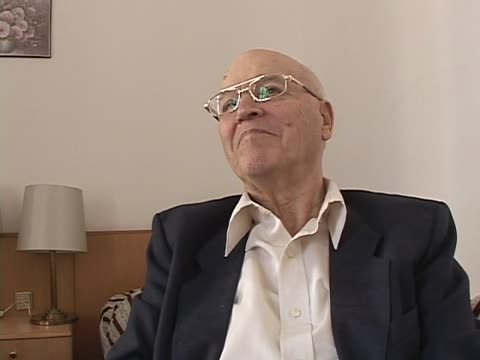
Hershkovich answers questions about cultural terminology. He also mentions the Satmar rebbe, Rebbe Yoel Teitelbaum. His sister went to see him and brought back a blessed coin, he explains.
Hershkovich answers questions about cultural terminology: words for the cemetery, the euphemism for the evil eye, the difference between rav and rebbe, and the plural forms of these words. He says his father travelled to the Satmar rebbe (Teitelbaum family). His sister brought him a blessed coin from the rebbe, which he still keeps. They also discuss the verb for holding the Passover seder.
adds the terms for rav and rebbe, the plural forms, and the verb for holding the seder
Hershkovich talks about prewar life, including non-Jews who knew Yiddish. They discuss using Hebrew words so that outsiders would not understand, and the term mame-loshn. He sings or recalls a Passover song and a song about the Messiah, and says he spoke little Hungarian until the labor service, where he spoke more of it. Kerler then asks Dr. Lemster to put some sentences to him.
adds the Hebrew words used as a secret language and the question of language in the Hungarian army
Hershkovich speaks about prewar culture and reading. As a yeshiva student he did not go to the theater. He read religious texts and stories of tsadikim in Hebrew, though he spoke and wrote letters in Yiddish. He says there are different Yiddish dialects, and that his own is closest to Polish Yiddish. He is asked about Litvaks, whom he describes as learned people.
adds the dialects, Litvaks, and the question of theater and Yiddish letters
Hershkovich answers questions about food terms and customs. These include the loaf called dalek, meat dishes, cholent with kishke, and the Sabbath fish, with imitation fish (made of meat) as an alternative. He names the word for brandy and the kinds of fruit brandy.
Hershkovich speaks about folk and healing customs. He then answers questions about cultural terminology. He recalls Hebrew proverbs about the term "golem."
Hershkovich speaks about the evil eye, the practice of removing it with water and coals, and the words connected with it. He knows the word dibbuk but does not use it. He then discusses the word golem and recites a Hebrew saying about seven things of the wise and the golem, tracing it to Pirkei Avot. Kerler closes by asking about the war years.
adds the dibbuk and golem terms and the Hebrew saying from Pirkei Avot
Hershkovich speaks about his life during World War II. He served in the army and worked in construction between 1942 and 1944. He then talks about his family's fate during the war and shows family photographs. He also shares photographs of the Dej synagogue and the head of the yeshiva.
Hershkovich recalls being taken in 1942 into the army labor service, where he worked in construction without arms until October 1944 (?). His unit was all Jews, working long hours on poor food. His mother and sisters were deported to Auschwitz, where they perished. He shows photographs of his family, of the Dej synagogue and of the head of the yeshiva (Panet), and mentions relatives in America.
adds the Auschwitz deportation of his mother and sisters and the named photographs
Hershkovich shows photographs of his family, including a grandson's bar mitzvah in Israel, a brother-in-law buried in Israel and his sister's grave in Cluj. Kerler asks about Jewish weddings and famous cantors visiting Dej. Hershkovich names some cantors, including Rosenblatt. The conversation turns to Kerler's own background, his documentation of Yiddish, and Litvaks and the Vilna Gaon.
adds Kerler's explanation of his own background and the Vilna Gaon
Hershkovich answers a question about the term ilui (a child prodigy), then speaks about the head of his former yeshiva. He recalls that the rabbi's brother, a learned rav, left the Dej ghetto for Romania with ten children, while the rabbi himself refused to leave. Kerler then begins greetings questions from the questionnaire.
Hershkovich answers dialectological questions from the AHEYM Yiddish questionnaire. The items include greetings, requests, words for the cat and mouse, war and battle, teeth, minyan and the well, and prepositions meaning 'at the father's'. They also cover plurals, the Hanukkah dreidel and regional names (the Regat). Further items are Jewish and non-Jewish terms, the word for face, house, room, and several sentences to translate.