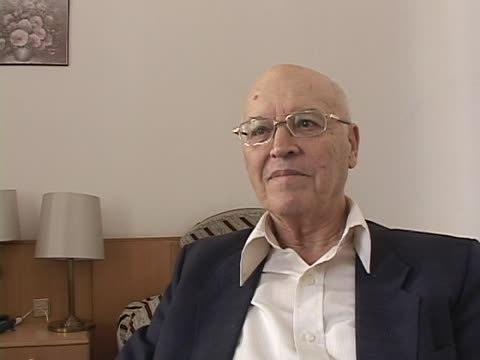
Kerler puts dialectological questionnaire items to Hershkovich. They cover particles and adverbs (perhaps, maybe, but, or, also, 'in three days'), phrases for liking a person, a sentence to translate, and words for farmer, illness and war. Hershkovich answers and mentions Maramureș Jews who all spoke Yiddish. Kerler then invites a song or joke.
Hershkovich also mentions Maramureș Jews speaking Yiddish and Kerler asks for a song or joke at the end.
Kerler ends the interview with Hershkovich and asks for a few closing words on the continuity of Jewishness. Hershkovich comments on genealogical research by relatives from America. The camera then records family photographs. He identifies a sister, Shindl, and a brother, Yisroel (?), both in Auschwitz in 1944 (?), and shows a photograph of a synagogue.
Names the sister and brother in the photographs, who were at Auschwitz in 1944 (?).
The new interviewee talks about languages in his youth. Jewish friends knew Yiddish, while Romanian and Hungarian were spoken with non-Jews and in town. He describes a village of about twenty Jewish families (twenty 'taleisim') with a melamed, mikveh and synagogue, between Cluj and Târgu Mureș. He recalls dressing as a peasant for Purim and visiting Jewish families, and Purim plays such as the Sale of Joseph and Esther.
Grunfeld speaks about his religious education and recalls Sabbath zemirot (songs). He attended a religious school (cheder) until the age of nine. Grunfeld then talks about an episode from his childhood when he did not say the morning prayer "moyde ani" and was chastised by a Christian woman. He also mentions the Yiddish Bible for women "tsene-rene."
He talks about his religious education, learning with a poor teacher, and Friday-night Sabbath songs at his grandfather's and father's house. He tells of a childhood episode in which a Hungarian Christian maid or nanny caught him eating before saying the morning prayer and reported it. He mentions the women's Yiddish Bible (tsene-rene) and that he studied Talmud and gymnasium.
He speaks about wedding customs and the matchmaker, and compares Maramureș Jews with those of Transylvania. He describes Passover food made with potato and goose fat. He also touches on Ashkenazic and Sephardic prayer rites in Cluj and Moldavia, and says his parents were in prison.
Grunfeld speaks about his family and his life during the war as forced laborer. His sister moved to Israel and lived a Hasidic life. Grunfeld also has Hasidic relatives in England. Grunfeld then addresses contemporary Jewish life in surrounding towns and the Satmar Hasidic dynasty.
He tells how his parents survived thanks to the prison and how aunts were taken to Auschwitz. He served in forced labour in the army and was held in a fortress. He has grandchildren in Israel and a Hasidic nephew in London. He then discusses Oradea, Satu Mare and its rebbe, and Hasidim near Czernowitz. He speaks of Sighet and Vișeu (Vișeul?) with many Jews, and shows a family-lineage document.
The man shows a Hebrew family-tree or yikhes letter, naming Menakhem Yehuda as himself and his parents David and Miriam Guta (?). The talk drifts to the interview and recording, with Romanian and Russian asides and a mention of the languages he uses. He mentions a village about thirty kilometres from where he grew up with a stream, and Friday-night fish at home.
Grunfeld speaks about food customs, in particular gefilte fish. He then speaks about contemporary Jewish life in Cluj-Napoca and answers a dialectological question.
He answers questions about gefilte fish and its taste, then calls Cluj a beautiful town where he lives and speaks of a street in town. Kerler asks which words he used for war (milkhome, krig, shlakht), and he explains them.
The team greets Eugen Kraus and sets up an interview with him. Kraus and Hershkovich speak about the former synagogue, which is presently used as Jewish Studies department of the university.
A short exchange as the team greets someone and discusses the former synagogue, now a Jewish institute of the university. There is no actual interview with Kraus in this stretch.
The transcript shows only a brief remark about the former synagogue being a Jewish institute.