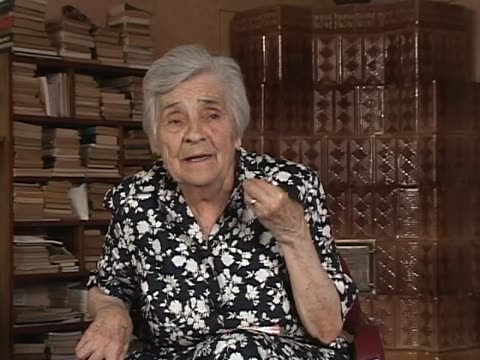
Freundlich speaks about hosting traditional weddings in her apartment after the war. She also addresses the involvement of the local kosher butcher Adler, who secretly held circumcision ceremonies.
From the machine transcript
Freundlich talks about Jewish ceremonies held in her Cluj home under communism. She tells how the shochet Adler would perform a wedding blessing but not a circumcision without a minyan, and how the mohel and the family were afraid. She says she was not afraid herself, and that a mezuzah was always on her door.
Adds a mohel's fear and a circumcision held with no minyan.
Freundlich discusses her family. Her father owned a shop. She raised a daughter and a son. Freundlich's brother and sister live in America.
From the machine transcript
Freundlich says she is from Satu Mare and describes her father as a merchant with a shop there who did not want his children to eat Communist bread. She names her daughter and her son, a doctor with a music diploma who performs internationally. She mentions her husband, her siblings in America and her father's standing in Cluj after the war.
Adds her son's musical career and her father's standing after the war.
Freundlich speaks about contemporary Jewish life in Germany.
From the machine transcript
Freundlich recalls speeches by Jewish public figures at a Munich event about Jewish continuity. She says that, unlike under the Communists, Jews elsewhere are free to practise. She mentions a brother and sister in America and says that no one in her family married out. She is then asked her surname.
Freundlich provides personal information and talks about her family.
From the machine transcript
Freundlich gives her name as Elizabeta (Elza), née Weiss, with the Yiddish name Rivke after her grandmother. She says she is proud to be a Jewish grandmother and speaks of her father, a learned man, and her cousin in California. She mentions having been in camp, Auschwitz and Geislingen.
Adds her names and her relatives in America.
Freundlich briefly addresses her life during the war. She was imprisoned in several Nazi camps, including Auschwitz and Geislingen and had to leave her hometown in 1944. She states that thirty-six of her family members were killed during the war.
From the machine transcript
Freundlich briefly refers to the war years, saying that she counted at least thirty-six murdered relatives, among them her parents and grandparents. She recalls a slogan displayed in the factory where she worked in camp. She says she was born in Satu Mare, where all her father's family lived.
Freundlich provides personal information and speaks about contemporary Jewish life in her hometown Satu Mare. She then talks about her family. Her mother was born in Hungary. Her maternal grandfather was a Beltser hasid, Freundlich explains.
From the machine transcript
Freundlich says she lived in Satu Mare until 1944 and that no Jews remain there. She names her parents and their approximate age at death in Auschwitz. She says her mother's family came from Hungary and her maternal grandfather from Nirmada was a wealthy Belzer hasid. She also mentions that the grandfather's house carried a reminder of the Temple's destruction and describes an incident with a visiting rabbi.
Adds her parents' names and the Belzer grandfather, and her view of the few Jews in Satu Mare today.
Freundlich remembers Hasidic visitors. She then talks about her family. Freundlich was a homemaker after the war. Her daughter lives in Canada. Freundlich then shares family photographs. She also provides family episodes. Her maternal grandfather was a wealthy merchant, according to her. Freundlich grew up with three sisters and one brother.
From the machine transcript
Freundlich recalls a visiting rabbi who ate nothing in a Jewish home. She says she stayed at home with her children while her husband worked and shows photographs of her children and a Torah dedication in Canada. She names her grandfathers, a wine merchant and a grain merchant from Nirmada, and describes the wealth and death of her maternal grandparents. She also says she grew up with several siblings.
Adds a grandmother deported to Auschwitz and a Torah dedication involving her son and daughter.
Freundlich talks about prewar religious life in Satu Mare. She then talks about her education. Freundlich attended a Hungarian school for ten years. She also received religious education from the brother of the chief rabbi of Budapest (after the war).
From the machine transcript
Freundlich talks about the prayer house built in Satu Mare for the Bixad rebbe and his family in America. She says she attended school for ten years, in Hungarian after the Hungarians took over, and had a religion teacher who was the brother of the chief rabbi of Budapest. She also mentions Satu Mare's graves and her last visit there in 2004.
Adds the Bixad rebbe and her last visit to Satu Mare.
Freundlich talks about her recent visit to Satu Mare. She then talks about her husband, who was a passionate soccer player and singer. Freundlich then describes how she met her husband in a Nazi camp after liberation. Freundlich returned to Cluj-Napoca in 1946, because her husband was born there.
From the machine transcript
Freundlich talks about her last visit to Satu Mare, a monument she set up there for her parents, and a memorial in Florida. She describes her husband Chaim Yosef Tsvi as a ladies' tailor, football referee and soloist, and mentions his well-attended funeral. She tells how they met in a hospital after liberation, and that they came to Cluj, his birthplace, in 1946.
Adds the memorial to her parents and the funeral of her husband.
Freundlich discusses her childhood memories and family. In particular, she addresses her son's successful musical career. Her son moved to Canada in 1985.
From the machine transcript
Freundlich says Yiddish was spoken at home in her childhood, and especially on Sabbath, while her husband's family mixed languages. She shows press clippings and pictures of her son, who has travelled to many countries. She says her son and daughter emigrated, to Canada in 1985, and that her daughter, a piano teacher, spent two years in Israel.
Adds the Yiddish spoken at home and the son's press clippings.
Freundlich discusses her childhood memories in an observant home. She also addresses prewar Jewish life, including kosher butchers. She then explains how to kosher meat. She then recites the prayer "Got fun Avrum."
From the machine transcript
Freundlich describes her observant childhood home and her mother's blessing over the candles. She recalls the kosher butchers, the shochet and the rabbi in Satu Mare, and describes how meat was salted and soaked. She talks about taking challah and recites the Saturday-night prayer to the God of Abraham, in Yiddish, at Kerler's request.
Adds how meat was salted and the Saturday-night prayer.
Freundlich speaks about Purim celebrations before the war. In particular, she describes how her father observed the holiday. Freundlich also touches upon well-known Purim shpiels.
From the machine transcript
Freundlich describes how her father kept Purim, working between meals and eating the festive meal late. She says Purim players came dressed up, sang and performed small plays, and were given gifts and money, and she recalls the megillah being read at home. She also mentions that the plays were done in Hungarian.
Adds her father's own Purim observance and the megillah reading at home.
Freundlich discusses her childhood memories and friends. She also talks about the Satmar rebbe, Yoel Teitelbaum. Freundlich maintains that her father did not want to be part of his court. She then talks about her father.
From the machine transcript
Freundlich says her childhood neighbours were Jewish, with one Christian family on the street, near the Bixad rebbe. She says her father respected but did not follow the Satmar rebbe and refused to kiss the rebbe's hand, and describes the kapores slaughter at home. She also tells of her grandfather's modest death on Sabbath eve in a snowy winter and his instruction to his son-in-law to say Kaddish.
Adds her neighbours, kapores, and her grandfather's death and burial.
Freundlich talks about her family, in particular her grandmothers and sisters. She also remembers how they ate cake every Sabbath morning during her childhood. Freundlich then addresses her son's circumcision.
From the machine transcript
Freundlich names her grandmothers and says she is named for one. She names her sisters, the eldest killed with children, and says one sister lives in Miami. She says her maternal grandfather went to the Belzer rebbe, and recalls cake delivered to her grandfather on Sabbath mornings. She is then asked when her son was born, and speaks of his circumcision.
Adds her sisters' names and fates and the Sabbath cake.