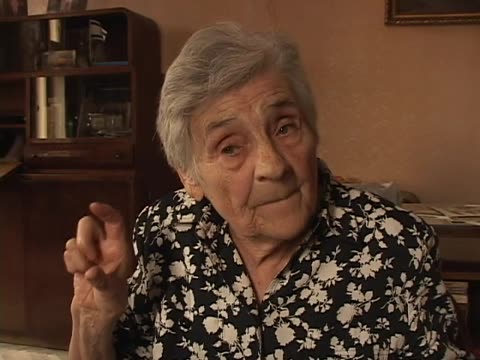
Freundlich speaks about her family and postwar Jewish life in Cluj-Napoca and surrounding communities. In particular, she addresses different religious authorities before and after the war.
Freundlich speaks about the absence of a circumcision in her family and about rabbis and rebbes known in the region. She names the Shaprana rabbi who came in 1946, the Bixad (Bixad) rebbe who was her neighbor, and his piety and death in Auschwitz. Kerler asks about the Hasidim who came to him and about tsadikim who slept on a couch. She also remembers her father's holiday and Sukkot piety.
Also names a rabbi who was her teacher of religion and describes the Bixad rebbe's practices.
Freundlich talks about his father's teachings. She maintains that her father bought a house in order to establish a Talmud Torah school. Freundlich explains how the community collected money to set up the school.
Freundlich speaks of her father's learning and the rabbinic offers he received from Pressburg (?) and New York, which he declined. He gave a house for a Talmud Torah in 1932. She explains that a woman organized a fundraising dinner for the school, with some seventy people. The passage ends with talk of a diploma and preparations for the interviewers' departure.
The catalogue sentence about teachings lacks the rabbinic offers and the departure talk.
Freundlich speaks about Jewish life in Cluj today, with a few Jews and mixed marriages. Documents including a diploma of a family member are shown. She begins to speak about her sister's print shop.
Names a diploma of Andrei Freundlich (?) and intermarriage.
Freundlich speaks about her family. Her sister owned a print shop and book store. According to her, her sister printed journals with Hebrew letters. Freundlich then addresses books she read.
Freundlich speaks about her sister's print shop and bookstore, where books were printed in Gothic type and in Hebrew letters for prayer books. She recalls reading books from the shop, including Cronin's. She also mentions a book by Lea Lieberman about the second generation, and Kerler asks about languages she learned.
Freundlich recalls prewar and postwar cultural life: visits to the theater in Cluj with the women of her family, and the actors and singers who performed, such as Sidi Tal, Maly Pick and Lea Konig (?). Kerler asks about a Purim play. She also talks about her son, a musician.
Freundlich explains that she learned Yiddish songs from a nanny of Maramureș background in Satu Mare, and a second voice sings a lullaby about longing for a lover. The nanny was illiterate, and the rebbe had said Jewish families should hire orphans. Kerler asks about the word for a nanny and requests more songs.
Adds the identity of the Maramureș nanny and the word for a nanny.
Freundlich sings a Yiddish song about remembering the mother, before she sings a Yiddish song about a happy childhood. She then sings a song about the mezuzah.
Songs: a Yiddish song about longing for the mother, a song of nostalgic childhood memories, and one about the mezuzah. Freundlich says she learned these from her nanny and sang solo in the synagogue choir. She notes that she can no longer sing.
Freundlich talks about Yiddish songs and a klezmer from the USA who recorded songs from them for a CD. A song about taking food on a journey is sung, and Kerler asks where her nanny got her songs.
Freundlich speaks about her family, in particular her mother. She then sings a religious song her mother taught her, as well as a snippet from a messiah song.
Freundlich says the nanny from Satu Mare taught her songs and that her mother knew Hungarian songs, among them one by the Kalev tsadik, with some Hebrew phrases. A fragment of a song about the Temple is sung. Kerler asks about a messiah song, of which she sings a snippet. There is a break about someone leaving the door open.
Freundlich discusses Sabbath table songs (zemirot, Shalom aleichem) and the Passover songs, and recalls her father singing at home. Kerler asks about a Passover song, about Hasidic melodies and whether the songs were sad. She mentions her two brothers, one buried in Satu Mare, and reflects that Jewish joy is never complete in exile.
Freundlich speaks about prewar traditional weddings in Satu Mare. She then sings a wedding song, she recalls from a postwar wedding in Dej. Freundlich also addresses her own wedding.
Freundlich speaks about traditional prewar weddings in Satu Mare, including the mitzvah dance, her sister's wedding and her own. She sings a wedding song heard at a postwar wedding in Dej with a badkhn. Her own wedding was quiet, with the seven blessings only, and Kerler asks about singing in the camps.
A woman sings a humorous Yiddish song about making a living, and Kerler asks Freundlich to repeat the lyrics so that he can understand the words. She then sings the wedding badkhn's song again, more slowly.
A song about the rebbe's house and the messiah's arrival is sung. Kerler explains the archive project, and Freundlich speaks about a Hungarian radio program on religion and Jewish matters. She talks about Jews in town today, with mixed marriages and a bar mitzvah.
Also covers the archive explanation and a Hungarian radio program.
Freundlich talks about her family and life today. Her children and grandchildren keep in touch, and she mentions relatives in Florida, Flushing and California. Her limited eyesight means she listens to the radio. She recalls conditions of Jewish life in the postwar years and her uncle who was a bank director.
Mentions relatives abroad and the bank-director uncle.