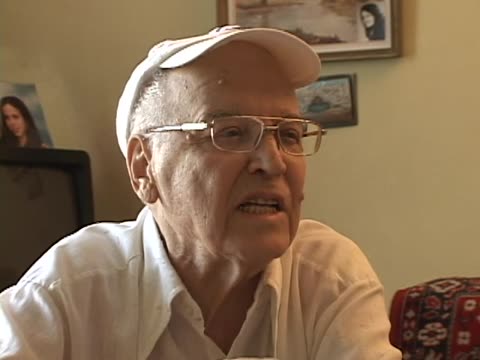
Hershkovich answers questions about cultural terminology. He and Kerler discuss derogatory words for a non-Jewish child and for a non-Jew, and a Jew who behaves like a non-Jew. Kerler asks about the night before a circumcision and how a baby girl was named, which Hershkovich says happened in the synagogue with the father. Kerler then asks what Hershkovich would like remembered about the region.
includes the customs of the night before a circumcision and naming a baby girl, and a closing question on what should be remembered
Asked what should be remembered about Jewish life in the region, Hershkovich mentions the Jewish rabbi there. He says people used to learn respect for one another and had closer ties. Today, he says, there is more enmity among Jews. Kerler asks about life with non-Jews, and Hershkovich says it was harder in antisemitic periods but otherwise not much of a problem.
adds the comparison with today's Jewish community and the question about relations with non-Jews
Hershkovich recalls what happened when the family came home from synagogue on Friday night, and Kerler asks for songs. They discuss a song or rhyme about the days of the week and a song about how hard it is to be a yeshiva student. Asked about the best time in his life, Hershkovich says life was hard, but the holidays were a joy, when children got new clothes.
adds the Friday-night return from synagogue, the yeshiva-student song, and the question on his best memories
Hershkovich names a childhood ball game, which Kerler notes is a Hungarian word for a ball, and describes how it was played. Kerler thanks him for his account and wishes him good health. The interview ends with Kerler's closing remarks, including a reference to a rabbi.