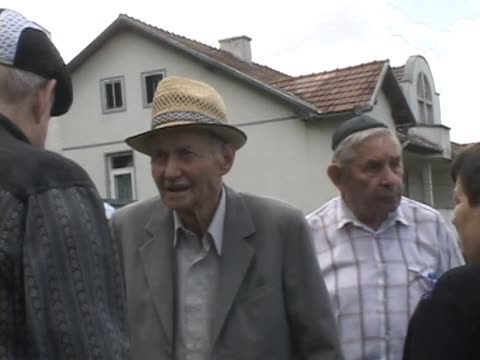
Footage at the cemetery with brief conversation. Kerler asks how old the cemetery is and is told it is over ninety years, with a reference to a tombstone. Near the end the group discusses how they will travel back and whether to eat together in a restaurant in the town centre.
The transcript shows talk about getting back and eating in a restaurant, and the age of the cemetery.
Miller talks about prewar life, in particular the influence of German residents. Miller maintains that the cemetery has existed for more than ninety years.
An informant talks about the town's German (Saxon) residents and their influence, which made it a good, orderly place. Asked about the cemetery's age, he says more than ninety years, and says he does not know the town's history or Hasidic life. He recalls a man named Grin, who spoke Yiddish, came to pray with them on the High Holidays, and was the last Yiddish speaker.
The transcript adds the recollection of the Yiddish-speaking Grin and the remark that only a few Jews remain.
The informants continue to speak of Grin as the last Yiddish speaker in town and his attendance at High Holiday services. They comment on his well-made tombstone. A proverb is mentioned and the memorial service is touched on, but the passage is fragmentary and hard to follow.
The transcript shows further talk of Grin and his tombstone.
The camera collects town footage of Gheorghe Gheorghiu-Dej, particularly the synagogue and a memorial, commemorating the deportation of Jews to Auschwitz in 1944.