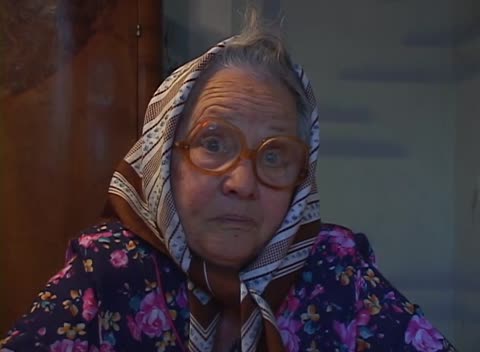
Grimberg discusses fish dishes: gefilte fish, how it was cooked for Friday night, and a recipe question from Lemster and Kerler. Kerler also asks about a custom of throwing something, probably burrs, at a holiday. She then answers questions about whether Yiddish is still spoken in Cluj and Satu Mare. She mentions the true tzadikim of Sighet and says that today men cook better than women.
Includes a question about children throwing burrs at a holiday and questions about Yiddish in Cluj and Satu Mare.
Grimberg says she read a booklet of Hershele Ostropoler stories and recalls Yiddish papers and the books kept in each synagogue. The rest is questionnaire work: sentences to translate, Yiddish greetings and wishes, a word about stars, and what Yiddish calls a few other everyday things. She says she did not hear one of the greeting forms Kerler asks about. A question about what is laid on the ground when someone dies leads into the next passage.
Also covers the synagogue book collections and a question about greetings and wishes.
Grimberg describes Jewish burial customs: potsherds placed on the dead person's eyes, small sticks in the hands, and earth under the head. She then describes a Jewish wedding: the bride seated and veiled, the chuppah, circling seven times, the breaking of a glass, the shouting of mazel tov and the throwing of sweets. Kerler and Lemster ask about a wedding jester (badkhn) and about the Purim noisemaker. Kerler ends by asking whether she remembers any songs.
Also covers the wedding ceremony and the badkhn and Purim noisemaker terms.
Grimberg addresses Yiddish songs. She then speaks about her family. Her father was born in Ripiceni. She also addresses Yiddish dialects and continues to answer dialectological questions from the AHEYM Yiddish linguistic questionnaire.
Grimberg cannot recall any songs. She says her mother was from Ripiceni and her father from Dorohoi, and that her grandfather was a shoykhet in Ripiceni. She compares Yiddish in Sighet and other Romanian regions with the Dorohoi dialect. She then answers questionnaire items on the expression "a good goy", words for a farmer, breathing, cemetery, buying a plot, running away, being ill versus bedridden, and potatoes.
The transcript has her mother, not her father, from Ripiceni, and adds the grandfather as shoykhet there.
Kerler and Lemster thank Grimberg and close the interview. She shows a photograph of the Ştefăneşti rebbe and talks about a painted Passover matzo cover. She says she brought it from Israel, and the inscriptions are discussed. The camera also records parts of the apartment.
Adds a decorated Passover item brought from Israel.
The interview with Lipovici begins. He provides personal information and talks about his family. His father, who worked at a mill, passed away when Lipovici was nine years old. He grew up with six brothers and three sisters.
Lipovici's interview begins with a remark about his pension. He gives his name in Romanian form, Lipovici, and his father's name, Shalom. His father worked at a big mill in Dorohoi and died when he was nine. He names his seven brothers and three sisters in part. He says his grandfathers lie in the old cemetery in Dorohoi and mentions Rădăuți and Siret. He also says he studied four classes of primary school and then three of commercial school.
Lipovici gives his birth year as 1921 and says he studied in cheder. He remembers the bearded melamed and a prank in which the boys glued his beard while he slept. Kerler and Lipovici also exchange some chat about where Kerler was born, and Lemster joins in.
The primary school is actually mentioned in the previous passage; here the focus is cheder and the beard prank.
Lipovici says he remembers little of his childhood. He tells at length of an episode in which bandits broke into his house, held him down and went through the rooms, after which the police came. The year is unclear. He says the present house was built after the war, and he and Kerler talk about the kerosene lamps of earlier times. Lemster then asks about his trade.
The robbery appears here as a long story of bandits breaking in and the police coming.
Lipovici says he worked with animals and sheep. He now keeps two sheep, though Lemster has heard three, and a lamb is mentioned as something to buy. Lemster asks about the work and its partners. He offers coffee and the interviewers decline.
Asked about Jewish Dorohoi, Lipovici mentions a Jewish bath, a synagogue and a Jewish hospital where the community office now stands. He says there were many synagogues, though the number is unclear, and that they were plundered. He repeats that his father worked at the big mill and died when he was nine. Lemster asks why he became a shepherd, and he answers briefly, apparently because of a livelihood.
Adds the Jewish bath, hospital and synagogues in Dorohoi.
Lipovici speaks about the war years in Dorohoi. He recalls Germans arriving and being put to work, and says Jews worked in a labor unit, about two hundred according to the transcript. Lemster asks whether he has married and Lipovici, apparently, is still a bachelor. Kerler asks what language he spoke with his siblings and he answers Yiddish and Romanian. Kerler also asks whether he prayed.
Adds the question about marriage and the languages spoken in the family.
Lipovici talks about his family. He has never been married. He then talks about his life and family during World War II. In particular, he mentions when his sister fell ill.
Lipovici talks about prayer and meals in his youth. Kerler asks about Purim customs and whether he took part in a Purim play. He then gives a hard-to-follow account of his mother's illness and of his younger sister during the war. It involves sending for a rebbe, soldiers, a priest and doctors.
Adds Purim questions and the illness of his mother and sister.
Lipovici says the sheep belonged to the family, who had four brothers working with them. Lemster asks which language he used with the sheep, Yiddish or Romanian. Lipovici says he knows some French, learned at school. He says he did not study at a Jewish school, but remembers a Jewish teacher. He repeats the story of gluing the melamed's beard in cheder and Kerler asks about the burrs thrown at Tisha b'Av. He also says he does not remember his grandparents.
Lipovici and the interviewers go through terms: burrs (berlekh) that catch in the beard, his role as the youngest brother and synagogue attendant, and the lack of a minyan today. Lemster asks about the words dybbuk and golem, which Lipovici does not explain. They then talk about how long the interviewers will stay in Dorohoi and a nearby Jewish town (name unclear, perhaps Săveni).
Adds the terms dybbuk and golem and the absence of a minyan.
Lipovici answers questions about his work as a shepherd, how far he took the sheep and where he grazed them. He says he worked as a shepherd for most of his life. He lists his surviving family, including a sister in Israel and brothers who have died. He says there are no Jews left in Mihăileni (?) and no shoykhet now, and that a lamb goes with Purim and Passover.
Adds the details about a sister in Israel and the lack of a shoykhet.
Lipovici tells of a shoykhet-rabbi with four daughters and two sons, and a story of miracles connected with the Ştefăneşti rebbe, including a wolf found in a pit. Kerler asks him about a Purim greeting and song and about wine at Passover and Purim. He then speaks about life today: community leaders, no pension, and smoking.
Adds Purim and Passover wine customs and the question of pension and smoking.