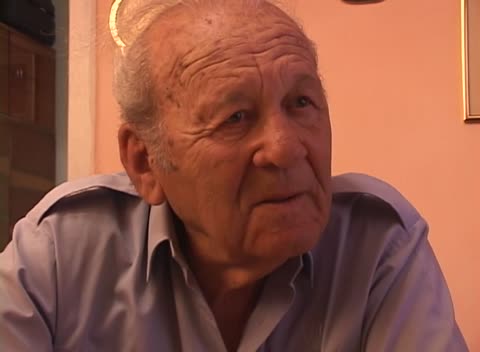
Walking toward Hirsch's home, the speakers talk about Hungary and Romania and about Luduș. Hirsch gives his birth year as 1924 and mentions studying at the gymnasium. Part of the exchange is in Hungarian, and the passage is fragmentary.
The formal part of the interview begins. Hirsch provides personal information and talks about prewar Jewish life in Luduș. According to him, 600 Jews lived there.
The formal interview starts with Hirsch giving personal information. Luduș lay about forty kilometers from Târgu Mureș. In 1941 it was a small town with about 600 Jews, a synagogue, a rabbi and a Talmud Torah. No Jews remain there today, and the last one died about two years earlier. He also mentions friends who were in Transnistria and says he himself was in several camps.
adds the town's institutions (rabbi, Talmud Torah) and the fact that no Jews remain
Hirsch talks about his life during World War II. He was confined to a ghetto in Southern Romania between 1941 and 1944. He then talks about his family. His parents and sister moved to Israel in 1960. Hirsch grew up with a sister and a brother. His brother was arrested for political reasons, Hirsch explains.
Hirsch speaks of being held in various camps in Romania from 1941 until the Soviet army liberated the area in 1944. He says his parents and sister left for Israel in 1960. He had a brother who was imprisoned as a political prisoner and died in August 1944, apparently of lung problems. He then begins to give his own name and the family name Hirsch.
adds that the brother died in prison in 1944, which the catalogue gives only as an arrest
Hirsch provides personal information and speaks about his education. He attended a religious school (cheder) and a Romanian Jewish school for four years. Hirsch also studied at a Talmud Torah school for two years. He then moved to Târgu-Mureş to attend a secondary school, which he attended for three years. Hirsch also addresses antisemitism during those years.
Hirsch gives his Yiddish name, Khayim Aryeh, son of Avraham, and his Romanian name, Edmund Hirsch. He attended cheder, a four-class Romanian-language Jewish school, and a Talmud Torah for two years. He then spent three years at the gymnasium in Târgu Mureș, until Jews were expelled from it. He ties this to Antonescu's fascism and antisemitism, and mentions that Jews were rounded up and taken to a camp in Turda.
Hirsch describes Jews being taken from Turda to a labor camp until the Red Army arrived in August 1944. He mentions the fascist government, the Iași pogrom and deportations to Transnistria, saying that only a minority returned. Kerler then asks about his father, who was named Avraham.
Hirsch speaks about his family. His father was born in a village near Luduș and was a grain merchant. Hirsch's son lives in Israel and made aliyah in 1987.
Hirsch talks about his family. His father came from a village near Luduș and was a grain merchant. His mother, Sarah, was a housewife. His parents and sister went to Israel in 1960, and the sister died some years ago. He had two siblings, his mother came from a family of twelve children and his father's family was smaller, and he remembers his grandfathers' long lives. He also says Luduș had about 600 Jews, one rabbi and two shoykhets, and that the synagogue was blown up after the war.
adds his parents' occupations, the two shoykhets and the destruction of the synagogue
Hirsch discusses antisemitism under communism and today, calling it a paradox that it exists where almost no Jews remain. He says his son lives in Israel, apparently since 1987. He explains that his mother tongue was Hungarian and Yiddish was also spoken at home, and that the town was split between Hungarian and Romanian speakers. He studied in cheder in Yiddish and recalls Jews from the villages being concentrated in a ghetto in Luduș.
adds the ghetto concentration of village Jews in Luduș
Hirsch speaks about Jewish life in the region during World War II. He then addresses his time as forced laborer at a stone quarry in 22:56. Hirsch then recalls Romanian soldiers who returned from a massacre in Odesa.
Hirsch describes Jews from the villages being gathered in Luduș and then taken to a camp in Turda. He then recounts forced labor in a stone quarry near Constanța in Dobruja until the Soviet troops came in August 1944. He says every Jew could write a novel, and mentions his mother's work as a nurse with the Red Army and relatives who perished. He recalls Romanian soldiers returning from Odesa who told openly of killing about 15,000 Jews, mentions a recent visit to Odesa, and talks about Auschwitz and his parents' whereabouts during the war.
adds the Turda camp, the Odesa soldiers' account, his mother's service and relatives lost
Hirsch speaks about the later war years, after Stalingrad, when the Romanian authorities treated Jews somewhat better. In a partly Hungarian-language account, a young man tells of being locked up with about ten other Jewish youths, with a minyan, as punishment, to be sent to Transnistria. They were released when an order sent officers to the front, which he calls great luck. He also says Botoșani Jews were not deported because they paid the authorities.
adds the rescue story of the ten young men and the bribery explanation
Hirsch mentions a pogrom after the war in what the transcript seems to give as Dorohoi, and shootings at its cemetery. He turns back to Luduș and describes its single synagogue with a beit midrash, and its morning and afternoon prayers and Sabbath services. He also speaks of the Jewish cemetery there, with about two thousand gravestones, which survived intact, and of his brother's grave.
Hirsch speaks about contemporary Jewish life in Dej, where a few Jews die each year. He worked for about fifteen years as secretary of the Jewish communities of Dej and Bistrița. He also mentions the labor camps and survivors' return. Kerler then asks him to say more about Luduș before they move on to Dej.
Hirsch speaks about his life after the war and family. He moved to Dej in 1960. In particular, he talks about his brother, who was imprisoned in 1942, accused of working for an illegal radion station. Hirsch explains that his brother returned home from forced labor in 1944 and died of tuberculosis shortly thereafter.
Hirsch says he settled in Dej in 1960 and speaks about his brother Iosif Hirsch, who was a radio technician. The brother was arrested as a political prisoner for building an illegal radio station with two Romanian colleagues and was sentenced to twelve years of hard labor. He was beaten, lost his health and returned home sick with tuberculosis, and died soon after. Hirsch also says Dej had about 4,000 Jews before the war and about a thousand at most afterward.
adds the brother's occupation and the Dej population figures
Hirsch speaks about his cheder education and prewar Jewish life in Luduș. He also addresses the population structure of the town with a majority of non-Jews. He also addresses his family.
Hirsch recalls his cheder, with a teacher named Kaufman (?), and the Jewish school, cheder and Talmud Torah housed in a single building in Luduș. He gives the town's population as about four thousand, half Hungarian and half Romanian, with about 600 Jews and some Roma, and touches on Romanian history. He mentions the Jewish pupils' gatherings, the rabbi, and a kosher restaurant in Târgu Mureș. He names the shoykhet (Mendel Berg (?)), says there was no yeshiva, and speaks about uncles and relatives named Berkovits. He ends with the distances from Luduș to Dej, Cluj and Turda.
adds the population structure and the Târgu Mureș lyceum and kosher restaurant
Hirsch describes the Dej synagogue, which was not dynamited, because a quarter of poor people lived around it. He says that before the war a Jewish quarter and a Jewish street stood about fifty meters from the synagogue. Part of the account, in Hungarian, says that blowing it up would have destroyed the surrounding houses.