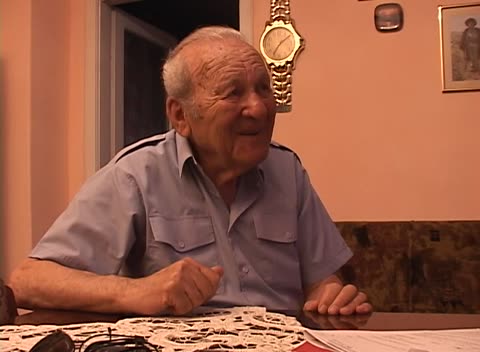
Hirsch talks about food customs around Yom Kippur, especially the large meal on Erev Yom Kippur and the children's fear of eating. Kerler asks about the family's dishes, and they discuss a dough dish and what it was called. The passage ends as Kerler turns to gefilte fish.
Kerler's questions about dish names and the dough dish.
Hirsch and Kerler discuss gefilte fish and "false fish" (made when there was no fish), and whether the fish was sweet or salted. They discuss a Passover potato dish, sweet pastry and bundlekh, then the dishes for each weekday, including the weekly soup with meat on market day and Sabbath cholent. Many dish names are garbled.
The weekday-by-weekday menu including bundlekh, market-day soup and noodles.
Hirsch answers questions about cultural terminology, such as a golem, the word for a church or synagogue, and the term for havdalah. He names wealthy Jewish landowners and says rich Jews built the synagogue in Luduș. He also mentions the town's four churches and the Jewish community's social life.
Questions on a golem and the word for a church, plus prewar Luduș with its wealthy landowners and churches.
Hirsch talks about the decline of the Jewish population in Luduș after the war, from several hundred Jews to a couple of hundred around 1960 (?). He says his cousins had left for Israel by 1948, and Kerler asks where he lived in between. The passage ends with Kerler asking about a memory remedy before thanking him for his help.
The talk about memory loss and a memory remedy, and Kerler's closing thanks.