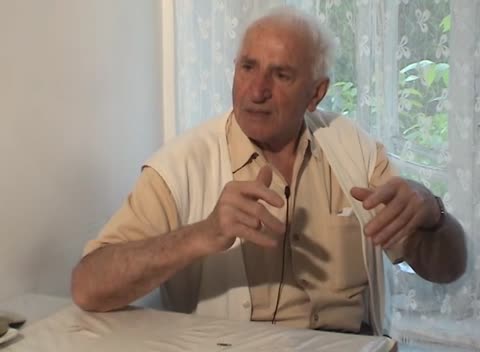
Finkelshteyn answers questions about prewar Purim. Children, boys and girls, dressed up in each other's clothes. He says he remembers no songs. Asked about a chimney-sweep costume, he turns to the cabs and horse-drawn carriages used in town, since there were no taxis. He then describes the special carriages used for weddings and the hearse, and how mourners followed a funeral on foot to the cemetery.
Finkelshteyn talks about prewar traditional weddings. He states that his parents were unterfirers (i.e. person who accompanies the couple getting married to the wedding canopy) at each of their children's wedding. Finkelshteyn does not have children.
Finkelshteyn describes prewar Jewish weddings. The rabbi came to write the ketubah and the couple was led to the huppah. His parents served as the couple's escorts (unterfirers) at each of their children's weddings. He has no children himself, though his siblings do. He is vague about dancing and a wedding jester because he was small at the time, and he says he has been married for some fifty-six years.
The catalogue entry fits, and the transcript adds his own marriage of some fifty-six years.
Finkelshteyn answers questions about a custom of throwing coins into the water by the ritual bath, and about the matzo factory and the straw sacks in which matzo was kept for Passover. He talks about foods eaten at Passover, Hanukkah and Shavuot, including potato dishes, dried-fruit compote, fried dumplings and dairy-only meals on Shavuot. He cannot say why Shavuot food is dairy.
Also covers Hanukkah and Shavuot food and the ritual-bath custom.
Finkelshteyn speaks about prewar Yiddish culture, particularly theater and musical performances. He also mentions that he saw the movie "A brivele der mamen" (a letter to mother).
Finkelshteyn speaks about the Yiddish theater in Iași, the first Yiddish theater in Romania, and how children helped as extras and with scenery. He mentions touring artists, a musician family named Sigali (?), and plays on the theme of emigrants' families. He says Yiddish films never reached Romania except one, "A brivele der mamen", which people fought to get in to see. He notes that the theater building is gone, and that a monument now stands at its site.
Also covers the memorial at the old theater site and emigration themes.
Finkelshteyn answers Kerler's questions about Yiddish words. He explains words for an ignoramus and a fool, and how a well and a pump with a handle worked. Most of the passage is carpentry and joinery terminology from his trade: planes, saws, the workbench, workshop, tools and a wooden mallet. He notes that many of these words come from German.
The transcript shows long carpentry-term elicitation, with German-derived words.
Finkelshteyn speaks about prewar Jewish life in his neighborhood in Iași. He also addresses childhood games and mentions that he built sleighs for the entire neighborhood. Finkelshteyn then explains how he built skates from a window frame.
Finkelshteyn says that about half of Iași's population was Jewish and that Jews lived in Jewish quarters, though not in a closed ghetto. He recalls childhood games with nuts, rag balls, and shoes his mother made from rags. He built sleighs for all the children of the street. He also describes making ice skates from iron window frames.
Finkelshteyn talks about non-Jews who apprenticed with Jewish craftsmen and about the rise of antisemitism, which led to trade schools for Christians. He speaks of visitors from abroad who no longer know Yiddish and need a translator, and of rabbis and yeshiva students who come to Iași. The synagogue is now closed. At the end he says his life was full of troubles.
Finkelshteyn addresses his best moments in life during the postwar Soviet period. He also speaks about his family and wife. Finkelshteyn has relatives in Israel.
Finkelshteyn calls the best time of his life the Soviet-style socialist period (he is probably speaking of postwar Romania), when he felt respected as a good worker in a collective. He speaks warmly of his wife and of never quarreling with his brothers and sisters. He has visited Israel a few times. He says he knows no songs, and that his wife's mother, from Bessarabia, sang well.
Adds his wife's family from Bessarabia and his remark that he knows no songs.