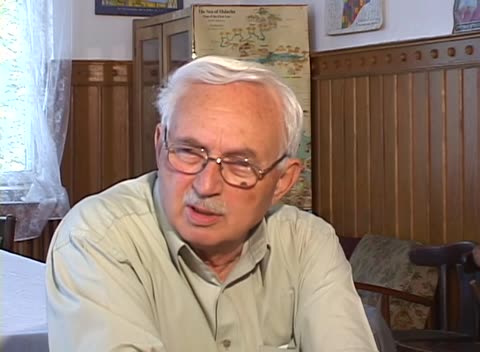
Kerler states the date and place of the recording and asks how Iași is said in Yiddish. The speakers discuss the Bukovinian and Iași pronunciations, and Kerler announces that they will talk about prewar life in Siret and then briefly about Botoșani.
The passage also covers Kerler's announcement of the interview plan (Siret, then Botoșani).
Iakob provides personal information and talks about his life during World War II. Iakob states that between 1941 and 1945, he was confined to several ghettos in the Transnistria region, including Pavlovca, Bershad, Nova Obodivka and Pishchana, Odesa province. He speaks about life in the Pavlovca ghetto, including starvation and diseases, and does not remember any shootings and beatings. Iakob then shares other episodes about ghetto life, including looting by Romanian soldiers and mentions his family's escape from Pavlovca. His father worked in his profession at a soap factory in Nova Obodivka.
Davidovich gives his birth date, with Kerler checking the year, and then tells of the deportation of his family from Siret in 1941 to Transnistria. They were held in several places, among them Pavlovka, Bershad, Obodovka and Pishchana, until 1945. In Pavlovka about 2,500 Jews were held in a pig farm, with starvation and typhus; he says nobody shot or beat them, but Ukrainian bandits came at night to kill and search for gold. His father went out looking for work, got a job making soap for a Romanian lessee near Pishchana, and brought the family there.
The transcript adds the Ukrainian bandits' night attacks, the lessee who hired the father, and the father's teaching a local man the trade.
Iakob speaks about his family's return to Siret in 1945. He explains that his father did not find work in Siret and therefore his family moved to Botoșani. Iakob studied at the Iaşi University. He then briefly addresses life in the Bershad ghetto.
Davidovich says the family returned to Romania in 1945 and stayed about three months in Siret. His father had no work there, so they moved to Botoșani (as the name is heard), where he again made soap. Davidovich then studied in Iași and at the university. Kerler asks about songs in the Bershad ghetto, and Davidovich says nobody sang there and that the family stayed only a few months.
The transcript adds Kerler's questions about songs in Bershad.
Iakob speaks about his family, particularly his grandfather, a melamed. He states that his grandfather also knew Latin and Greek and prepped students for secondary school in Vienna. Iakob also mentions how his family had to leave behind his grandfather in Suceavea (Yiddish: Shotz) at the beginning of the war. He also mentions the fate of the Jews in the region during World War II, as well as memorialization.
Davidovich talks about his mother's father, the melamed Meir Hersh Shekhter (name as heard), and his wife Golda. The grandfather taught small children and older boys Hebrew, and gave lessons in Latin and Greek to students preparing for medical studies. He describes how the old people left behind in Siret at the deportation, eight in all, some blind, were murdered by legionnaires, beheaded and buried in sand. He also tells of his other grandfather, who visited a daughter in America in the 1930s and came back because he could not keep kosher there, and who died in a trench on the march. A large monument now stands in the Siret cemetery.
The transcript adds the second grandfather's trip to America, the murder of the old Jews left in Siret, and the monument.
Iakob discusses his childhood memories. He attended religious school (cheder) to study with his grandfather. Iakob also studied at a Romanian school. Iakob then addresses his life in the Pishchanka ghetto, where he studied with a kosher butcher religious texts.
Davidovich recalls his prewar childhood: he attended cheder, where his grandfather was the melamed, and about two years of Romanian school until 1941. In Pishchana, in the ghetto, his father had him study religious texts several times a week with the local ritual slaughterer. Kerler confirms the point, and Davidovich says that otherwise no studying was possible in Transnistria.
The transcript adds the Romanian school, and that the study in Pishchana was with a shoykhet arranged by his father.
Davidovich says he returned from Transnistria at age 13 and was placed in the first class, knowing no Romanian but having learned Russian there. He knew some German from his mother, who was born in Siret and went to school in Austria-Hungary. Kerler asks about her name and work: Dvoyre (?) Shekhter, a housewife. Ruti confirms, and Kerler remarks that the twin siblings were together and spoke Yiddish.
The transcript adds the languages he knew after the return, his mother's name and occupation, and the twin sister.
Ruti speaks about postwar Jewish life in Siret. She recalls how Jews buried people and tells episodes from ghetto life, including how she encountered a German doctor. Iakob then complements this story.
Ruti recalls the aftermath of the Transnistria years: only two families with children came back to Siret, and she remembers the dead being carried out on a cart. She describes a woman's body in a trench and two dead children. She then tells how a German doctor in Pishchana, when she was six or seven, took a liking to her and wanted to take her to Germany. Her parents hid her, he threatened them, and the Russians arrived before he could act. Davidovich adds details, and Kerler says the whole town knew the story.
The passage is mostly Ruti's wartime memories (the German doctor, corpses) rather than postwar Siret life, with Iakob adding details.
Ruti and Davidovich answer questions about which language was spoken at home and recall that German was forbidden to them in Transnistria. Kerler asks about Volhynia place names, and Davidovich talks about his wish to visit Obodovka, Pavlovka and Pishchana; they discuss Bershad and a song Kerler recorded. They then retell their father's jokes and sayings: that a Jew is beaten twice, the rebbe who divides a sack of nuts, the woman who comes to the rebbe about her husband, and a joke about queueing. There is also a story about a synagogue and a shop selling yeast.
The transcript adds recollections of the father's jokes and sayings as well as the language question.
Kerler puts dialectological questions about forms of address, the singular and plural forms of 'you' and the corresponding verb forms. Davidovich explains the plural forms and illustrates greetings, and then a joke about greetings, hard to follow in the transcript, is told. They mention that the father was fond of telling jokes, and Kerler mentions making a recording.
The transcript shows questions on the singular and plural forms of 'you', and the joke on greetings is only partly intelligible.
Iakob speaks about Passover celebrations. He then speaks about postwar Jewish life in Botoșani. Iakob and Pnina joined the youth Zionist organizations Bnei Akiva and Gordonya. Iakob also lists Havat HaNoar HaTzioni and Hashomer Hatzair. Pnina then describes meetings.
Davidovich says his father led the family seder with a fine singing voice and that he recorded it on cassette. Asked about Jewish life after the war, he says he was not in Siret but in Botoșani (as the name is heard), where the organizations included Bnei Akiva, Gordonia and others. Pnina says they sang many songs, held literary evenings and studied Zionism and hakhshara.
The passage opens with the father's seder singing and a recording of it.
Pnina provides personal information and talks about her family. Her father was a teacher and was born in Frumușiţa. Pnina is a pediatrician and grew up with a brother. Pnina then speaks about her father's arrest. Ruti and Iakob also share information about their family, specifically their father. They then address weddings.
Pnina gives her maiden name Albrecht, her father Haim's and mother's names and her brother Baruch, and says her father was a Zionist from Frumușica who taught them Hebrew. She is a pediatrician. When she was in her fourth year at the faculty her father was arrested, and she was expelled from the faculty. Ruti and Iakob explain their Hebrew and Yiddish names (Rukhl-Leye, Yankl Shimshn), the names of their parents and grandparents and the added name Alter. The talk moves to religious and civil weddings and mixed marriages in Israel.
The transcript adds the names of grandparents, the added name Alter, and the discussion of weddings and mixed marriages.