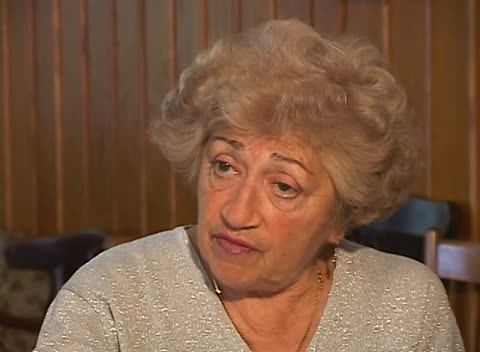
Kerler asks about the Jewish population of Moldova and Romania; a figure of about fifteen thousand is mentioned. He then asks whether they remember children's songs or other songs. The interviewees say they know many Yiddish and cantorial songs and keep them on a computer, and a father's good singing is mentioned.
opens with a question about how many Jews live in Moldova and Romania; the singing is Yiddish and cantorial songs kept on a computer
Pnina discusses her childhood memories of Odobești, as well as her family. Pnina attended a Yiddish school in Odobești. She then explains how her family took went on vacation in Frumușiţa in 1940 and were unable to return to Odobești due to the war. Pnina then speaks about her family's life during World War II. She describes how her father was taken to forced labor to Botoșani and then Edineț. Pnina and the remaining family evacuated to Botoșani, where they were confined to a ghetto. Pnina also recalls violence against her grandparents in 1941.
Davidovich says she was born in Frumușiţa(?), and that her father was a teacher at a Jewish school in Odobești. In 1940 the family visited her grandparents and could not return because the war began. Her father was taken to Botoșani and then to forced labor in Edineț(?). She, her mother and her grandmother were evacuated to Botoșani, left on an empty field, and took shelter with Jewish families, among them the Leibovich family. She also tells how her grandfather was attacked and robbed on the road in 1941, and died of his injuries in a hospital in Iași.
adds the grandfather's attack and death in Iași, and her father's forced labor and return
Pnina addresses her life after the war. She attended a Romanian Jewish school in Botoșani, where her father also taught. Iakob and Ruti then talk about their Jewish education with a private tutor after the war. Iakob also mentions Yiddish language classes at the Romanian school.
The speakers discuss schooling after the war in Botoșani. The school was called a Jewish school but taught in Romanian, and the father taught there. They mention private tutors for Hebrew and Jewish subjects and two hours a week of Yiddish in the Romanian schools. Kerler asks about Yiddish literature and authors they read, and Itsik Manger's recorded Megillah is mentioned. The passage ends with his question about Purim after the war.
adds Kerler's questions about Yiddish literature and authors, and the Itsik Manger cassette
Asked about Purim after the war, the speakers recall hard times and hunger in 1945–46, with Purim treats made at home but no old-style Jewish life. At Kerler's request Iakob tells a story about his parents in Iași. They were given a flat in a block where all the doors looked alike, and his mother once tried the wrong door and met a neighbor. A passage on the word for a stove tile or similar (kakvele) also occurs. The story then turns to his mother's sister in Palestine.
adds Iakob's anecdote about the identical doors in the apartment block