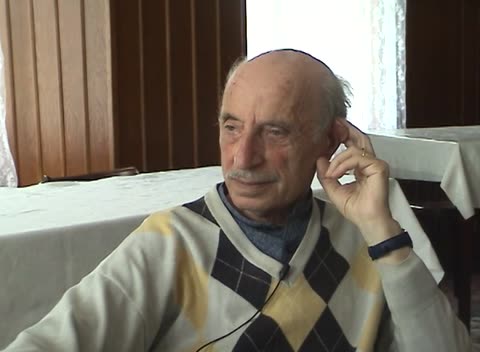
Kaizerman provides personal information and speaks about his family. His father, who was born in Dömös 1:25, Hungary, owned a shop and worked as 2:30 beforehand. Kaizerman's mother was born in Vaslui. Kaizerman grew up with two sisters.
Lemster introduces Kaizerman as leader of the Iași Jewish community. Kaizerman gives his name, his parents' names and his birth in Iași in 1924, and says he lived there through the war. His father, Avrom Leyb, was a craftsman and later had a small shop. His mother, Rivke, was a housewife from Vaslui, and he names two sisters, one living in Bucharest and one in Iași.
The transcript has the father born in Iași and names the two sisters; it does not show Dömös.
Kaizerman discusses his childhood memories, including his education. He atteneded a Romanian Jewish school. Kaizerman then speaks about his bar mitzvah.
Kaizerman talks about his schooling in Iași, a Jewish school where Yiddish, Romanian and mathematics were taught, and says he knew Yiddish and Hebrew well. He recalls reading Sholem Aleichem and Mendele and children's games. He then speaks of his bar mitzvah, tefillin and rabbis who taught him, one of them a professor-rabbi Shafran (?).
Kaizerman talks about his family, particularly his father's observance. He then discusses his observance after the war during military service. Kaizerman states that he attended services in uniform on holidays.
Kaizerman describes his father as a very observant Jew who went to the synagogue daily. He says that during the war, as an army officer (a major), he attended services in uniform on holidays.
Kaizerman speaks about prewar Jewish and religious life, as well as poverty in Iaşi. Kaizerman recalls unemployment on the street he lived on. According to Kaizerman, more than half of the population was Jewish. He also remembers local rebbes.
Kaizerman describes the Jewish quarter where he grew up, with many poor, unemployed Jews and a few bankers and doctors. He says Iași had about 80,000 people, 45,000 of them Jews. He mentions several talmud torahs, his melamed, many rabbis, and the meaning of a 'good Jew' (a wonder-working rebbe), including the Ștefănești rebbe visited for blessings and notes.
Also covers the meaning of 'a good Jew' and the Ștefănești rebbe.
Kaizerman describes Friday and Sabbath at home before the war: the bathhouse, synagogue, his mother's blessings and the Sabbath meal. Fish, soup, meat and beans were eaten, and the cholent was kept warm in a fire prepared on Friday. He does not remember the fish recipe beyond potatoes and a sauce.
Kaizerman addresses prewar Passover celebrations. He provides an account of the holiday routine. Kaizerman then explains how his mother would kosher meat, before talking about prewar Purim celebrations.
Kaizerman describes preparations for Passover: cleaning and koshering the house, burning the chametz and eating matzo. His father led the seder and he asked the four questions. He recalls his mother salting meat to make it kosher. He then describes Purim, with sweets and preserves, and masked players going from house to house with the Esther story, together with Gypsy musicians and klezmorim.
Kaizerman speaks about prewar Yiddish culture, including the Yiddish theater founded by Abraham Goldfaden. He also remembers using the library established by the Zionist organization Hashomer Hatzair. Kaizerman then answers questions about cultural terminology.
Kaizerman speaks of Yiddish theater in Iași, including Goldfaden's theater and a performance of The Dybbuk, and of Yiddish libraries. He answers Lemster's questions about the words 'dybbuk' and 'golem'.
Includes the discussion of the meanings of dybbuk and golem.
Kaizerman addresses holiday celebration, including Shavuot, Simchat Torah and Sukkot. Kaizerman describes how neighbors celebrated Sukkot in a sukkah together. He then addresses prewar life Iaşi in general. Kaizerman mentions two non-Jews who converted.
Kaizerman briefly addresses Shavuot, Simchat Torah, which he calls a great joy with the Torah carried in synagogue, and Sukkot, with a sukkah in the courtyard where Jewish neighbors came. He says non-Jewish neighbors saw but did not join. He says few non-Jews now understand Yiddish, and speaks of two or three non-Jews he knew who converted. One married a Jew and their children went to Israel.
Kaizerman speaks about prewar Jewish life, including occupational structure and Zionist organizations. He lists Hashomer Hatzair, Dror and Gordonia. Kaizerman also recalls activities of the Maccabi sport club and talks about local cultural life.
Kaizerman answers questions about Jewish life in Iași: occupations (little farming, unlike Vaslui), Zionist organizations including Gordonia, the Maccabi sports club with football and gymnastics, and the Jewish press, with a Romanian-language Jewish paper. He also mentions libraries, Jewish students from Bessarabia at the university, Yiddish films and klezmer music.
Kaizerman briefly recalls Hanukkah in the house, with candle lighting and potato latkes. He then answers questions about local rabbis, the Yiddish words for a cemetery and the Hasidic groups in the city, including Chabad. He is also asked about matchmakers, written engagement contracts and the wedding jester.
Also includes Yiddish cemetery terms, Hasidic groups and matchmakers.
Kaizerman talks about kosher butchers, Sabbath morning breakfast with a little wine or brandy, and his mother's healing of the evil eye with water and coals and spoken words. He answers questions about the word for a cemetery and describes going to graves today, asking the dead to pray for the living and for Jewish soldiers. The passage ends with an invitation to eat.
Kaizerman answers Lemster's dialectological questionnaire in Yiddish, with some Russian and Romanian. Items include wedding and congratulation phrases, words for 'luck', and everyday words such as 'cold', 'high', 'fast' and 'run'. Others are verbs of sickness and sleep, a cross, a convert, body parts, the attic, the garden and the fence, and words for 'room', 'suddenly' and 'enemy'. Kaizerman often says he does not know the item or asks for it to be repeated.