0:00
The team greets Chirilau, who is not Jewish herself, in front of her house and sets up the interview with her.
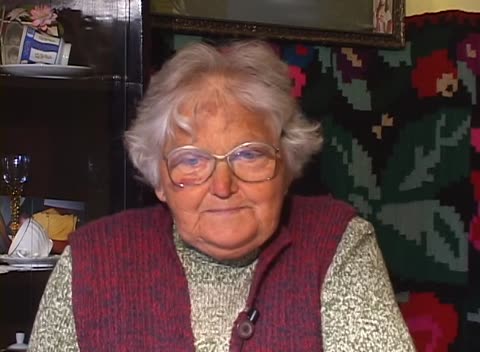
One conversation with Maria Chirilau, continuing over MDV 281, MDV 282.
The team greets Chirilau, who is not Jewish herself, in front of her house and sets up the interview with her.
Chirilau provides personal information and speaks about prewar life in Mihăileni, particularly the peaceful relations among ethnic minorities. She recalls how Jews attended Christian weddings and vice versa before and after the war.
Chirilau gives her birth date and place, Mihăileni, in 1932. She recalls the town's three quarters of Jews, Romanians, Germans and Ukrainians living in harmony, with Jews and Christians attending one another's weddings. She tells a story about her father and a neighbouring friend, whose wives gave birth on consecutive days.
Gives her birth date and tells the anecdote about two friends whose wives gave birth on consecutive days.
Chirilau talks about her family. She grew up with a sister. She then talks about traditional weddings before the war.
Chirilau gives her mother's name as Lena and says she had one sister. She talks about the neighbouring family's children, one of whom died and another who lives in Israel and visits her yearly, and Kerler offers to find his phone number. Asked about weddings, she describes Jewish weddings with a buffet, dancing and the kolomeyke dance, in contrast to Christian ones.
Covers the neighbour family's children in Israel and the contact details, and the kolomeyke dance.
Chirilau discusses her childhood memories and games. She attended a Romanian school. Chirilau maintains that she only communicated with her friends in Yiddish. She then addresses the occupational structure among Jews.
Chirilau explains that she had to learn Romanian at school and that the neighbourhood children, Jews and non-Jews, played together in Yiddish. She names games played with rag dolls and hide-and-seek, and says her family spoke Romanian at home. Lemster asks about the Jewish trades before the war, and she names shoemakers, tailors, merchants and bakers.
Chirilau speaks about Jewish life in the region during World War II. She recalls how her family and friends returned home and their lives after the war. She has relatives in Canada.
Chirilau recalls the war years and the deportation of the town's Jews to Transnistria, and the return after the war. She tells about a neighbour who came back with four children after his wife died there, and about their poverty and illness. Two of the children went to Israel, one to Canada, and the interviewee remembers a visit from the Canada relative.
Adds the deportation to Transnistria, the return of a widowed neighbour with four children, and the later emigration to Israel and Canada.
Chirilau speaks about her relative's visit from Israel in 1965. In particular, she talks about fixing up the grave of her brother-in-law's father.
Chirilau recalls a visit from her relative Natan, who came from Israel in the 1960s. She tells how she had the Jewish graves put in order and a stone repainted and dated, and how he paid her for the work. She also discusses the word 'pares' as a word for money.
The catalogue says brother-in-law's father; the transcript shows the grave belonged to a neighbour's father and mentions a 1965 date and costs.
Chirilau speaks about Jewish life before the war, particularly theater performances and synagogues. Chirilau remembers when the wooden synagogue burned down.
Kerler asks about theatre before the war, and Chirilau says that Yiddish and Romanian troupes came, in a primitive style. She then speaks of the town's synagogues, one for each trade, and the festive days when the whole town would go. She remembers the wooden synagogue burning down when she was five and that the others were built of brick.
Chirilau talks about prewar holiday celebration, in particular Purim and Purim shpiels. She maintains that Jews and non-Jews dressed up on Purim. Chirilau then talks about a poor family in town.
Chirilau recalls Jewish holidays, including Simchat Torah dancing and Sabbath attendance at the synagogue. She talks about Purim, when Romanians, Germans and Jews dressed up and ate hamantaschen, and tries to recall a Purim song with Kerler. She then tells about a poor local family, a short husband who drank and a tall wife with many children.
Adds the attempted recall of a Purim rhyme with Kerler and the stories about a poor couple.
Chirilau talks about prewar cultural life, particularly the local Jewish library. She then talks Passover celebrations before the war and recalls private tutors for the boys' religious education. Chirilau then talks about Rosh Hashana.
Chirilau answers questions about Jewish books and says the library belonged to the Yiddish school. She knows nothing of Zionists before the war but remembers two boys leaving as pioneers. She talks about Passover matzo and potato dishes, a tutor who came to teach the boys, and the shofar blown at the High Holy Days. A stretch about language and the phone is garbled.
Adds the Zionists/pioneers, the tutor and the shofar, and a garbled stretch on a phone call.
Chirilau addresses prewar weddings. She then talks about Jewish life after the war. Chirilau remembers Christian women who converted to Judaism.
Chirilau discusses mixed marriages between Jews and Christians, before and after the war, saying they were not a catastrophe. She mentions Jews from Czernowitz who stayed in Mihăileni after Transnistria and married Christians. She says that Christian women could convert to Judaism and describes their Sabbath customs, but that Jews did not enter monasteries.
Chirilau talks about her family. Her father was a coachman. She then addresses prewar occupational structure and mentions a Jewish family Regenshtrayf who owned a factory.
Chirilau talks about her father, an honest coachman who transported wine for Jewish tavern keepers, and about her mother, who worked the field and garden. She says few Jews worked the land, and names the Regenshtrayf pottery factory, with about sixty workers, and other rich Jewish families. She also mentions a workshop making kerchiefs and the word for them.
Adds the rich families and the Regenshtrayf factory.
Chirilau speaks about prewar Jewish life. She tells an espisode about a poor from her hometown man who gets married. According to her, wealthy and poor Jews were equally represented. She then speaks about other locals.
Chirilau tells a comic story about a short poor man, brother of Malka's husband, who was matched with a very tall bride. She says wealthy and poor Jews were about equally numerous. She tells about a madman, a drunk beating his wife, and a poor man who slept on a rag.
The catalogue sentence does not mention the madman Moshe Bilet(?) and the brawling neighbours.
Chirilau addresses prewar cultural life, in particular musical performances. She then recalls proms.
Chirilau names the local klezmer musicians, the Nadler brothers, Yoselekazak(?) on accordion and a drummer from Galati, who played in one orchestra at Jewish, Romanian and Ukrainian weddings. She says she will speak better the next day. She then describes the balls held for young Jews and Romanians, and on holidays, with fine clothes.
Chirilau speaks about prewar religious life, in particular religious authorities. She then addresses geography and prewar buildings in Mihăileni.
Chirilau answers questions about prewar religious life: the rabbi, a cheder teacher and the town's ritual slaughterer. She is asked what the Jews called the town and recalls the names of nearby cities, such as Seret, Iași and Rădăuți(?). She says no synagogue buildings survive and that a Jewish bathhouse also stood in the town.
Names the neighbouring towns and the lost synagogue buildings.
Chirilau speaks about prewar Sabbath celebrations. She then addresses food customs, in particular variety of fish.
Chirilau recalls attending the synagogue and being asked to light Sabbath candles for a Jewish woman, and that some Jews were not observant. She lists Jewish foods and answers Lemster's and Kerler's questions about how gefilte fish was made, with bread, egg and a little sugar, and meat dumplings of beef. A short exchange about firefighters and the synagogue fire closes the passage.
Chirilau speaks about folk and healing customs. She then talks about a visit from a relative, who lived in Canada.
Chirilau describes folk cures: quenching coals in water against the evil eye, wrapping an inflamed spot, and cupping glasses. She then tells of the barber shop of a neighbour's father, and the visit of his son from Canada, whom she met on the road, who kissed her father in bed. She explains that she is known locally as Mika and officially as Maria.
Gives the Canada visit story about the barber and the nickname Mika.
Chirilau speaks about her work after the war. She is a tailor and worked the fields. She then provides personal information and addresses prewar Jewish life.
Chirilau says she worked as a tailor, in handicraft and in the fields after the war, and that her husband was an accountant. Kerler asks about her family name, Haynts, from Filip's family. She says the family was Romanian and that, before the war, Jews spoke Yiddish at home, though doctors spoke Romanian or German.
Covers the family name and languages spoken in Jewish homes.
Chirilau speaks about prewar traditional weddings and Purim celebrations.
Kerler asks about prewar Jewish weddings and the wedding jester, and Chirilau describes the huppah set up by the synagogues of the tailors and shoemakers, without recalling the entertainer's name. She also confirms that small plays were performed at the Yiddish school on Purim.