0:00
Maria Chirilau provides personal information.
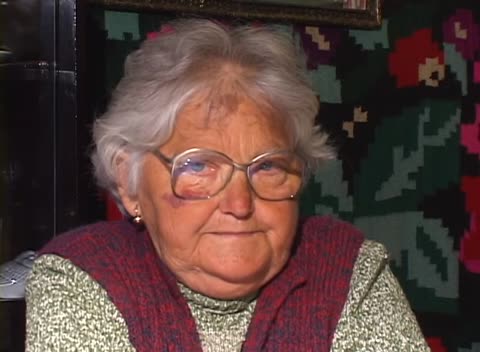
One conversation with Maria Chirilau, continuing over MDV 281, MDV 282.
Maria Chirilau provides personal information.
Chirilau answers dialectological questions from the AHEYM Yiddish linguistic questionnaire.
Chirilau answers questionnaire questions: greetings and farewells used in the street, whether she knows words from Hebrew and the holy language, and the names of holidays. She also says she does not remember a song she is asked about and mentions a grandson who reads English.
Chirilau speaks about life today, before she speaks about Sabbath celebrations before the war.
Chirilau talks about her grandson, who visited today, and about the songs he sang that she recognised. Kerler explains the researchers' backgrounds and that they work in an international group. She then recalls a Sabbath song sung after services that her mother mentioned, and answers questions about animal terms and about an unfaithful or dishonest woman.
Includes an exchange about the interviewers' origins and a Sabbath song.
Chirilau answers questions about cultural terminology. She then speaks about prewar Jewish life in Mihăileni, including Sabbath celebrations.
Chirilau answers questions about terms such as drunkard, fool and proverbs, and says she cannot recall them on demand. She describes the town as handsome, with well-kept houses, and recalls women blessing the candles on Friday. She says Jews stopped working on Friday afternoon, and shopkeepers and tailors took up work again after the Sabbath.
Covers Friday-evening candle-blessing and the stopping of work before the Sabbath.
Chirilau answers dialectological questions from the AHEYM Yiddish linguistic questionnaire. She also addresses prewar kosher butchers and matchmakers, as well as geography.
Chirilau answers questions about words for enemy and about the singular and plural of shoykhet. She says the town had two slaughterers, one for poultry and one for cattle, and recalls a Jewish butcher named Moshe Kune (?). She describes matchmakers who arranged remarriages and says Jews and non-Jews lived in the area. She also gives the distance to the border, roughly two kilometres in a straight line, and Kerler promises to come again.
Adds the butcher, matchmaker and border-distance topics, including the interviewers' reassurance that they are not laughing at her.
Chirilau speaks about her life today and her visits to the local cemetery.
Asked about life now, Chirilau says things are not good in any respect, and Kerler hopes they will improve. She says she regularly visits the Jewish cemetery, before Passover and before Rosh Hashanah, to see that no weeds have grown over the graves. She asks for blessings and a long life there and mentions the grave of her mother, which is fenced.
Chirilau answers dialectological questions from the AHEYM Yiddish linguistic questionnaire. She then speaks about her friends.
A long questionnaire stretch covers household words (attic, beams, garden, window pane), curses, colours, body parts, kinship and numbers, as well as sentence translations. Chirilau also answers questions about illness, verbs of motion, being pious or honest, a Jew who converted, prayer, the word for grandmother and street versus town. Toward the end she describes a Jewish street and a local pharmacist, Zakhachinski, and his wife, a doctor from Craiova (?).
Includes a recollection of the town pharmacist and his wife.
The team concludes the interview with Chirilau.
The interview closes, with a few remarks about Jews from Iași.