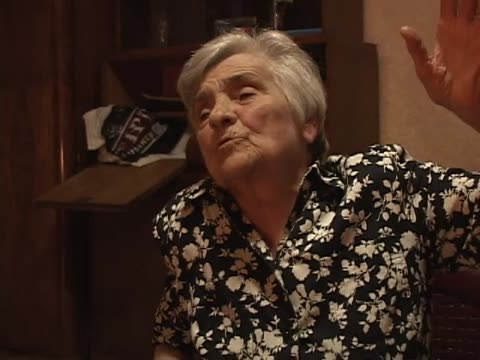
Freundlich recalls women from Auschwitz and a household with a governess who was deported with them. She then describes a woman from Budapest who came to the synagogue wanting a conference on why Jews do not keep Jewishness, and her own reaction, with reflections on Jewish history and fate. Kerler interjects with a Yiddish saying about being born a Jew.
Includes her reflections on Jewish history and an interjection by Kerler.
Freundlich shows photographs, including a birthday picture of her son and the grave of a Jewish actor. She recalls declaring Yiddish her mother tongue to an official in 1977 and mentions her daughter, a piano teacher in Satu Mare, and her son the professor. She also talks about Christians who spoke Yiddish, answering questions from Kerler and Lemster.
Covers the 1977 episode about declaring Yiddish her mother tongue and Christians who spoke Yiddish.
The camera records footage of the Oradea synagogue. The team then meets Gershun Shwartz and sets up an interview with him. He has lived in Oradea (Yiddish: Groysvardeyn) for forty years. The team then chats with community members about prewar Jewish life in Oradea.
Camera work and chat at the Oradea synagogue. Kerler and Lemster speak with a visitor who lives in the United States and was born in Budapest; they trade birth years and places, talk about Satu Mare, Moscow, Cluj and Budapest, and the Jewish community of Cluj. They arrange to meet and exchange contact details.
The transcript shows the chat is mostly with an American visitor and does not clearly show an interview set up with Gershun Shwartz.
The formal interview with Freundlich, who is the cousin of Elizabeta Freundlich's late husband, begins. He speaks about Oradea and then provides personal information, before talking about his family. His father was a wood merchant. He grew up with three brothers and three sisters. Freundlich also addresses his family's fate during World War II. His mother was born Baia Sprie and his father near Jibou.
The formal interview with Mihai Freundlich begins. He explains the Yiddish name of Oradea and its fortress, gives his name, birth in 1921 near Baia Mare, and his Yiddish name Avrum-Khayim. He describes his parents (father a poor wood dealer, mother Rachel), his siblings, grandparents and the deportation of relatives. He says he and some siblings survived deportation and two brothers died in a camp.
Gives the Oradea fortress etymology, the names and birth years of siblings, and the grandparents' occupations and deportation.
Freundlich speaks about his life before the war. He was an employed merchant. Freundlich worked at an egg factory after the war, after he moved to Oradea. He also worked as secretary for the local Jewish cultural organization. Freundlich then speaks about his yeshiva education until he was fifteen years old. He attended three yeshivot in Şomcuta Mare, Tîrgu Lăpuş and Copalnic-Mănăştur. He also studied with a rabbi in Baia Mare.
Freundlich lists his work: before the war an employee of a merchant, after the war a partner in a factory until nationalisation, secretary of the Jewish cultural association, and an oil factory worker. He then describes his yeshiva study up to age fifteen in three small yeshivot and with a rabbi in town, and recalls a teacher named Polak.
Freundlich talks about his work as merchant and then speaks about prewar Jewish life in Baia Mare. According to him, eight hundred Jews lived there. Freundlich also recalls enmity between Hasidim and Ashkenazim. He then talks about his father and different Yiddish dialects.
Freundlich recounts working for a merchant after yeshiva, then describes Jewish life in the town near Baia Mare, with several hundred Jewish families, the arrival of Hasidim in the 1930s and the new Hasidic beys-medresh and their rivalry with the Ashkenazic Jews. He discusses the languages spoken at home, his father's literary Yiddish and German, Hungarian among the children, and differences between the Yiddish of Transylvanian, Polish and Moldavian Jews, in answer to Lemster's questions.
Adds the languages spoken at home and dialect differences among Jews.
Freundlich discusses his childhood memories before the war. In particular, he recalls the difficulties to reach religious school (cheder) every day and shares his daily routine. On Sundays, Freundlich explains, he attended cheder all day.
Freundlich recalls his childhood daily routine from age six: cheder before dawn, prayer, the non-Jewish state school in the morning, back to cheder and school again in the afternoon, with Sundays spent all day in cheder. He describes the long way, the lack of electricity and the children singing under windows.
Freundlich speaks about prewar Sabbath celebrations at home. He remembers how his family sang zemirot and their Christian neighbors would listen outside. Freundlich explains how the cheder boys were quizzed by the rebbe on Sabbath afternoons. He also recalls visits of a cantor twice a year.
Freundlich describes the Sabbath of his childhood: the family sang zemirot while Christian neighbours listened under the window, and in the afternoon the community rabbi examined the children on what they had learned. He mentions the shoykhet as prayer leader and a cantor who visited a couple of times a year, whom his father imitated.
Freundlich sings a Sabbath song (zemirot) and addresses contemporary Jewish life. He then addresses prewar Purim celebrations. Freundlich explains how he participated in Purim shpiels and went from house to house.
Freundlich sings a Sabbath zemer, then speaks about hearing Yiddish songs on a car and how a Yiddish language requires living among Jews. He addresses prewar Purim: he and his brother prepared a Purim play and went from house to house for money, and he begins an episode about his brother.
Freundlich talks about his family, in particular his father. Freundlich maintains that his father was an unsuccessful businessman and took the money Freundlich earned as youngster.
Freundlich talks about his father, who was deported at about sixty-four, was strong despite a First World War injury, and was always an unsuccessful businessman. He tells how his father took the money he earned as a teenage employee, and recalls a confrontation with him.
Freundlich tells a family episode in which his engaged older brother, delayed, arrived at a festive meal with a new hat and tie bought with his wages, and their father slapped him. The family then searched the town for him and he went to an aunt.
The transcript does not clearly confirm the Tisha B'Av setting.
Freundlich remembers a Purim shpiel and addresses his childhood and the rebbes' austerity. He then speaks about his life after the war. Freundlich states that he became a Communist at eighteen and did not enter a synagogue until he was sixty years old. He married a non-Jewish woman in 1956.
Freundlich recalls a Purim play and reflects on his Jewishness. He describes the poverty of yeshiva boys, favouritism toward rich students, and the honours of the minyan in a small village. He became a Communist at eighteen or nineteen and stayed away from synagogue until about sixty, and married a non-Jewish woman in 1956.
Adds the poverty of yeshiva students and the minyan in a small village.
Freundlich speaks about traditional weddings and his life before the war. He explains how tolerant his parents were regarding his a-religious way of life. Freundlich joined a Zionist youth organization.
Freundlich speaks about Jewish weddings, to which only families were invited, and about his non-religious youth. His father did not reproach him, while his mother kept her traditions. He describes working all week and joining a Zionist youth organisation with weekly discussions.
Adds Sabbath preparation and his mother's keeping of tradition.