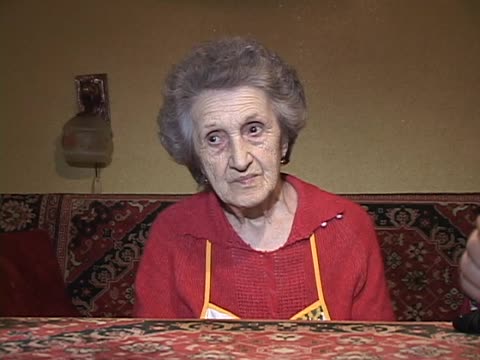
Opening of the interview: Kerler gives the date and purpose. Macarie gives her Romanian name Macarie and Yiddish name Khaye Rivke, and says she was born in 1925 in Sighet. She grew up in a village about three kilometres away, where only Jews lived, with one Hasidic synagogue. Her father, Yosl, wore a beard, sidelocks and a shtreimel, and was about sixty-five when the family was deported to Germany. Lemster closes by asking his occupation.
Catalogue speaks of contemporary Jewish life; the transcript shows personal data, her home village and her father.
Freundlich speaks about his family, in particular his father, a Vizhnitzer hasid. He shares an episode when his father visited the the Vizhnitzer rebbe. He then addresses religious customs.
Macarie names her parents: her father was a businessman, her mother Sheindl Ester sewed at home for Romanian Christian customers. There were twelve children. She recalls her paternal grandfather Hershi and his wife, and her maternal grandmother Khaye, but not the other grandparents' names. After the war only four siblings were left: a brother who lived in Vienna, a sister in Israel and a brother in America. The others, with the parents, were taken to Auschwitz. No visit to a rebbe is heard here.
Father's Vizhnitz Hasidism and a rebbe visit are not heard; the transcript shows grandparents, siblings' fates and the mother's sewing.
The formal interview with Lazar Freund begins. He provides personal information and speaks about his family. His father was born near Sighetu Marmației and was a tailor. Freund grew up with one brother, who died in Auschwitz.
Macarie continues to list siblings and their Hungarian or Romanian names. She says her parents died in Auschwitz, and that her mother came from Slatina in Czechoslovakia, née Kaufmann, while her father was born in her own village. She had four classes in a Romanian school, with Jewish learning from her father at home. She remembers the Hungarian arrival when she was eighteen and the ghetto, and some prayer lessons. After the war she trained for a few months as a technician in medicinal plants.
The tailor father and Freund identity are not shown; the transcript gives mother's origin and name, schooling and postwar technician training.
Freund addresses different Yiddish dialects. He then discusses his childhood memories. He attended a Jewish school in Oradea and attended a cheder and Talmud Torah school in Baia Mare.
Macarie describes working in a laboratory with medicinal plants after the war. She recalls her childhood up to eighteen in a large, happy family where Yiddish was spoken at home and Romanian learned at school. Asked whether the Yiddish of Maramureș differs from that of Moldova, she says no. She recalls holiday preparations and what her mother taught her in the kitchen: cooking, kneading bread, Sabbath cholent and kugel.
Catalogue's Oradea school and Baia Mare cheder are not heard; the transcript shows the plant laboratory, mother's cooking and the Maramureș versus Moldova Yiddish question.
Freund speaks about prewar life in Baia Mare. He then briefly addresses Purim celebrations, before talking about his life during World War II. He was a forced laborer in 20:01 and returned to Oredea in 1947. Freund got married in 1952 and does not have any children.
Macarie describes her mother's baking of challah and bread, using a peel and different shapes, and her salting and washing of meat as required by kosher rules. She recalls her mother making gefilte fish and, after Lemster's questions, begins to give the recipe: carp cleaned, skinned and boned, the flesh chopped.
Catalogue's forced labor, postwar return and marriage are not in this stretch; it is about baking and gefilte fish.
Macarie completes the gefilte fish recipe and talks about bread. She describes the family house: three rooms (boys, girls, parents), a separate kitchen and a porch with steps and a threshold. Kerler elicits the porch word. She says on holidays they cooked, baked, ate and went to the temple.
Zemirot are not heard; the transcript shows the fish recipe, house layout and holiday routine.
Macarie says village children had few toys; they played in the garden, and she made dolls from corn silk. Lemster asks about Purim; she mentions a large shared courtyard and field where all the Jews lived together. She says nothing about postwar work as an accountant in this stretch.
Accountant work after the war is not heard; the transcript shows children's games, dolls and Purim in a Jewish courtyard.
Freund speaks about his religious education and prewar Jewish life in Baia Mare. He then addresses holiday celebration before and after the war. Freund also talks about postwar circumcision until the 1960s.
Macarie says that on holidays families visited each other as guests. Pressed by Lemster to sing, she refuses but recalls climbing a fruit tree and singing while her father was at the temple, and a Hungarian bird-name endearment (?) addressed to a sweet child. She says her brothers studied in Sighet. Lemster then asks about the word for a mohel or painter (?), which she does not know.
Postwar circumcision is not clearly heard; the transcript shows guest visits, the singing request, an endearment word and her brothers' study.
Lemster and Kerler ask word and custom questions: she does not know dybbuk but explains golem as a slightly mad person. Then come questions on gefilte fish: whether sugar or pepper was added (a little sugar), and vinegar meat. Lemster asks what she cooks today.
Aliyah and contemporary Jewish life are not heard; the transcript shows the questionnaire items dybbuk and golem and gefilte fish seasoning.
Macarie says she cooks Romanian, Hungarian and Jewish food today, buying kosher meat. After the camp she returned home and married; her second husband has died. Her son is a school director with a good wife, and a daughter married a Jew from Johannesburg (?). She had no children with the second husband. Lemster asks about her first Jewish wedding.
Baia Mare prewar institutions are not heard; the transcript shows present-day cooking and postwar marriages and children.
Macarie describes a Jewish wedding, apparently a cousin's, with a chuppah set up (in the temple, though one word is garbled), and her own second marriage. She uses and explains a word for a decent, upright person, and describes her good relations with her son, grandchild and daughter-in-law.
No formal dialect questionnaire is evident; the transcript shows weddings, her second marriage and family relations with a word explained.