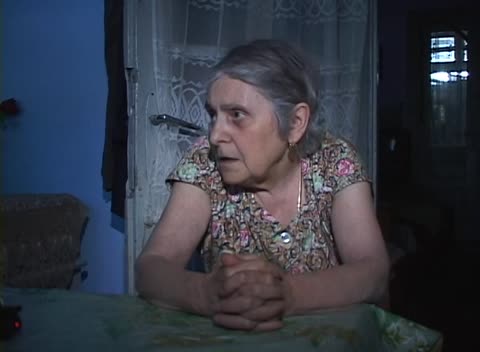
Cojocaru provides personal information and speaks about her family. Her father, brother and sister made aliyah. Her father, who was born in Dorohoi, worked as tailor. Her mother passed away when Cojocaru was four years old. Cojocaru raised a son and daughter.
Cojocaru explains that she was named after a cousin of her mother's and that her Yiddish name differs from her official one. Her father was named Mendl (?) and was a tailor born in Dorohoi. Her brother in Israel works in a hospital. Her mother, Faigy, died when she was about four. She also recalls two American visitors with whom communication failed, and says she was in Transnistria as a young woman.
adds the naming after a relative and the American visitors
Cojocaru touched upon her life during World War II. She was imprisoned in the Mohyliv-Podilskyy ghetto. After the war, Cojocaru was a homemaker. She then speaks about her family. Her mother was also born in Dorohoi. Cojocaru grew up with one half-brother and one sister.
Cojocaru says she was in Transnistria (Mohyliv). She does not remember her grandparents, and her mother was also from Dorohoi. Kerler explains the project's aims. She tells of three children in her father's household, a brother Dudl and sister Haya, both in Israel. Her two children live in Botoșani. She also notes that her grandchild and son speak little Yiddish and mostly Romanian.
adds the discussion of Yiddish and Romanian in the family
Cojocaru says she had a Jewish mother who kept the Sabbath and ran the home. After the mother died, the father remarried, and the stepmother treated the children well. She names the stepmother and says her father attended synagogue morning and evening. She recalls the call to the synagogue in Romanian and tells of a local Jew who married a non-Jew and wished for a Jewish burial. She also mentions the large Jewish cemetery.
Cojocaru says she was in Transnistria (Moghilev) with her stepmother, sister and father; the brother had been born there. After the war many Jews lived in Dorohoi on all streets. She mentions the Romanian and Yiddish word for the cemetery.
adds the answer about the number of Jews and street life
Cojocaru says she married in Dorohoi in a Jewish ceremony, with a rabbi brought in from elsewhere for the chuppah. She explains why no one goes to the synagogue now and that the building still stands but is damaged. She recalls the circumcision of her son, with a Jew brought from elsewhere. She discusses a man whose son broadcasts in Yiddish on Israeli radio.
Cojocaru speaks about postwar Yiddish culture, including theater performances. She also mentions that her son went to religious school (cheder). She then talks about visting Israel.
Cojocaru says Yiddish theater came from Bucharest after the war. She cannot read Yiddish letters; her son attended cheder but forgot. Her brother lives in Israel and her son has visited him. She says she wanted to visit Israel but did not go. She mentions the children's life in Romania.
Cojocaru says she travelled every year with family and a hired car to the rebbe's grave at Ștefănești. She explains how they prayed there for health and livelihood and that the visitors spoke Yiddish. Kerler and Lemster ask about the term "mame-loshn"; she does not give much of an answer. The talk also touches on her children's language shift to Romanian.
Cojocaru answers questions about the terms "mame-loshn" and "a gutr yid". She says there are no good Jews today, and remembers that formerly Jews were friends and visited on Sabbath. She describes an unpleasant encounter with a non-Jewish neighbour. She says she knows of no other rebbe besides the one of Ștefănești.
Cojocaru explains how she prepares Sabbath food, including baked rolls and sweet-and-sour meat with onion and bouillon. She mentions that people here use borscht for souring. She says she does not make gefilte fish, but cooks plain fish with pepper and sugar. She describes making fruit layer cake (flodn) for Purim, with fillings of nuts, preserves and sugar.
Cojocaru speaks about Purim, Passover and Hanukkah celebrations before the war, including food customs. She also speaks about her family. Her father was a synagogue caretaker.
Cojocaru speaks about Purim masquerading in the old days and says her father was a synagogue warden for fifteen years. She talks about Simchat Torah, and a dish called einhakts (?) of eggs and potatoes. She compares Yiddish and Romanian terms and notes she once spoke Russian with a sister-in-law. She names red borscht with vareniki for Hanukkah and the Passover potato dishes.
Cojocaru answers questions about cultural terminology. She then addresses prewar life, including non-Jews who spoke Yiddish. She then speaks about her life today and her husband's family. She also addresses her family's occupations before the war.
Cojocaru answers questions about words like golem, dybbuk and orl, and explains that non-Jews who learned crafts from Jews spoke Yiddish. She and the interviewers talk about speaking Yiddish by telephone with relatives abroad. She mentions the cap and hat maker Moshe, a relative, and the efforts of her son to be involved with the Jewish community. She tells of her husband's family: several generations of furriers (?), his age (80), his blindness, and her own family of tailors.
adds the husband's family trade and the telephone talk
Cojocaru describes Simchat Torah celebration in the synagogues, with singing and drinking, and what people drank. She answers questions on stuffed goose neck and Passover goose fat. She lists the towns she travelled to, including Botoșani, Bucharest and Ștefănești, and towns with many Jews. She talks about the Yiddish names for Mihăileni. Kerler asks about her husband's Yiddish and about stories.
Cojocaru says she has not been to a Jewish wedding or circumcision since her daughter's wedding and son's brit. She speaks about a relative in Bucharest who died without papers and was buried with vagrants. She says songs and stories are forgotten when no one sings or hears them.
Cojocaru is asked about Hanukkah food and mentions vareniki with red borscht and doughnuts fried in oil. Kerler and Lemster then put questionnaire items to her: greetings such as good evening and good night, thanks, the words for big and small, comparative forms, 'late' and 'close', and 'come closer'. She gives Romanian equivalents, and ends by giving her own Yiddish name.