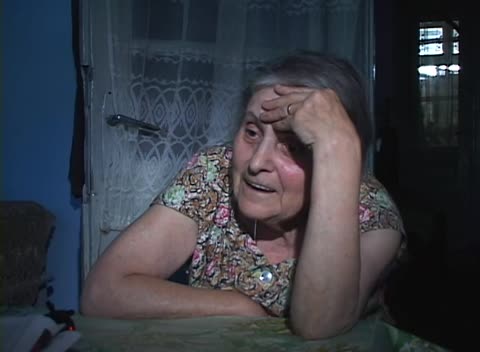
Cojocaru answers dialectological questions. The items include phrases for 'very sick', words for 'honest' and 'ladder', the Yiddish for a peasant, and the question 'where are you from'. They also cover 'come here' and 'go there', numerals, and a paradigm of 'to be right' with the pronouns.
Cojocaru addresses the evil eye, saying she does not believe in it but remembers that children were treated for it and that old women knew how to charm it away. Kerler and Lemster then continue the questionnaire with words for potatoes and flowers, the word 'anderthalb' (one and a half), 'other' and 'three persons', and the answers 'yes' and 'no'. She also says that only Jews lived on the street.
adds her remarks on the street where only Jews lived and on the evil-eye remedies
The team greets Melanie Mehler in front of her house and chats with her in Moldovan. She also speaks about her family. Her father was killed in the Iaşi pogrom in June 1941.
The team greets Mehler in front of her house and chats with her, in Romanian and Yiddish, about her origin in Iași and whether other Yiddish speakers live in Vatra Dornei. She gives them an address to visit, on the street Podul Verde. She says her father was a professor and was killed in the Iași pogrom; the date is unclear in the transcript.
adds the address she gives for other Yiddish speakers
Mehler talks about her life in Iași and about the few people who still know Yiddish or German. She recalls seeing Yiddish theater as a child, says Yiddish was not spoken at home, and says the Jewish community office is closed on weekends. Kerler explains the project; she mentions an American connection (Connecticut?).
The team enters with Mehler the Vatra Dornei synagogue. The camera then collects footage, while Mehler speaks about contemporary religious life and the relationship between Jews and non-Jews.
Mehler and the team enter the Vatra Dornei synagogue; the camera then films while she talks about contemporary religious life. The congregation is small and old, with holidays such as Shavuot kept with dairy food; Passover seder cannot be held. She speaks about the gendarmes and the guarding of the synagogue, and about relations with non-Jews, and mentions visits by communal officials and a Hanukkah event.
adds the guarding of the synagogue and the visit of communal officials
Mehler briefly speaks about her life during World War II. She left Iaşi and got married in 1955. Mehler then speaks about the contemporary Iaşi community.
Mehler says she lived in Iași until 1955 and briefly recalls the war years, including the bombardment and wearing the yellow star. She names the contemporary Iași community and a doctor who works there as a volunteer. She also recalls an excursion with a young group from the community.
adds the doctor and the people she knows in the Iași community
Mehler addresses her childhood schooling. She attended a Romanian school for two years, was then moved to a Jewish school and later a Jewish lyceum held in synagogues, and went to a state school after 1944. She says she lived in a Romanian neighborhood of Iași and describes the Jewish quarter, where Christians also spoke Yiddish. She also mentions a stay in Cernăuți.
Mehler speaks about the Jews of Vatra Dornei and the surrounding area. The big synagogue was once full, with men below and women above. She says there were three synagogues in town and others in villages along the road toward Cluj, none of which remain. Lemster asks about Jews along that road and the mountain route.
The camera briefly films the synagogue; Mehler then speaks about contemporary Jewish life, with a place name (Vatra Dornei) heard. The passage is badly garbled and little can be said with confidence.
Mehler speaks about her family: a grandfather, named Mendel Weinstock, and a grandmother who lit Sabbath candles and said blessings. She remembers the grandfather as a rich cattle dealer with a big farmyard and exporting animals, and recalls his funeral. She also says she does not speak Hebrew.