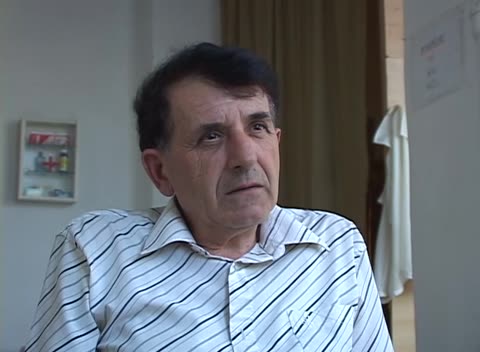
Marcus provides personal information and speaks about his family. His father, who was born in Săveni, was a merchant. Her mother was also born in Săveni and a homemaker. His grandfather was a cattle dealer and went on business to Israel and other countries.
Marcus gives his father's name, Moshe, and says he was born in Săveni in 1926 and worked as a cloth and manufactured-goods seller. His mother, Leah, was born in 1922. He names his paternal grandfather, Chaim, who traded in cattle and travelled by ship to Israel and Turkey. Marcus was about four when the grandfather died, and he says his grandmother died in Transnistria. The interviewers also first sort out the pronunciation of his birth year.
The grandmother died in Transnistria, and the opening is about how his birth is to be recorded.
Marcus speaks about Jewish life in Săveni after the war, including his childhood memories. He attended a Romanian school. Marcus states that five synagogues were active after the war. He also addresses postwar religious and cultural life. Marcus also describes his religious education.
Marcus says he attended a Romanian school in Săveni. He estimates the number of Jews in the town before and after the war, and says his Jewish childhood friends spoke Yiddish and have all gone to Israel. He recalls studying with a private Hebrew teacher for several years at home, for two hours a day, and that he once could read Yiddish. He also says touring theater groups used to come from Bucharest.
Adds the teacher's name (unclear), the Yiddish theater visits from Bucharest, and his friends' emigration to Israel.
Marcus describes holiday customs: people went to synagogue, visited and strolled. On Purim children dressed up in costume and went from house to house. He tries to recall a Purim song but can only partly remember it, and Kerler fills in some lines. He says he cannot name longer plays such as a Purim play. Lemster also asks about the present population of Săveni, which is mostly Christian. A second voice interrupts about the television.
Adds the Purim song that Kerler tries to prompt and the later talk about the town's current population.
Marcus speaks about Passover celebrations. He recalls matzo baking. He then remembers how he visited the Ştefăneşti rebbe's grave when he was ten years old. Marcus also speaks about his family, particularly his mother's observance. He grew up with one brother.
Marcus recalls that matzo was baked before the rebbe's death, and that the rebbe's remains were taken to Israel. He says he visited the grave at about the age of ten, when many people travelled from the region. He discusses his mother, who blessed the candles every Friday and baked challah at home. He mentions that kosher meat was bought and describes the town's shochet after the war. He had one brother, who is no longer alive and was two years younger.
Adds the shochet's name and the detail that the brother died young.
Marcus says he has forgotten the morning prayer and does not recall Yiddish songs sung in the synagogue. He talks about Jewish weddings in Săveni, saying he attended two. His own wedding was in Botoșani at a restaurant, with a Jewish ceremony under a canopy led by a rebbe, and the music was Romanian. A rebbe also came from Rădăuți in Bukovina to a wedding, and he mentions that the last Jewish wedding in the town was held in a restaurant.
Adds weddings in the town and the rebbe from Bukovina.
Marcus answers questions about his son and about his own emigration to Israel and return to Săveni. His son was born in the 1980s (the year is unclear) and was circumcised in Săveni, and the family returned in 2004. The passage is hard to follow, with the interviewers asking repeatedly for clarification, and the dates of emigration are unclear.
Adds that the dates and details in the transcript are unclear.
Marcus and Kerler discuss Yiddish after the war. Many non-Jews spoke Yiddish, because they had worked as servants in Jewish homes. Yiddish was heard in the street, shop and market, and before the war three quarters of the town were Jews. They mention a woman of German origin, Maria Kirilov (?), who speaks Yiddish well. Marcus says Romanian Jews in Israel are ashamed to speak Yiddish.
Adds the woman who speaks Yiddish and attitudes of Romanian Jews in Israel.
Marcus speaks about his family and addresses his return to Saveni from Israel. He then speaks about Jewish life after the war and recalls Jews who converted.
Marcus speaks about returning to Săveni from Israel, a difficult process involving housing and citizenship papers, and about his son and other family. Kerler and Lemster ask about secret words that Jews used so non-Jews would not understand, and about a woman of German origin who speaks Yiddish. Towards the end they ask about Jews who converted, and about non-Jews who became Jewish. Several stretches are garbled.
Adds the secret-words question, the woman of German origin, and the question of non-Jews becoming Jewish.
Marcus speaks about the occupational structure in Săveni, including prewar synagogues. Marcus also addresses postware religious life and food customs and recalls Jewish drunks and someone who collaborated with the Germans during the war.
Marcus names Săveni's Jewish trades: tailors, shoemakers, barbers, carpenters and bakers. Before the war there were separate synagogues for the trades. He says there was a rabbi before the war but only a shochet after it, and he again mentions theater visits from Botoșani. He and the interviewers discuss Yiddish dishes his mother cooked and his wife's cooking of gefilte fish, and Jewish drunks and Jewish taverns. He tells about a man named Shmiluke (?), a Jew who was a police officer in Ukraine and sided with the Germans, was later imprisoned and went to Israel. The interviewers also ask about madmen and wedding entertainers.
Adds the synagogues by trade, Yiddish cooking in his family, and the madmen and entertainer questions.
The interviewers ask Marcus about wedding entertainers, and Kerler recounts that he saw one in Uzhhorod (Transcarpathia). Marcus says he has seen one. The passage is short and partly garbled.
Adds that Kerler describes the wedding entertainer from his own experience.
The interviewers greet Cojocaru in front of her home and say they come with greetings from Tuva and Yankl. Kerler explains that they are collecting Yiddish interviews about Jewish life in earlier times. She says that she has forgotten much, but that a little can be recorded, and that she was born in Dorohoi.
The formal interview with Cojocaru begins. She says there are few Jews left, mentions a grandchild in Warsaw who does not know Yiddish, and says she has lived in Săveni for thirty-four years. The interviewers ask her year of birth, and she says she was born in Dorohoi (the year is unclear in the transcript).