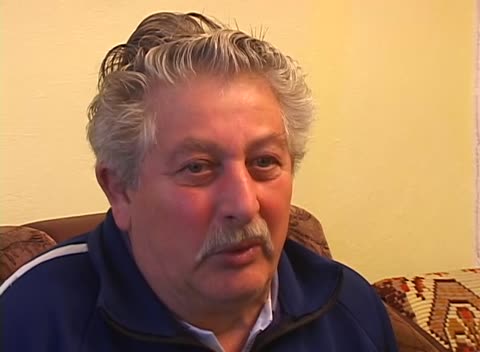
Kurtsberg speaks about healing customs. He recalls how his mother practiced cupping therapy. He then speaks about a family in the Bershad ghetto, which was under Romanian and German command. The family's son sold dry goods and was busted by a Romanian soldier, Kurtsberg explains.
Kurtsberg talks about his mother's cupping (setting 'bankes') for colds and how it helped him as a child. He recalls a story from the Bershad ghetto, which was under Romanian and German command: a Romanian commandant had a young Jewish peddler who sold small wares dragged to death behind his motorcycle, and was later caught in Bucharest and shot at Siret. Lemster then asks about Jewish work in Transnistria.
The cupping is only briefly mentioned; the main part of the passage is the ghetto story of the peddler killed by the Romanian commandant, and a question about Jewish work in Transnistria.
Kurtsberg speaks about occupations, including tailor, barber, carpenter, dentist, doctor, in the Bershad ghetto. He then speaks about Sabbath celebrations, including food customs, at home. Kurtsberg also recalls how people went to the kosher butcher and describes how to kosher meat.
Kurtsberg lists occupations in the Bershad ghetto (carpentry, a barber, a blacksmith, doctors who made medical cabinets, dentists). Answering Lemster's questions, he describes Sabbath preparations at home, his mother's Friday cooking and the food of Sabbath and Shavuot. He also describes how chickens were slaughtered and salted at the kosher butcher.
Adds the Shavuot dairy food and the dialect terms for bean dishes and chicken dishes.
Kurtsberg speaks about Jewish life before the war, including non-Jews who spoke Yiddish and the Zionist organizations Yichud and Comitetul Democratic Evreiesc (Jewish Democratic Committee). Kurtsberg also addresses prewar cultural life.
Answering Lemster's questions, Kurtsberg discusses non-Jews who spoke Yiddish and says he has not heard of converts. He names the Zionist organizations in Siret (Yikhud, Maccabi) and the Jewish Democratic Committee through which people registered for emigration to Palestine. He also answers questions about a Yiddish library, newspapers, sports clubs and Yiddish theater performances in Siret.
Kurtsberg talks about prewar religious life, as well as the Siret cemeteries. The team then shows Kurtsberg how Iosif Kogan sings (see Tulchyn MDV 709,710,711,717,719,725,726).
Kurtsberg talks about Hasidim in Siret and describes the holy place (the Jewish cemetery area) with its old and newer parts and the graves of famous rabbis, visited by Hasidim from America and Israel. The team then plays him a recording of Iosif Kogan singing songs from the Bershad ghetto, with brief remarks identifying Kogan, now in Tulchyn.
Adds Kurtsberg's description of the three parts of the holy place and the visiting Hasidim from abroad.
Answering Lemster, Kurtsberg describes his mother's Jewish dishes such as jellied fish and goulash from offal, and the drinks at Friday night and Sabbath meals (home-distilled grain brandy). He also answers a question about kosher sausage.
Kurtsberg explains the meaning of several Yiddish terms (dibbuk, golem, a foolish person, and a word his father used). Kerler then asks about Purim rhymes; Kurtsberg recalls the chimney sweep play and says that Christian friends joined the Purim players and that they were all friends.
Adds the explanation of terms such as dibbuk and golem and the point that Christian friends took part in the Purim performances.
Kurtsberg talks about folk and healing customs. He recalls how his mother practiced "leshn koyln" (extinguish coals) to avert the evil eye. Kurtsberg also shares episodes about locals from his childhood.
Kurtsberg describes how his mother cured the evil eye by extinguishing coals in a glass of water, and a similar cure used by his wife. He explains the term 'geshterkt' (starched) in an anecdote about a person with a strong will, and tells a story from his father about a melamed in Strazhynits (?) who cooked his food all mixed together.
Adds an explanation of the starched laundry word and a story about a melamed who cooked all his food in one pot.
Kurtsberg shares an anecdote about Hershl Ostropoler eating at a restaurant without paying. Another anecdote involves Hershl falling asleep at dinner and losing his beard. Kurtsberg remembers the anecdotes from his father. Kurtsberg then speaks about the Golem of Prague, which he read in Yiddish.
Answering Lemster, Kurtsberg tells two anecdotes about Hershl Ostropoler: one where he eats in an inn without money and persuades the innkeeper to forgive the bill, and one where a friend glues his beard to the table. He says he heard them from his father. He then recounts the story of the Golem of Prague and says he read it in Yiddish.
Adds the Golem of Prague story and the source of reading.
Kurtsberg addresses Yiddish literature. Kurtsberg then speaks about his religious customs today, particularly yahrzeit and visiting the local cemetery. Kurtsberg also mentions contemporary hasidic visitors.
Kurtsberg discusses his reading of Yiddish literature, saying he read Sholem Aleichem in Romanian. He describes his monthly visits to the Jewish cemetery to pay the electricity bill, light a memorial candle at his grandfather's grave and sit there. He also talks about the key to the Radauti cemetery and about visitors, rabbis and yeshiva students who come to Siret.
Adds the key to the Radauti cemetery and the tourists and rabbis who visit.