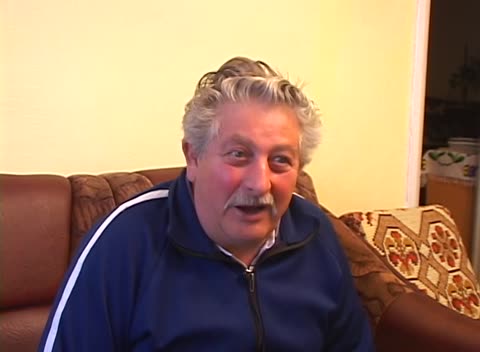
Answers Kerler's questions about Christians who came to the synagogue to light candles on Friday evening and pray to God in times of trouble. He says the practice also occurred in Siret and Rădăuți. The passage ends with his promise to tell a story about Hershl Ostropoler.
Also mentions that the practice occurred in Siret and Rădăuți, and leads into a story about Hershl Ostropoler.
Tells a story about a poor, pious Jew who prayed all his life to earn a living. After his death he reproaches God for not helping him, and God asks whether he had ever played the lottery. Kurtsberg is unsure whether the hero is Hershl Ostropoler or Sholem Aleichem's figure. Lemster then asks about Chelm stories and about the crazy people of Suceava.
The anecdote's hero is uncertain (Ostropoler or another figure), and Lemster steers toward Chelm and Suceava stories.
Kurtsberg shares more episodes about "meshige Shots" (crazy Suceava). He also addresses contemporary Jewish life in Suceava and speaks about Shoyl Petraru (Suceava MDV 307).
Talks about Suceava as a "crazy" town whose people were always drunk and quarrelsome. He then discusses the current mayor and a teacher, a professor who also served as community president. He also describes a former Securitate officer, a Communist party member who had changed his family name. He begins to speak about his own father, a butcher, and says he does not want some of this recorded.
Includes talk of a local professor and community president and a former Securitate officer.
Kurtsberg speaks about his family. He raised a son and daughter, who live in Israel. Kurtsberg also raised another son with Tania, who lives in Suceava.
Answers questions about his children. His son and daughter live in Tel Aviv, and the daughter has no children. His second wife has a son in Suceava, an engineer, who is married and works with his wife. Kerler gives a business card with his email so the grandchildren can be reached.
Adds the second wife's son and his family in Suceava, a grandson who is also an engineer, and the exchange of contact details.
Kurtsberg speaks about prewar Jewish life in Siret, in particular episodes about the daily business routine. According to him, thirty-eight percent of the population was Jewish. Kurtsberg also touches upon prewar Jewish life in Mihăileni and shares episodes about locals' business life.
Prompted by Kerler, Kurtsberg describes prewar Jewish life in Siret. He says Jews were a large share of the population (a figure around thirty-eight percent is given), lived above their shops in the center, and sold to peasants on credit. He contrasts this with Mihăileni, where Jews were an overwhelming majority. He ends with a long humorous story, heard from his father, about cavalry horses quartered at an estate near Mihăileni and an officer whose horse grew horns. Kerler thanks him at the close.
Adds the cavalry-horse story and the contrast between Siret and Mihăileni.