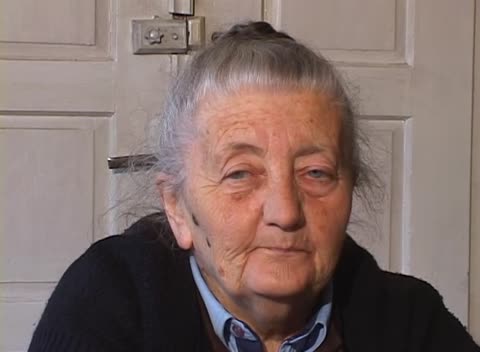
Kerler greets Saldinger and asks for her name, her Yiddish name and her birthplace, Chernivtsi. She gives her birth year as 1933 and says she has lived in Suceava since 1946. Kerler then asks her to tell about her childhood.
Saldinger discusses her childhood memories. She was confined to the Murafa ghetto during World War II. Saldinger briefly touches upon her arrival in the ghetto. She then speaks about her family. Saldinger grew up with another sibling and her father was a merchant.
Saldinger says she had a good childhood in Chernivtsi until the deportation to Transnistria, where she was in Murafa, with hunger and disease and everything lost on the way. She had one sibling. Her father, Yosl Krenter, was a flour merchant, her mother was Regina (Rivke), and her maternal grandfather administered an estate. Kerler explains the purpose of the archive interviews.
Adds her mother's name and the grandfather's work, and Kerler's explanation of the archive's purpose.
The interviewers are introduced to the community head, Petraru, and exchange pleasantries about Canada, America and Israel. A woman gives her grandfather's name as Lanner, who may have come from Poland. Most of the passage is Petraru and others talking, partly in Romanian, about community and synagogue administration, payment for the work and a phone/recording matter. The garbled speech makes much of it unclear.
Shows mostly Romanian administrative talk among community members, not a continuation of Saldinger's story.
Petraru speaks about the history of the Suceava synagogues. He recalls how the synagogues were closed in 1957. Petraru then speaks about Jewish life in Suceava.
Petraru speaks about the Suceava synagogues, mentioning the big synagogue in the town centre, now the site of a fast-food shop, and the destruction of the synagogues, dated to the 1950s (the year is only partly clear). He gives the Jewish population as about six thousand before the war and fewer than two thousand after it, and about eighty Jews today. Kerler asks why there is no minyan; Petraru says the men do not want to come.
Adds Jewish population figures and the missing minyan today.
Petraru provides personal information and speaks about his family. He moved to Suceava from Dorohoi in 1953. His mother died during the war in a Transnistrian ghetto and his father made aliyah after the war. They were both born in Dorohoi. Petraru then addresses Jewish life in Dorohoi and contemporary Jewish life in Suceava.
Petraru says his mother died in Transnistria and his father in Israel, and that both were born in Dorohoi. He gives Dorohoi's prewar Jewish population as about twelve thousand, with few returning after the war. He says he went to the synagogues there, and speaks of young Jews and weddings in Suceava today. He moved to Suceava in 1953, and was cashier, vice-president and president of the community for many years.
Adds the Dorohoi Jewish population, his own community offices and the state of Jewish life in Suceava.
Petraru speaks about his role as community head and about contemporary religious life: the cost of coming to the synagogue by taxi, his praying at home, and the Federation in Bucharest. Lemster asks about Rabbi Moses Rosen, whom Petraru describes as a person without equal. Petraru also speaks of attending a cheder and then a Jewish school with Romanian lessons in the morning and Hebrew in the afternoon.
Adds Rabbi Moses Rosen and the beginning of his schooling.
Petraru addresses his education at a religious school (cheder) and Romanian school. He then speaks about his family. He raised a son, who lives in Iaşi.
Petraru discusses his education: cheder, a Jewish school and Hebrew (not Yiddish) teachers, including one from Chişinău. Kerler asks about modern Hebrew, Hebrew songs and Purim customs, which he barely recalls. He says his wife comes from Dorohoi and that he has a son in Iaşi, an engineer. Lemster mentions a visit to the Iaşi community and asks whether anyone else in town speaks Yiddish.
Adds Hebrew teaching and Purim questions, and the question about other Yiddish speakers.
The talk turns to quenching coals, a custom against the evil eye, which Petraru does not remember his mother doing. He says his grandmother died in America at age 105. Lemster asks about kosher meat, and Petraru says his wife makes it. Kerler asks to go into the large synagogue.
Kerler and Lemster talk with Petraru inside the great synagogue, while the camera films it, including its paintings. Petraru explains that the family name Petrarlu/Petraru comes from his great-grandfather's trade as a builder or mason, and speaks of a woman who restored the paintings and what the work cost. They discuss the women's section and who prays there; he prays at home and the synagogue meets mainly on Sabbath and holidays.
Adds the origin of the family name and the synagogue restoration and women's section.
Kerler asks Petraru about the Jewish cemetery, from which the tsadikim were moved to Israel, and about Hasidim and rabbis in Dorohoi, including the last rabbi there. Kerler also asks what he knows about Suceava and Bukovina. The passage then turns to a language exchange about Romanian and local expressions for royalty and a dismissive saying about the dead.
Adds Hasidim in Dorohoi and the language exchange on sayings.
Petraru answers questions about Yiddish terms such as dibbuk and golem, giving 'fool' or 'idiot' for the first and 'lout' for the second. He says Yiddish speakers in town are few, mentions that the community president also speaks Yiddish, and gives a contact name and phone number.
Petraru tells of a foreign visitor and his wife who left a donation of a dollar in the box, which he pressed back to them. Kerler and Petraru discuss American donations of a few thousand dollars and what sums are allowed. The footage of the synagogue follows in the catalogue but is not in this transcript.
The transcript shows only the visitors anecdote and donations talk, no footage.